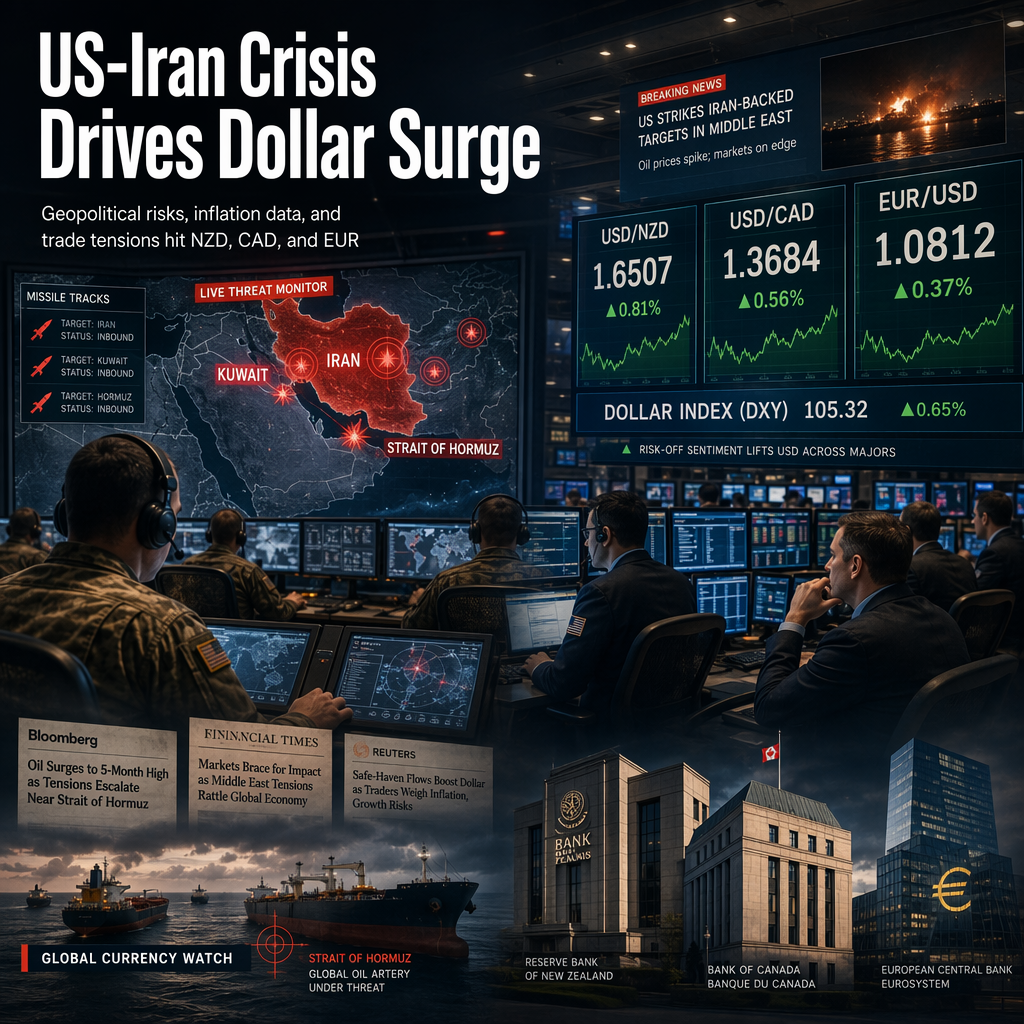
Renewed US-Iran tensions have triggered significant moves across major currency pairs, with the US Dollar strengthening as a safe-haven amid escalating geopolitical risks. The US military launched its 10th consecutive night of attacks on Iran, targeting military command centres, air defence, coastal surveillance sites, maritime capabilities, missile and drone launch sites, and communications networks, according to The Guardian and US military statements. Iran responded with attacks on Bahrain and Kuwait, and strikes on tankers in the Strait of Hormuz, while Yemen’s Iran-backed Houthi rebels announced a maritime embargo of Saudi Arabia. Explosions were reported across southern Iran, including Qeshm Island, Bandar Abbas, Sirik, Chabahar, Isfahan, and Konarak. Kuwait activated its air defences against Iranian missile and drone attacks [1][3]. These developments have fueled risk-off sentiment, boosting the US Dollar against the New Zealand Dollar, Canadian Dollar, and Euro [1][2][3].
The New Zealand Dollar (NZD) rose above 0.5850, trading around 0.5865, after Statistics New Zealand reported that Q2 2026 Consumer Price Index (CPI) climbed 4.1% year-on-year, up from 3.1% previously and exceeding market expectations of 4.0%. Quarterly CPI inflation rose to 1.5% in Q2 from 0.9% in Q1, also beating consensus estimates of 1.4%. This hotter-than-expected inflation data bolstered expectations for back-to-back Reserve Bank of New Zealand (RBNZ) rate hikes, with traders anticipating possible hikes in October or December and another in February, according to Bloomberg [1]. However, ongoing Middle East tensions could create headwinds for NZD as investors seek safe-haven assets [1].
The Canadian Dollar (CAD) fell to a one-week low versus the US Dollar, with USD/CAD climbing to around 1.4085. Statistics Canada reported that annual inflation slowed to 2.8% in June from 3.2% in May, declining by 0.4% month-on-month. The Bank of Canada’s preferred core CPI gauges—trim and median—dropped below 2% for the first time in nearly six years. This data reinforced expectations that the BoC will keep rates unchanged through the remainder of 2026, while traders are pricing in at least one US Federal Reserve rate hike this year. Additionally, US President Donald Trump announced a new 50% tariff on most Canadian products, covering about $20 billion in goods. Canadian Prime Minister Mark Carney signaled readiness to intensify trade talks, while Ontario Premier Doug Ford encouraged retaliation, raising the risk of a renewed US-Canada trade war. Elevated crude oil prices, supported by the closure of the Strait of Hormuz, provided some support to CAD, but overall sentiment remained bearish amid geopolitical and trade risks [2].
The Euro (EUR) declined to near 1.1400 against the US Dollar, with EUR/USD posting modest losses around 1.1410. The risk-off mood driven by US-Iran hostilities weighed on the Euro, while upcoming ZEW surveys from Germany and the Eurozone, as well as the US ADP employment report, were awaited by traders. Signs of cooling US inflation data could reduce the likelihood of a US rate hike later this year, with Fed funds futures pricing an 84.5% chance of a hold at the next Fed meeting on July 29, up from 61.5% a month ago, according to CME FedWatch tool [3].
Across all three currencies, the escalation in the Middle East has heightened volatility and driven flows into the US Dollar, with market participants closely watching inflation data and central bank policy signals for further direction [1][2][3].
CONCLUSION
Escalating US-Iran tensions have driven risk-off sentiment, strengthening the US Dollar against the NZD, CAD, and EUR. Divergent inflation trends and central bank expectations are shaping currency moves, with the NZD supported by hotter CPI and rate hike prospects, while the CAD is weighed down by soft inflation and trade risks. The Euro remains under pressure as geopolitical uncertainty persists, and markets await further economic data and central bank decisions.