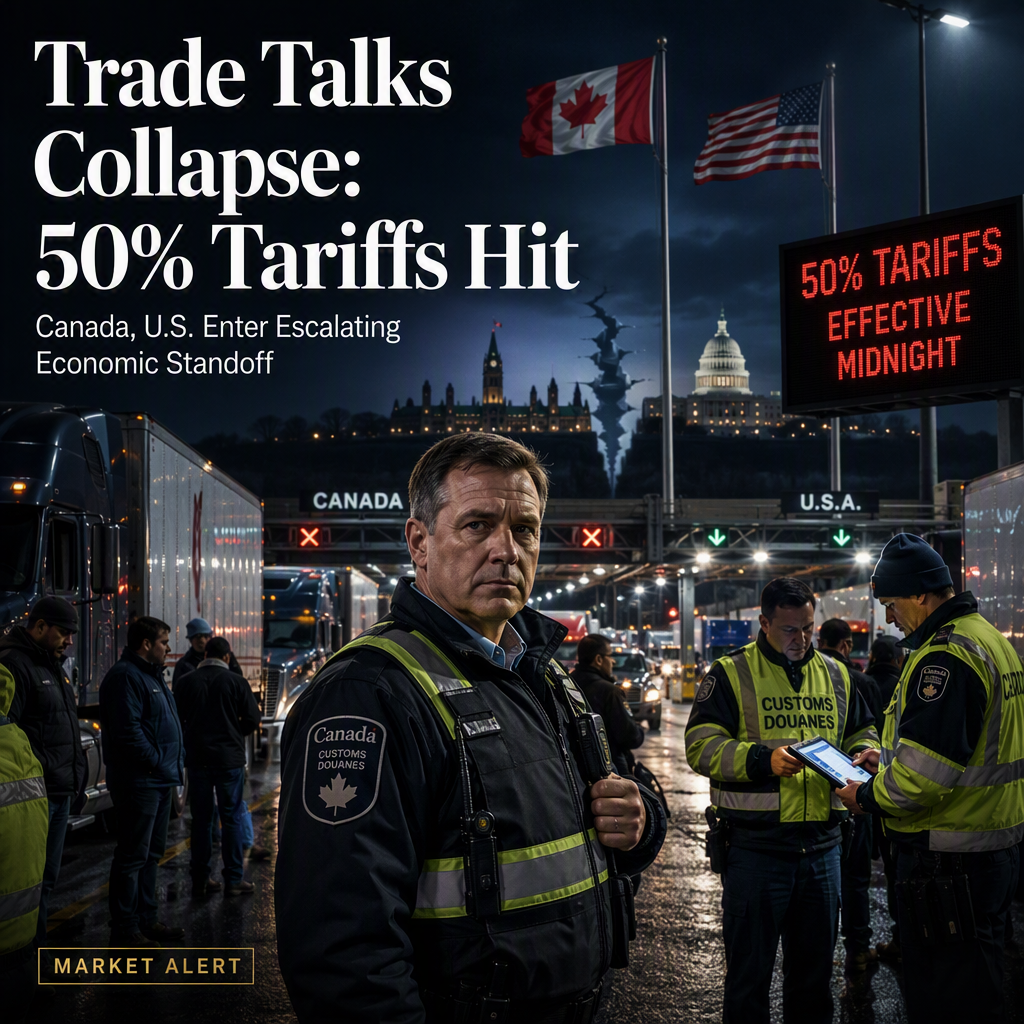
Trade negotiations between Canada and the United States collapsed late Friday night, prompting Canadian Prime Minister Mark Carney to suspend talks and direct negotiators to return to Ottawa [1]. As a result, steep 50% tariffs on a wide range of Canadian goods imported into the U.S. will take effect at midnight, impacting approximately $20 billion worth of U.S. imports from Canada, according to the U.S. Trade Representative’s office [1]. The affected goods include hockey sticks, building materials, liquors, and certain types of clothing [1].
Prime Minister Carney stated that while progress had been made during weeks of negotiations, it was insufficient to meet Canadian objectives. He announced Canada’s immediate retaliation, pledging to match the U.S. tariffs dollar for dollar to protect Canadian workers and businesses [1]. The breakdown followed nearly two weeks of intense discussions, with optimism persisting until the final hours. Canadian minister Dominic LeBlanc had expressed hope for a deal after meeting with U.S. Trade Representative Jamieson Greer on Thursday, but no compromise was reached after further talks on Friday [1].
The Canadian government faced internal pressure from provincial premiers during the negotiations. Manitoba premier Wab Kinew urged the federal government to “fight” Trump, while Quebec premier Christine Fréchette was still considering a request to lift bans on American alcohol sales. Ontario premier Doug Ford did not make public remarks on the issue [1].
Prime Minister Carney previously argued that Trump’s threatened tariffs violate the United States-Mexico-Canada Agreement, which Trump had negotiated and signed during his first term [1]. The U.S. Chamber of Commerce warned that higher tariffs would harm both economies, increase costs for U.S. families, disrupt supply chains, and threaten 13 million American jobs dependent on North American trade [1].
CONCLUSION
The collapse of U.S.-Canada trade talks and the implementation of reciprocal 50% tariffs mark a significant escalation in the trade dispute, with immediate and far-reaching consequences for both economies. Market sentiment is strongly negative, given warnings about supply chain disruptions and job risks. The situation is likely to remain volatile as both sides dig in for a prolonged trade conflict.