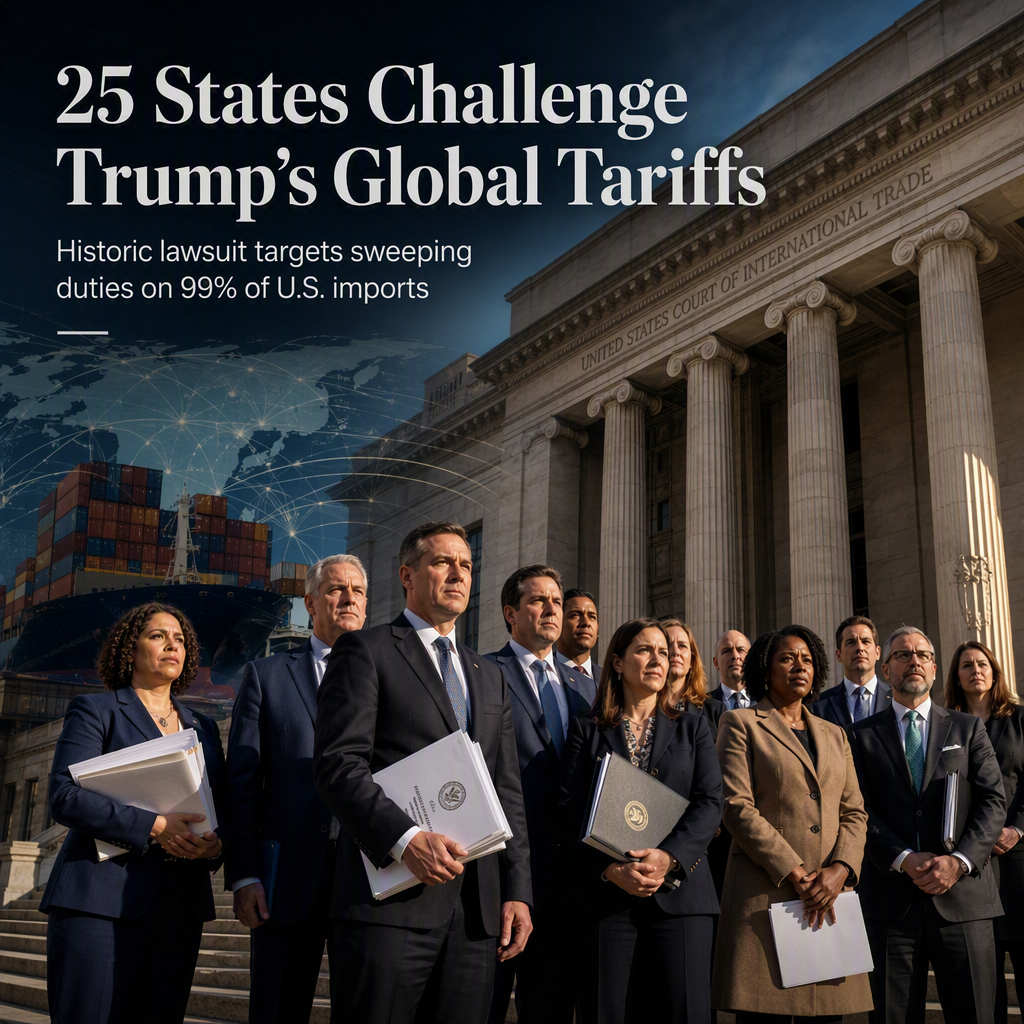
A coalition of 25 Democratic-led states filed a lawsuit against the Trump administration on August 3, 2026, challenging the imposition of sweeping new tariffs on goods from 60 U.S. trading partners [1]. The complaint, submitted to the U.S. Court of International Trade, argues that President Donald Trump exceeded his authority by enacting tariffs of 10% or 12.5% on most imported goods from these economies, which collectively account for 99.4% of U.S. imports [1]. The states are seeking to have the court block and overturn the tariffs, as well as refund duties already paid [1].
The lawsuit alleges that the administration rushed investigations into the 60 economies, bypassed required country-specific consultations, and failed to justify the nearly uniform tariff rates for countries with varying forced-labor import policies [1]. The complaint asserts, 'There is no rational fit between the purported problem of forced labor in international supply chains and the blanket global tariffs the USTR imposed' [1].
This legal action marks the administration's third attempt to preserve Trump's broad tariff policy under a different legal framework, specifically Section 301 of the Trade Act of 1974, after previous duties were rejected by both the Supreme Court and the trade court [1]. The case is at least the second legal challenge to the new duties, following a similar lawsuit by a group of small businesses [1].
Market implications are significant, as the tariffs affect nearly all U.S. imports and have prompted swift legal opposition from both states and businesses [1]. The outcome of this case could determine the future of U.S. trade policy and the legality of the administration's approach to tariffs.
CONCLUSION
The lawsuit by 25 states against the Trump administration's global tariffs represents a major legal and policy challenge, with potential to reshape U.S. trade practices. With nearly all U.S. imports affected and multiple legal challenges underway, the market is closely watching for judicial decisions that could reverse or uphold the sweeping duties.