
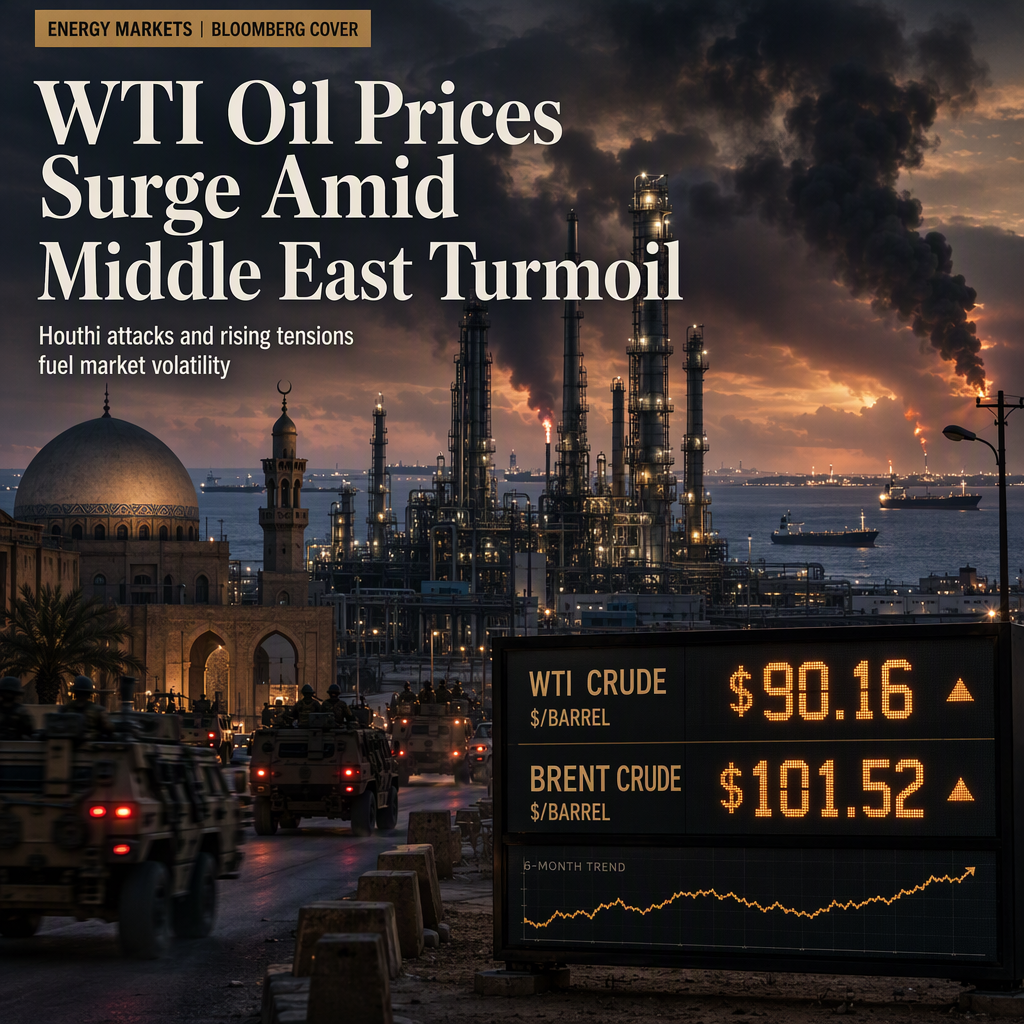
West Texas Intermediate (WTI) crude oil prices saw continued gains on Wednesday, trading near $89.50 and up approximately 0.30% during the Asian session, marking a second consecutive day of follow-through buying after rebounding from an over one-month low [1]. U.S. WTI futures for November advanced 0.81% to $90.16 per barrel, while international benchmark Brent crude for December delivery rose 0.93% to $101.52 a barrel [2].
The upward momentum in oil prices is attributed to escalating geopolitical risks in the Middle East. Yemen's Iran-backed Houthi forces launched attacks on key targets in Saudi Arabia, including an Aramco refinery in Riyadh and airports in Jazan and Najran, as reported by the Saudi aviation authority [1][2]. In response, Saudi-backed Yemen government forces claimed control over strategic points along the Red Sea coast, particularly around the Bab al-Mandeb Strait [1]. Additionally, Iran has intensified attacks on tankers in the Strait of Hormuz, further stoking fears of supply disruptions [1][2].
Despite these risks, Saudi Energy Minister Prince Abdulaziz bin Salman stated that oil pumped through the East-West Pipeline had reached 5.8 million barrels as of Tuesday morning, indicating some recovery in supply [2]. However, analysts warn that the persistent ability of the Houthis to target oil infrastructure keeps the risk of a large-scale crude supply disruption high, and these risks could escalate if the Houthis lose more territory and seek to apply additional pressure [2].
From a technical perspective, WTI prices remain capped below the 200-period Simple Moving Average (SMA) on the 4-hour chart, with initial resistance at $90.66 and further barriers at $91.05 and $95.25. Support levels are noted at $87.66, $84.27, $79.44, and $73.29. The Moving Average Convergence Divergence (MACD) has turned positive at 0.15, and the Relative Strength Index (RSI) is around 50.55, suggesting a neutral-to-positive momentum but also indicating that rebounds may face selling pressure [1].
Naeem Aslam, chief investment officer of Zaye Capital Markets, commented that oil remains 'caught between improving physical supply and persistent geopolitical risk.' Samer Hasn, senior market analyst at XS.com, highlighted that the risk of renewed large-scale crude supply disruption remains present and could worsen if hostilities intensify [2].
CONCLUSION
Oil prices are being buoyed by heightened geopolitical tensions in the Middle East, particularly due to Houthi attacks on Saudi infrastructure and increased Iranian activity in the Strait of Hormuz. While some supply recovery has been noted, the market remains sensitive to further disruptions, keeping risk premiums elevated and price momentum cautiously constructive.