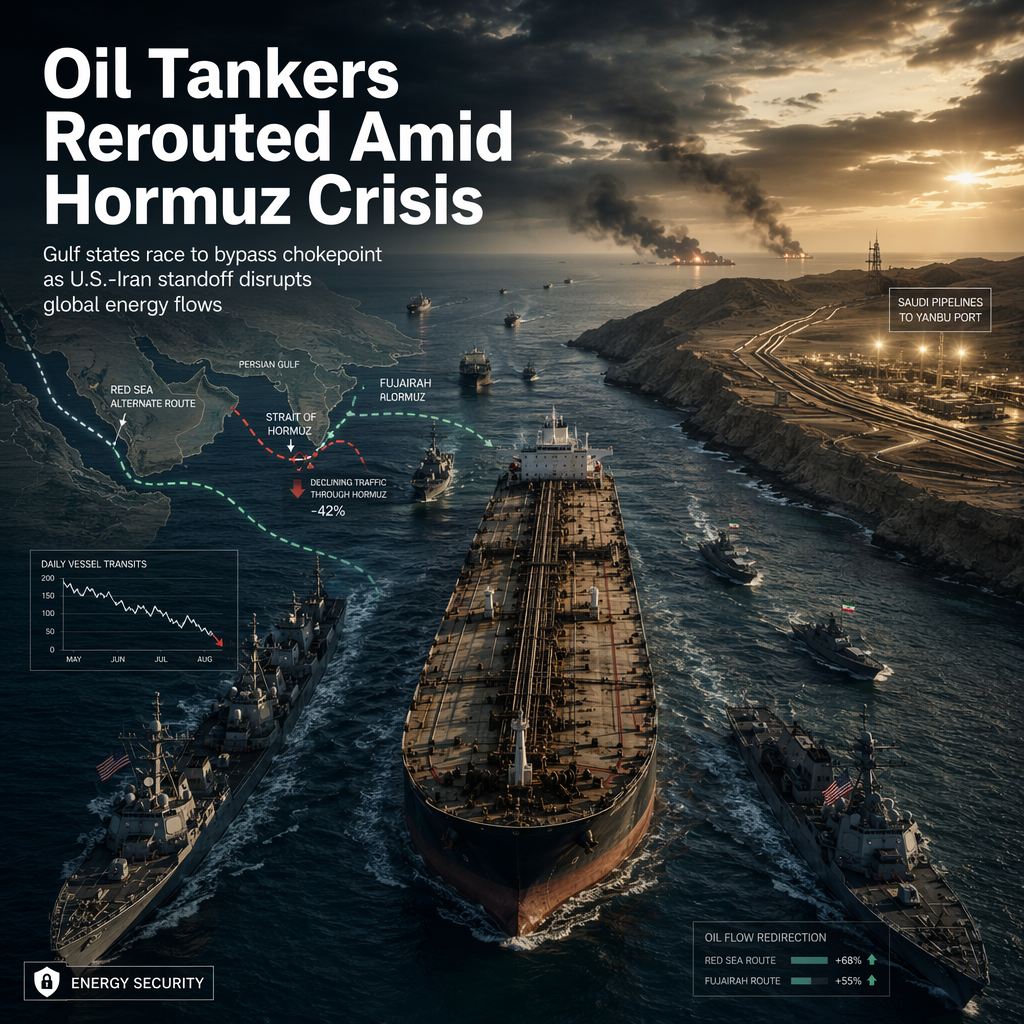
A sharp escalation in U.S.-Iran tensions has led to significant disruptions in oil shipping through the Strait of Hormuz, a critical chokepoint for global energy supplies. President Donald Trump threatened to impose a 20% fee on all cargo passing through Hormuz and announced plans to reimpose a U.S. naval blockade against Iranian ships, intensifying the urgency among Gulf states to find alternative export routes [1][2]. Amid renewed fighting, the U.S. Energy Department reported that more than 8 million barrels of oil transited Hormuz on Sunday with U.S. military assistance, while total flows out of the Middle East Gulf region are averaging 15 million barrels per day [2]. However, ship tracking data revealed a steep drop in traffic: only 14 ships, including four crude oil tankers, crossed Hormuz on Sunday—a 60% decline from the previous week [2]. Pre-war, over 100 ships and about 20 million barrels per day of oil products moved through the strait daily [2].
The deteriorating security situation has prompted Gulf producers to accelerate efforts to bypass Hormuz. Saudi Arabia has diverted roughly 4 million barrels per day through its East-West pipeline to the Red Sea port of Yanbu, leveraging a system with a total design capacity of 7 million barrels per day after recent expansions [1]. Bob McNally, president of Rapidan Energy Group, described Saudi Arabia's ability to reroute oil as a 'major success,' while Andy Lipow of Lipow Oil Associates provided data confirming the scale of these diversions [1]. The United Arab Emirates is reportedly considering the construction of a new port and container terminal on its east coast, outside the strait, with Dubai-based DP World in talks to develop the project in Fujairah [1]. Ahmed bin Sulayem, CEO of the Dubai Multi Commodities Centre, characterized these moves as both immediate and long-term strategies to reduce reliance on Hormuz [1].
Despite these efforts, bypassing Hormuz does not eliminate geopolitical risks, as tankers rerouted to the Red Sea must still navigate other strategic chokepoints such as Bab el-Mandeb [1]. Meanwhile, the U.S. military has pledged to ensure continued oil flows, with a spokesperson stating, 'The U.S. military will ensure oil flows continue, with or without the Iranians, to keep markets well supplied' [2]. However, the security environment remains volatile, with Iran attacking commercial ships in U.S.-protected lanes and demanding that all vessels use a northern route through its territorial waters [2]. Ship tracking firms noted that traffic through the southern, U.S.-protected corridor has 'effectively collapsed,' and the Omani route has seen traffic 'all but disappear' [2]. Since the end of the ceasefire on July 8, more than 9.2 million barrels of Iranian crude have passed through Hormuz, according to Kpler [2].
While U.S. Central Command maintains that Hormuz remains open and traffic is flowing, the use of transponders by some ships has made it difficult to ascertain the exact number of vessels transiting the corridor [2]. The ongoing conflict and shifting routes underscore the fragility of global oil supply chains and the heightened geopolitical risks facing the region.
CONCLUSION
The renewed U.S.-Iran conflict and President Trump's threat of a 20% toll on Hormuz cargo have led to a sharp decline in shipping traffic and accelerated Gulf efforts to develop alternative export routes. While Saudi Arabia and the UAE are making progress in bypassing the strait, the overall security situation remains highly unstable, posing ongoing risks to global oil markets.