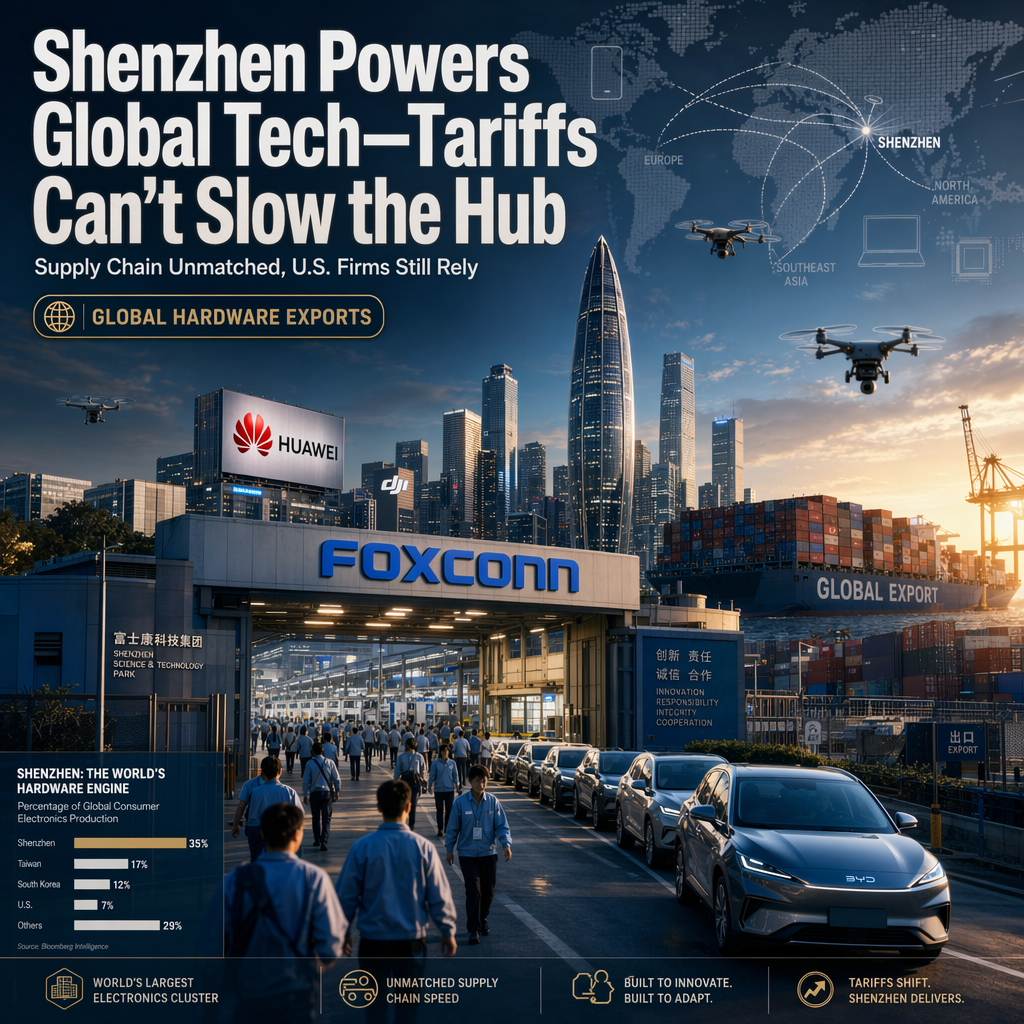
Apple established a significant manufacturing base in Shenzhen over two decades ago, leveraging supplier Foxconn, and the region has since become home to major consumer electronics companies such as DJI, Huawei, and electric car giant BYD [1]. According to Even Realties CEO Will Wang, Shenzhen offers unparalleled supply chain proximity, with all necessary components available within a two-hour drive, making it an attractive location for hardware startups and established firms alike [1]. MIT graduate Joshua Woodard, who left Apple to run supply chain management company The Sparrows in Shenzhen, emphasized that many clients are from the United States and expressed confidence that Shenzhen's factories will continue to supply global technology markets for the next decade [1].
Despite escalating U.S. tariffs leading to a sharp year-on-year decline in imports, China remained the largest source of California's imports last year, with computer and electronic products accounting for around 36% of the total, according to the state's chamber of commerce [1]. Shenzhen itself accounted for nearly 19% of China's advanced tech exports last year, underscoring its pivotal role in the global hardware supply chain [1]. Analyst Lian Jye Su from Omdia noted that Chinese vendors are becoming increasingly important in niche technologies [1].
While some argue that proximity to end users and mitigation of geopolitical and tariff risks are important, industry voices like Woodard and Wang maintain that China, and specifically Shenzhen, remains unrivaled for hardware manufacturing, with no immediate challenge from countries like India or Vietnam [1]. The region's ecosystem is seen as essential for building the next generation of consumer electronics, potentially even the next Apple [1].
Market implications center on the continued reliance of Silicon Valley and U.S. tech firms on Shenzhen's manufacturing capabilities, despite trade tensions and tariffs. The ongoing dominance of Shenzhen in advanced tech exports and its robust supply chain infrastructure suggest that the city will remain a key player in global hardware innovation and production [1].
CONCLUSION
Shenzhen continues to be a critical hub for global hardware manufacturing, attracting both startups and established tech giants despite geopolitical and tariff challenges. The region's supply chain advantages and export strength reinforce its importance to Silicon Valley and the broader tech industry. Market reliance on Shenzhen is expected to persist, with no immediate alternatives emerging.