
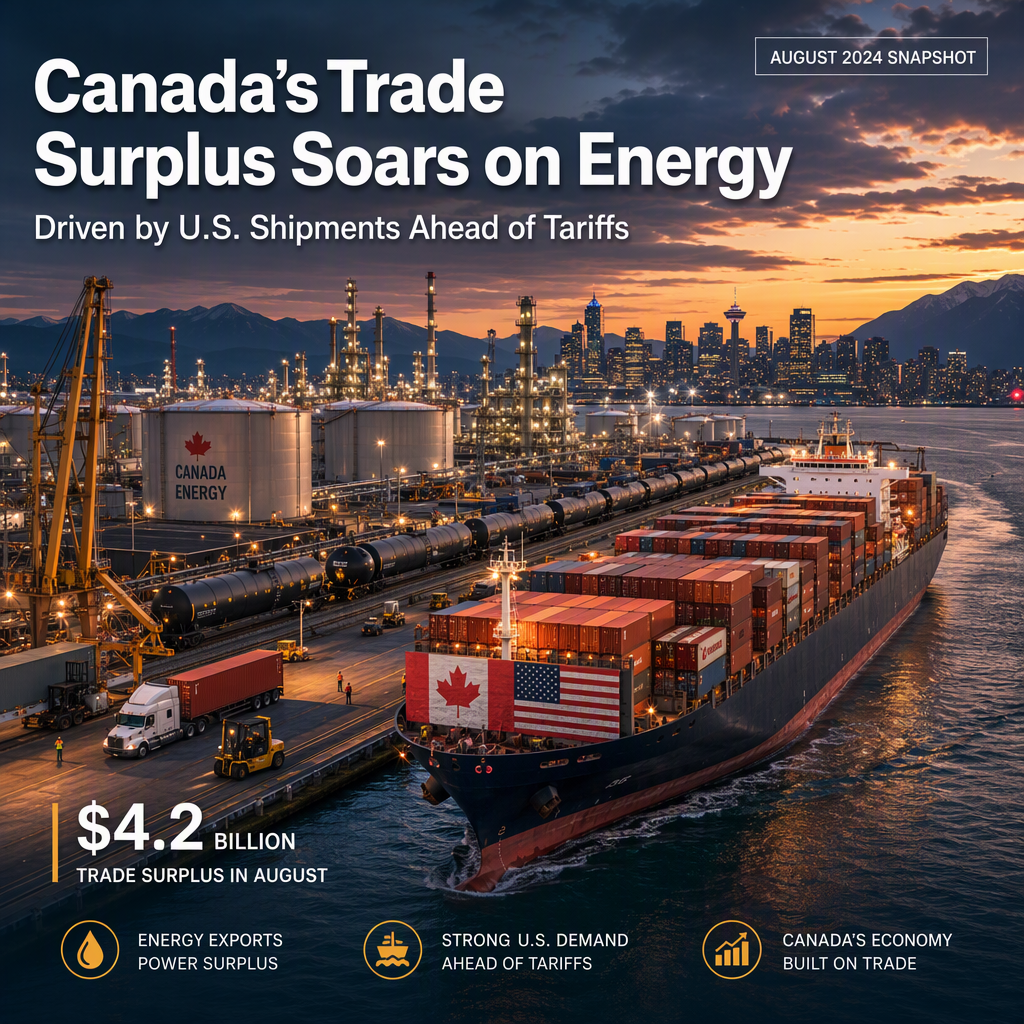
Canada's trade balance swung sharply to a $4.2 billion surplus in August, according to Nathan Janzen of the Royal Bank of Canada (RBC) [1]. This improvement was attributed to higher energy prices and a surge in exports to the United States ahead of new U.S. tariffs imposed late in the month [1]. Energy exports played a significant role, with refined product exports such as diesel rising 13% year-over-year, excluding price impacts [1]. Crude oil prices continued to climb into September, up another 16%, further supporting Canadian energy exports [1].
Exports to the U.S., excluding tariffed and energy products, increased approximately 16% year-over-year, indicating resilient non-tariffed trade flows [1]. On the domestic front, import volumes (excluding price impacts) fell by 1.7%, but imports of machinery and equipment—a key indicator of business investment—and consumer goods, an indicator of consumer demand, both rose, suggesting improving domestic demand [1].
RBC expects the new U.S. tariffs to significantly impact directly targeted sectors; however, with over 80% of Canadian exports to the U.S. still enjoying duty-free access under CUSMA, the broader economic spillover is anticipated to be limited [1]. The outlook remains cautiously optimistic, with expectations for a gradual per-person recovery and limited broader economic effects from the tariffs [1].
CONCLUSION
Canada's August trade surplus was driven by strong energy exports and a rush of shipments ahead of new U.S. tariffs. While certain sectors may face challenges from the tariffs, the majority of Canadian exports remain unaffected, supporting a cautiously optimistic economic outlook.