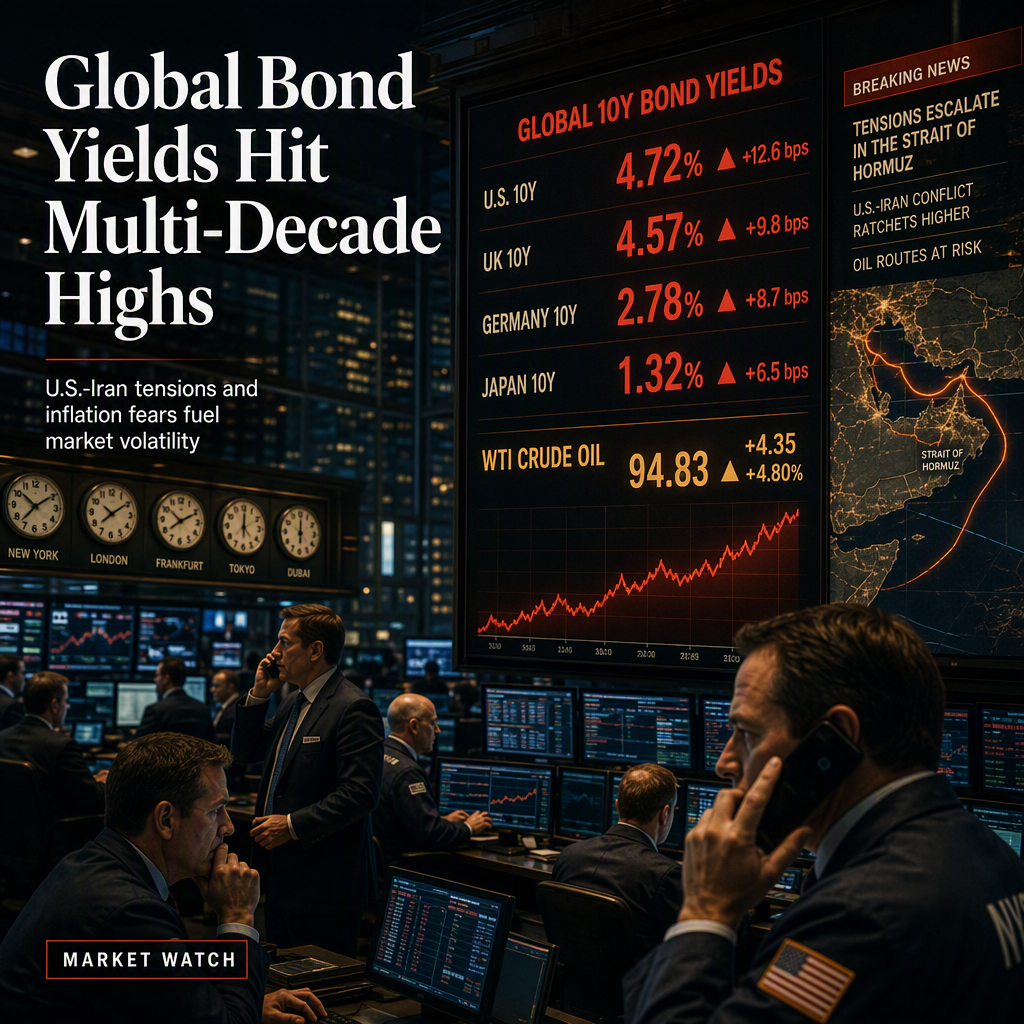
Global government bond yields surged to multi-decade highs on Tuesday, following a sharp rise in U.S. Treasury yields, as escalating tensions between the U.S. and Iran fueled concerns about inflation and higher energy prices [1]. The failure to reach a diplomatic breakthrough between Washington and Tehran, coupled with renewed threats of military escalation from both sides, led to a global sell-off in government bonds and increased borrowing costs [1].
The closure of the Strait of Hormuz, a critical shipping route, throughout the nearly six-month conflict has contributed to rising costs for energy and other commodities. This has pushed oil prices higher, with Brent crude futures trading above $90 per barrel on Tuesday [1]. At 4:16 a.m. ET, the yield on U.S. 30-year Treasurys climbed almost 2 basis points to 5.3275%, marking the highest level since 2002. The 20-year Treasury note yield reached a post-2006 high, while the benchmark 10-year Treasury yield was at 4.74%, its highest since 2007 [1].
Yields also spiked in other major markets: Germany's 10-year bund yield hit a 15-year high, France's reached its highest since 2008, and Japan's 10-year bond yield rose to 2.954%, surpassing the 40-year high seen earlier in the year. Similar upward movements were observed across British, Italian, Swiss, and Canadian government bonds [1].
Dan Coatsworth, head of markets at AJ Bell, noted that the lack of progress in ending the war has heightened inflation fears and the possibility of interest rate hikes among investors. He emphasized that rising long-dated bond yields are not solely driven by expectations of higher rates and inflation, but also by concerns over high government borrowing and the need for greater compensation for holding long-dated bonds [1]. Deutsche Bank's Jim Reid commented that there was no single catalyst for the bond market declines over the past 24 hours [1].
CONCLUSION
The surge in global bond yields reflects heightened investor anxiety over inflation, energy prices, and geopolitical risks stemming from the unresolved U.S.-Iran conflict. With borrowing costs at multi-decade highs and oil prices elevated, markets are bracing for further volatility and potential interest rate hikes. Analysts highlight that both inflation fears and concerns about government debt are driving the current bond market dynamics.