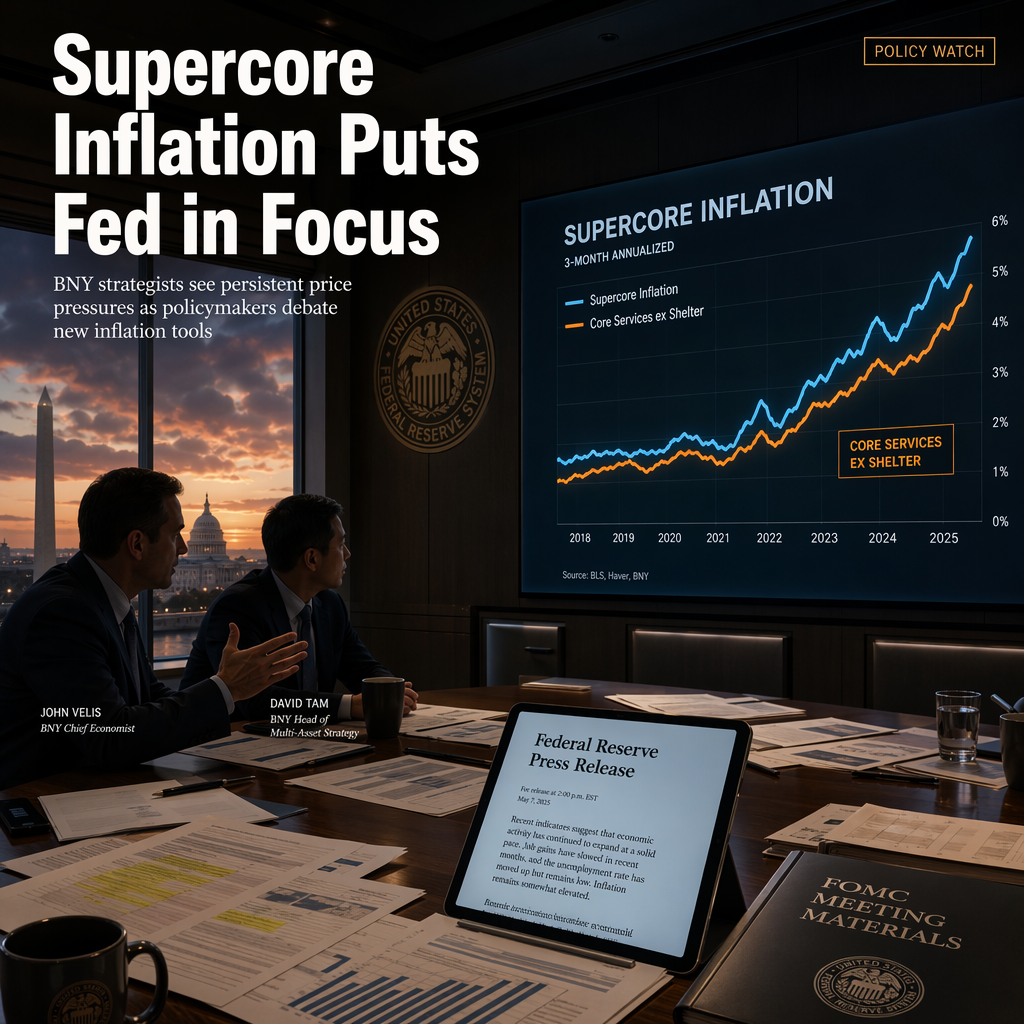
BNY strategists John Velis and David Tam emphasize that elevated US supercore inflation, defined as core services inflation excluding shelter, remains a significant argument for further Federal Reserve tightening, though they still anticipate the Fed will hold rates steady in July [1]. They note that since mid-2023, supercore inflation has been running nearly a percentage point above its pre-COVID pace, with core services ex shelter consistently exceeding historical levels [1].
The strategists point out that much of the increase in supercore inflation stems from transportation services, particularly airfares impacted by energy shocks, as well as rising health care costs driven by higher insurance premiums and reduced Obamacare subsidies, and financial services. Transportation and health care together contribute 0.7% to the 3.0% increase in supercore inflation, and these components are not particularly sensitive to tighter monetary policy [1].
Chair Kevin Warsh’s Inflation Frameworks Task Force is set to reassess inflation measurement tools, including trimmed mean inflation, and their implications for policy. Warsh has indicated that the task force will examine the drivers of inflation from first principles and consider a range of ideas for achieving price stability in a changing economy [1]. The strategists highlight that while trimmed mean inflation can understate both rising and falling inflation depending on the economic context, it is not inherently dovish or hawkish [1].
Despite concerns about sticky supercore inflation, BNY strategists do not find the arguments for an immediate rate hike fully persuasive, describing the upcoming Fed meeting as a close call. They acknowledge that supercore inflation has remained steady rather than accelerating [1].
CONCLUSION
BNY strategists see persistent supercore inflation as a key concern but expect the Fed to hold rates in July. The upcoming review of inflation measurement frameworks by the Fed's task force could influence future policy decisions. Market participants should monitor both inflation trends and the Fed's evolving approach to measurement.