
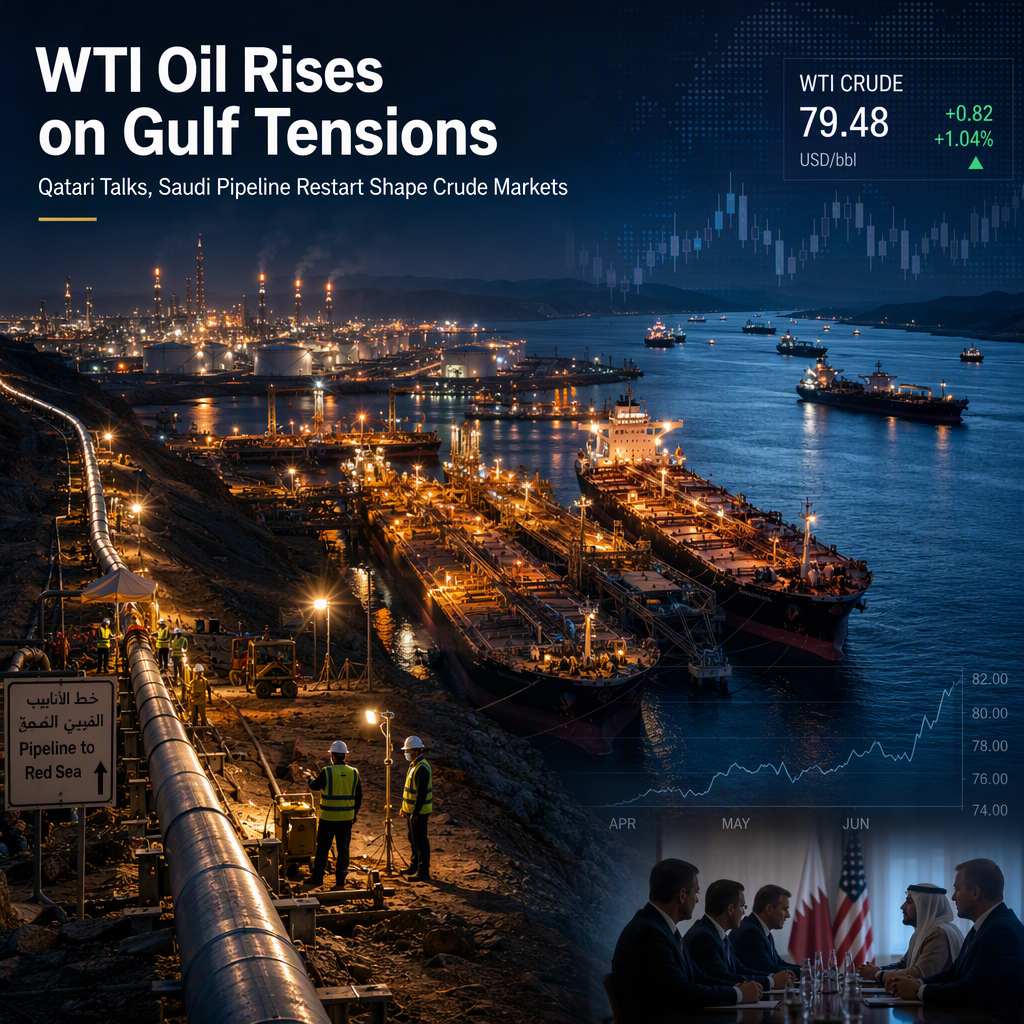
West Texas Intermediate (WTI), the US crude oil benchmark, traded around $92.05 during early Asian hours on Tuesday, showing mild gains as traders assessed reports of Qatari-mediated talks between the US and Iran aimed at reopening the Strait of Hormuz [1]. On Sunday, US President Donald Trump rejected an Iranian proposal to reopen the Strait, according to Reuters, but WTI prices pared gains on expectations that Qatari mediators would continue discussions with both sides [1]. Iran's Foreign Minister Abbas Araghchi stated on Monday that Tehran had discussed proposals with Qatari mediators, which would be conveyed to the US, and that Iran's Supreme Leader's conditions must be met for the Strait to reopen [1].
Meanwhile, Saudi Arabia has restored about half the flows through its cross-country oil pipeline, which bypasses the Strait of Hormuz, after drone strikes halted the route earlier in the month. Flows through the East-West pipeline to the Red Sea have reached at least 3.5 million barrels per day, according to Bloomberg [1]. This partial restoration may limit further upside for oil prices [1].
Analysts at MUFG noted that oil prices have climbed back towards recent highs near $110 per barrel, reflecting disappointment over the lack of progress in US-Iran talks and the continued closure of the Strait of Hormuz [1]. They explained that the absence of a tangible deal to end the US-Iran conflict and reopen the Strait is keeping crude prices elevated [1].
From a technical perspective, WTI maintains a constructive near-term bias, holding above the 100-day simple moving average (SMA) and the lower Bollinger Band. The price is just below the Bollinger 20-period SMA, which acts as immediate resistance, while the Relative Strength Index (14) at around 52 indicates moderate, still-positive momentum [1]. A sustained break above the Bollinger middle band at $93.65 could open the way toward $100.80, while support is seen near $92.05 and stronger demand at $86.55 [1].
CONCLUSION
WTI oil prices are being supported by ongoing geopolitical uncertainty in the Middle East and the slow progress of US-Iran negotiations, despite partial restoration of Saudi pipeline flows. The market remains sensitive to developments in the region, with technical indicators suggesting a bullish near-term outlook as long as key support levels hold.