
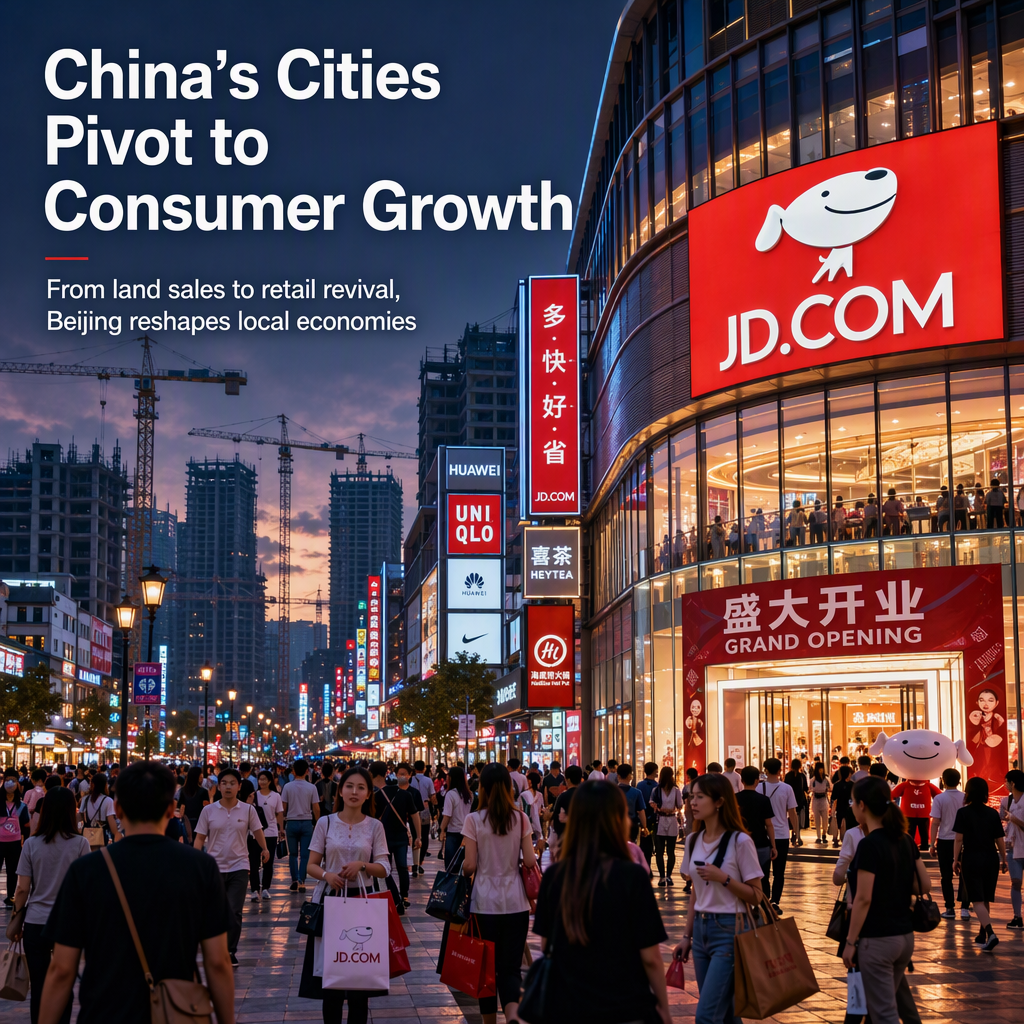
China is undertaking a significant economic reset, with the central government directing local municipalities to move away from their traditional reliance on land sales as a primary revenue source and instead focus on boosting domestic consumption [1]. This policy shift comes as the Chinese economy faces challenges regaining momentum, and the longstanding land-driven growth model has become unsustainable due to a cooling property market, resulting in mounting local government debts and fewer fiscal options [1].
To address these issues, Beijing is incentivizing cities to support sectors such as retail, tourism, and high-value services, which are expected to provide more stable tax revenues and reduce dependence on the volatile real estate market [1]. An example of this transition is the opening of a JD.com mall for trial operation in Suzhou on October 1, reflecting efforts to stimulate consumption-driven growth [1].
However, the transition presents significant challenges for local governments, including the need to overhaul fiscal systems, improve service delivery, and build consumer confidence. The process also highlights deeper structural issues such as uneven development and income inequality, which will require sustained policy efforts to resolve [1].
Despite these hurdles, the move is seen as a pivotal turning point for China's economic trajectory. By realigning municipal finances with consumption rather than construction, Beijing aims to foster a more balanced and sustainable growth path, even if this results in slower expansion in the short term [1]. The outcome of this reset is expected to have major implications for property markets, retail sectors, and the country's overall fiscal health [1].
CONCLUSION
China's shift from land-driven to consumption-based local government revenue marks a major policy change with medium market impact. While the transition aims to create more sustainable growth, it introduces challenges and uncertainties for investors and market participants, particularly in property and retail sectors.