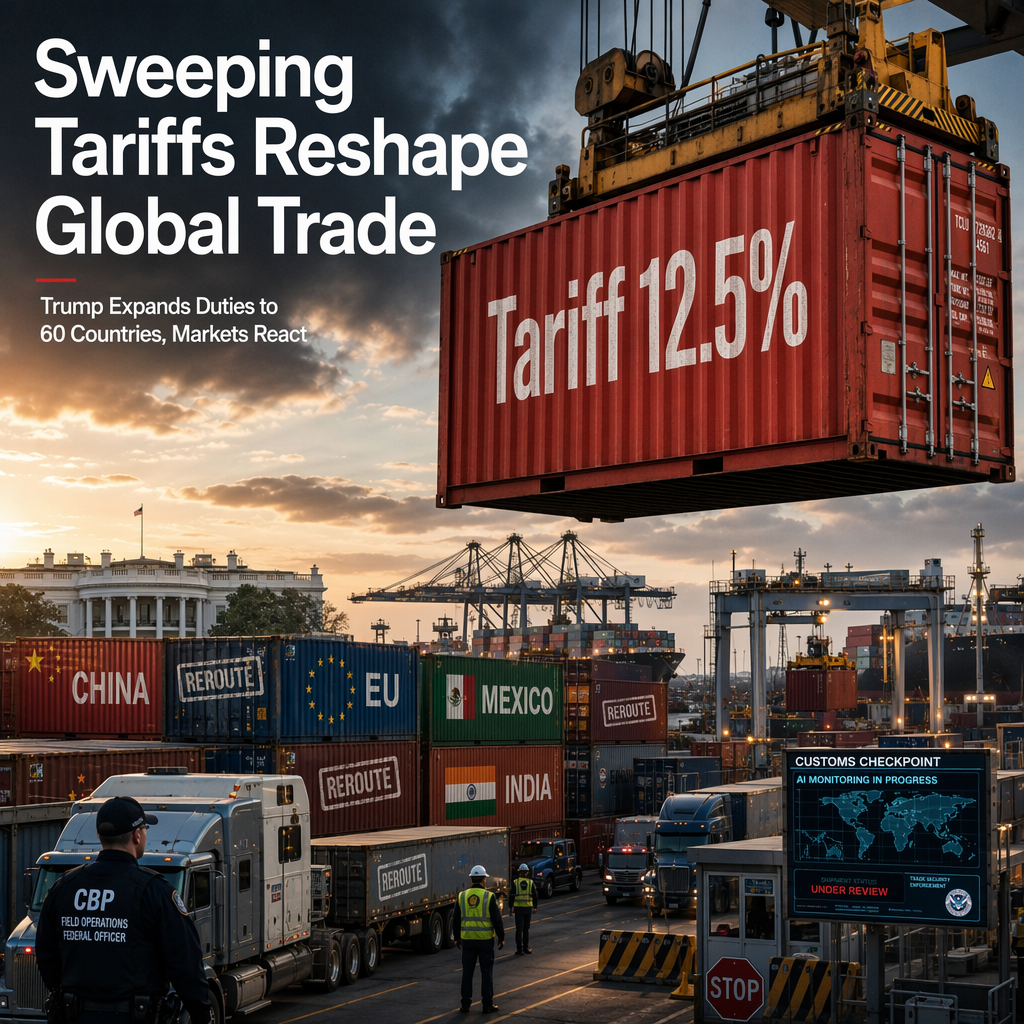
President Donald Trump has reinstated and expanded tariffs on over 60 countries, with new rates set at 10% to 12.5%, following the expiration of the previous 10% global tariffs at 12:01 a.m. Friday [1][2]. The new duties target a wide range of trading partners, including India, Malaysia, Mexico, Bangladesh, Cambodia, China, Japan, and the European Union, with Chinese and Japanese goods facing a 12.5% levy and other countries such as India and Malaysia subject to a 10% rate [1][2]. According to the Office of the U.S. Trade Representative, the tariffs now cover 99.4% of U.S. trade [2].
The Trump administration stated that these tariffs are being imposed under Section 301 of the Trade Act of 1974, citing alleged forced labor violations as the primary reason for the action [2]. The new measures do not stack on top of existing Section 232 duties on steel and aluminum [2]. The administration described the move as 'the most sweeping international labor rights action the United States has ever taken — that any country has ever taken,' according to a senior official [2]. The tariffs are part of a broader strategy to protect domestic industries and rebalance trade relationships, following legal setbacks earlier in the year that forced a reset of Trump's previous tariff regime [1][2].
Market participants are closely monitoring the impact, as the new tariffs have already disrupted supply chains and led to a spike in global shipping costs [1]. U.S.-China container rates have reached a two-year high in anticipation of the changes [1]. Analysts are divided on the effectiveness of the tariffs in boosting U.S. manufacturing, given the complexity of global supply chains [1]. Some observers believe that Asia's major trade pacts may help mitigate the damage, but sectors reliant on U.S. imports, particularly electronics and apparel, are expected to face profit pressures [1]. Industry sources in Vietnam report that Chinese goods are increasingly being rerouted through Southeast Asia to avoid higher tariffs, a trend U.S. customs authorities are monitoring [1].
The White House has also recently imposed 25% tariffs on most U.S. imports from Brazil, effective Wednesday, and 50% tariffs on a wide range of goods from Canada, set to begin next month [2]. The administration has committed to continuing the use of tariffs and negotiating deals to support U.S. industry, with further Section 301 investigations ongoing, including one focused on excess manufacturing capacity by 16 economies [2].
Critics argue that the tariffs could invite retaliatory measures and further disrupt established supply chains [1]. No specific estimates for revenue generation from the new tariffs were provided by the U.S. Trade Representative [2]. Overall, market sentiment remains cautious, with expectations of increased volatility in affected sectors as the new tariffs take effect [1].
CONCLUSION
The Trump administration's sweeping new tariffs mark a significant escalation in U.S. trade policy, affecting the vast majority of U.S. trade and prompting immediate market reactions such as higher shipping costs and supply chain disruptions. While intended to protect domestic industries and address forced labor concerns, the measures have sparked debate among analysts and market participants, with expectations of continued volatility and potential retaliatory actions from trade partners.