
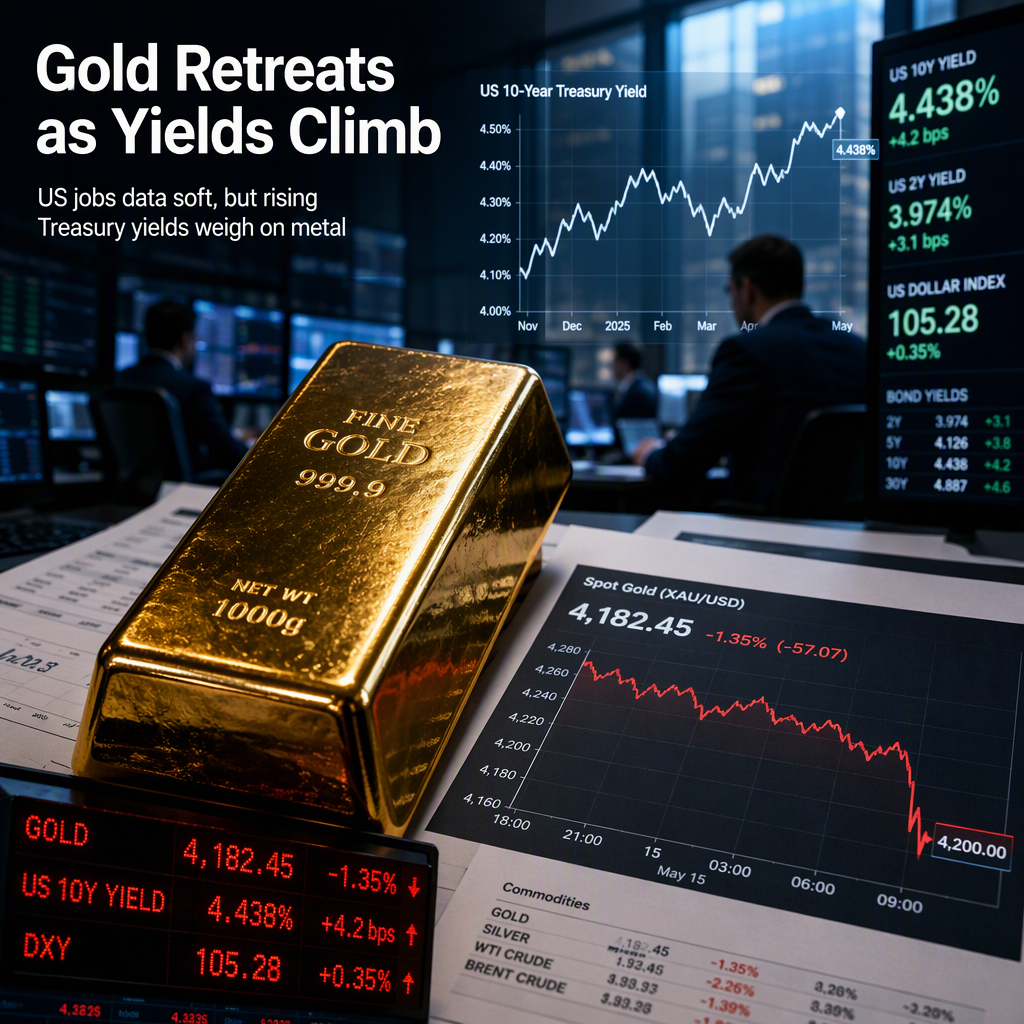
Gold prices fell nearly 1% on Friday, with XAU/USD trading at $4,138 after reaching an intraday high of $4,227, as the metal failed to decisively break the $4,200 resistance level [1]. The decline occurred despite US Nonfarm Payrolls for September coming in well below estimates at 29K, compared to expectations of 90K and a downwardly revised August figure of 133K [1]. The US unemployment rate rose from 4.1% to 4.2%, slightly above the Federal Reserve's projections for 2026 and 2027, though this was attributed to an increase in the participation rate [1].
Dovish comments from New York Fed President John Williams and Vice Chair Philip Jefferson, who indicated no rush to raise rates, increased market expectations for the Federal Reserve to hold rates at its October 28 meeting, with odds at nearly 77% for a hold and 88% for December [1]. However, rising US Treasury yields, with the 10-year note yielding 5.9% (up 4 basis points), made gold less attractive due to its non-yielding nature [1]. The US Dollar Index (DXY) fell 0.14% to 101.89, indicating a loss of safe-haven appeal for the greenback [1].
Technical analysis shows that sellers remain in control, with the Relative Strength Index (RSI) below the 50-neutral level [1]. Key support for XAU/USD is at $4,100, with further downside targets at $3,996 and $3,959 if selling pressure continues [1]. On the upside, buyers need to reclaim $4,200 to challenge the 100-day Simple Moving Average at $4,279 [1].
Elsewhere, light news from the Middle East and reports of potential European diesel and crude reserve releases kept energy prices subdued, with West Texas Intermediate (WTI) crude down 1.6% to $91.42 [1]. Looking ahead, the US economic docket next week includes the ISM Services PMI, additional jobs data, FOMC Meeting Minutes, a speech by Fed Governor Bowman, and the University of Michigan Consumer Sentiment report [1].
CONCLUSION
Gold's inability to hold above $4,200, despite weaker-than-expected US jobs data and a softer dollar, highlights the dominant influence of rising US Treasury yields. Market participants are now focused on upcoming US economic releases and Federal Reserve communications for further direction.