
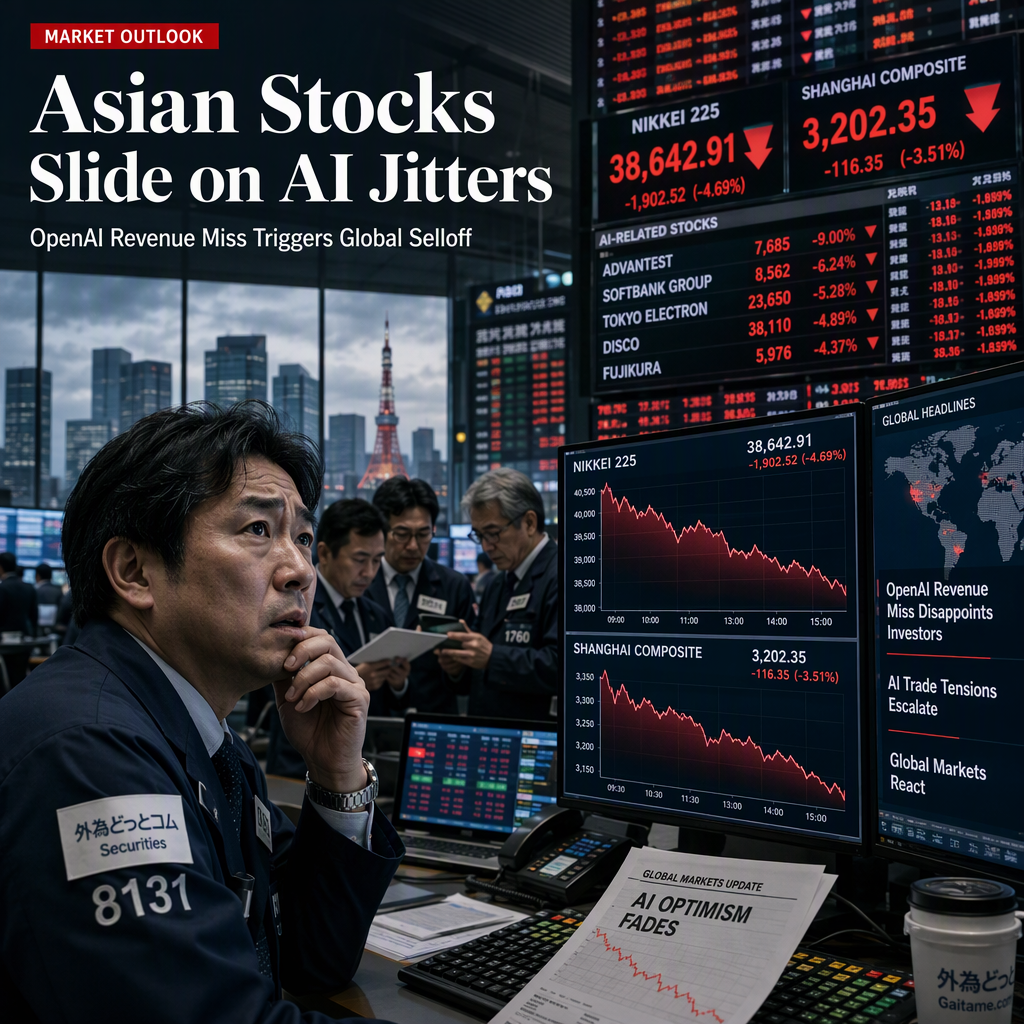
Asian stock markets faced significant pressure on Friday, triggered by a sharp selloff in US technology shares after reports revealed that OpenAI's annualized revenue reached $50 billion at the end of September, falling short of the $68 billion figure widely reported the previous month [1]. This revenue miss raised doubts about the sustainability of AI-related growth and cast a shadow over the broader artificial intelligence sector, particularly impacting Japanese firms that play a critical role in global AI infrastructure [1].
Japan's Nikkei 225 index, after initially opening lower, traded down by 0.13% around 68,950, weighed by declines in AI-linked heavyweights such as Advantest, Kioxia Holdings, and SoftBank Group. Despite the day's losses, the Nikkei managed to secure its fourth consecutive weekly gain [1]. In mainland China, investor caution over international trade further dampened sentiment, with the Shanghai Composite falling 1.2% to 3,765 and the Shenzhen Component dropping 2.1% to a multi-month low of 12,480. These declines came as market participants closely watched the conclusion of China-EU trade talks, which have been marked by European industry groups calling for action against what they describe as unfair Chinese commercial practices and Beijing's restrictions on rare earth and critical mineral exports [1].
Contrasting the regional downtrend, Hong Kong's Hang Seng Index rose 1.1% to 24,050, buoyed by bargain hunters and late-session support from advancing US index futures, positioning the index to break a two-week losing streak [1]. Meanwhile, crude oil prices retreated after US President Donald Trump stated he would avoid military action against Iran before the November midterm elections, providing some relief from inflation concerns, though high US Treasury yields continued to weigh on the broader market outlook [1].
Analysts at Rabobank noted that the recent pullback in US equities may be influenced by relative valuations, with market gains increasingly concentrated among a small group of AI-adjacent tech megacaps. They highlighted the narrow breadth of the US equity rally and observed that the AI narrative 'had a wobble' as SpaceX 5-year CDS spreads widened by 16.5 basis points, reflecting growing investor caution [1].
CONCLUSION
The OpenAI revenue miss has sparked renewed skepticism about the AI sector's growth prospects, leading to notable declines in Asian equities, especially among AI-linked stocks. While some markets like Hong Kong saw a rebound, overall sentiment remains cautious amid trade tensions and persistent macroeconomic headwinds. Market participants are increasingly wary of the narrow leadership in US equities and the sustainability of the AI-driven rally.