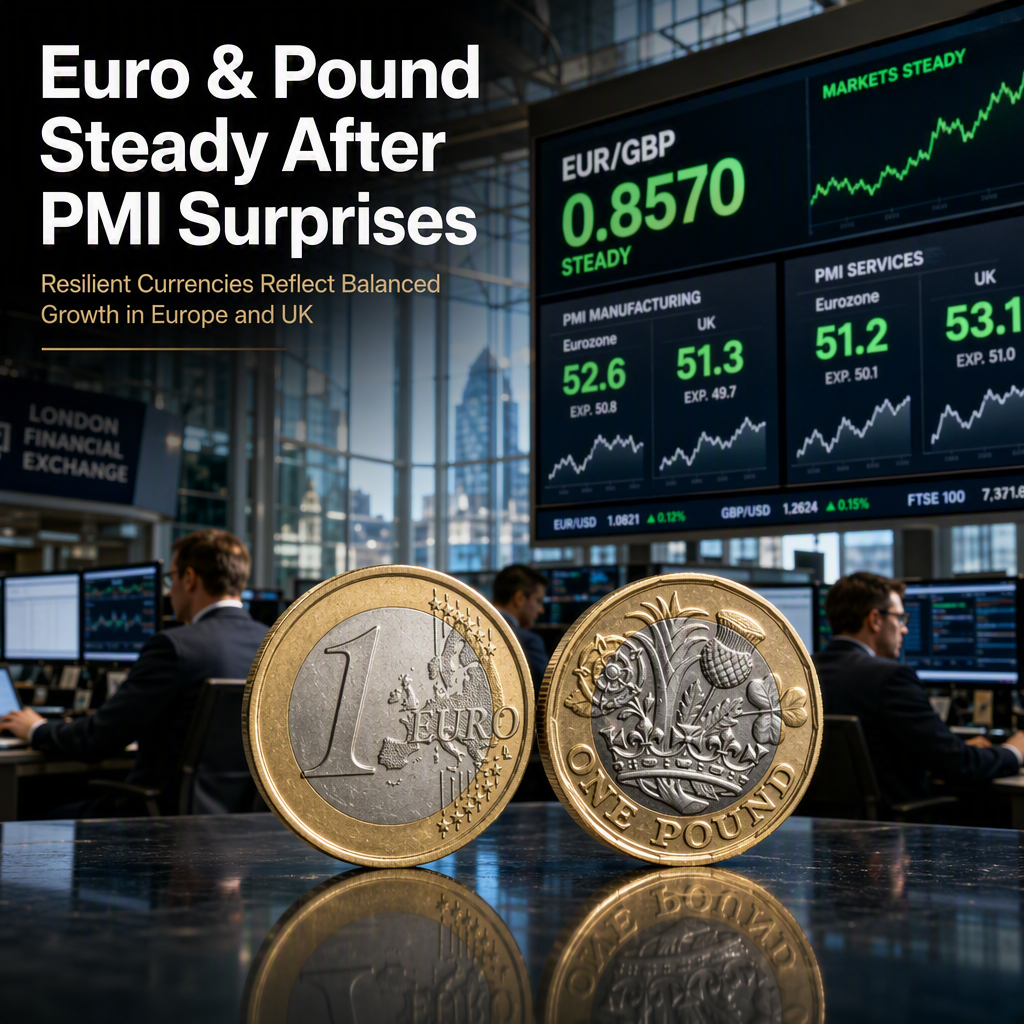
The Euro and British Pound both remained resilient on Friday following the release of stronger-than-expected Purchasing Managers' Index (PMI) data from the Eurozone and the United Kingdom. The EUR/GBP pair traded around 0.8570, virtually unchanged on the day, reflecting balanced support for both currencies after solid activity indicators were published for both regions [1].
In the Eurozone, the preliminary HCOB Manufacturing PMI rose to 52.8 in August from 51.9 previously, surpassing market expectations of 51.8. The Services PMI remained steady at 51.7, slightly above the 51.5 consensus, while the Composite PMI improved to 52.1, beating the 51.7 forecast and the previous reading of 52.0 [1][3]. German data was mixed: Manufacturing PMI surged to a 51-month high of 54.1 from 52.2, well above the expected 52.0, but Services PMI fell to 48.5 from 49.8, missing expectations of a return to expansion at 50.1. Consequently, Germany’s Composite PMI eased to 51 from 51.3, below expectations [1][3].
In the UK, the S&P Global Composite PMI expanded to 52.5 in August from 52.2, beating expectations of 51.6. The Services PMI accelerated to 52.8 from 52.1, exceeding the 51.8 consensus, while the Manufacturing PMI slowed to 51.5 from 51.9, in line with expectations [1][2]. Despite robust business activity, UK retail sales data showed a 0.5% month-on-month decline in July, matching expectations, and annual sales growth slowed to 1.6%, below the 2.2% forecast and down from a revised 3.8% previously [1][4]. UK headline inflation accelerated to 2.9% year-on-year in July from 2.6% in June [4].
Market reactions were muted for EUR/GBP, reflecting the supportive macroeconomic backdrop for both currencies [1]. The British Pound saw a slight gain against the US Dollar, with GBP/USD trading 0.15% higher near 1.3650, though this was attributed to US Dollar weakness following the US Treasury's announcement of increased long-term bond buybacks [2][3]. The Euro held near three-month highs against the US Dollar, buoyed by the strong Eurozone PMI data and a softer Greenback [3].
Analysts noted that the positive PMI surprises in both regions support their respective currencies, with the Euro benefiting from unexpected manufacturing strength and the Pound finding support from robust services activity despite weaker consumption data [1][3]. Technical analysis for EUR/GBP indicated a mildly bullish near-term bias, with the pair consolidating above key moving averages and neutral momentum on the Relative Strength Index [1].
Looking ahead, the market focus remains on the sustainability of these positive trends, with inflation and central bank policy in both regions under scrutiny. In the UK, higher inflation and subdued retail sales may pose challenges for the Bank of England, while in the Eurozone, the divergence between manufacturing and services in Germany could influence future currency moves [1][3][4].
CONCLUSION
Stronger-than-expected PMI data from both the Eurozone and the UK provided balanced support for the Euro and British Pound, resulting in limited movement for the EUR/GBP pair. While robust business activity underpins both currencies, ongoing inflation and consumption trends will be key for future market direction. Overall, the market reaction was steady, with technicals suggesting consolidation rather than a decisive move.