
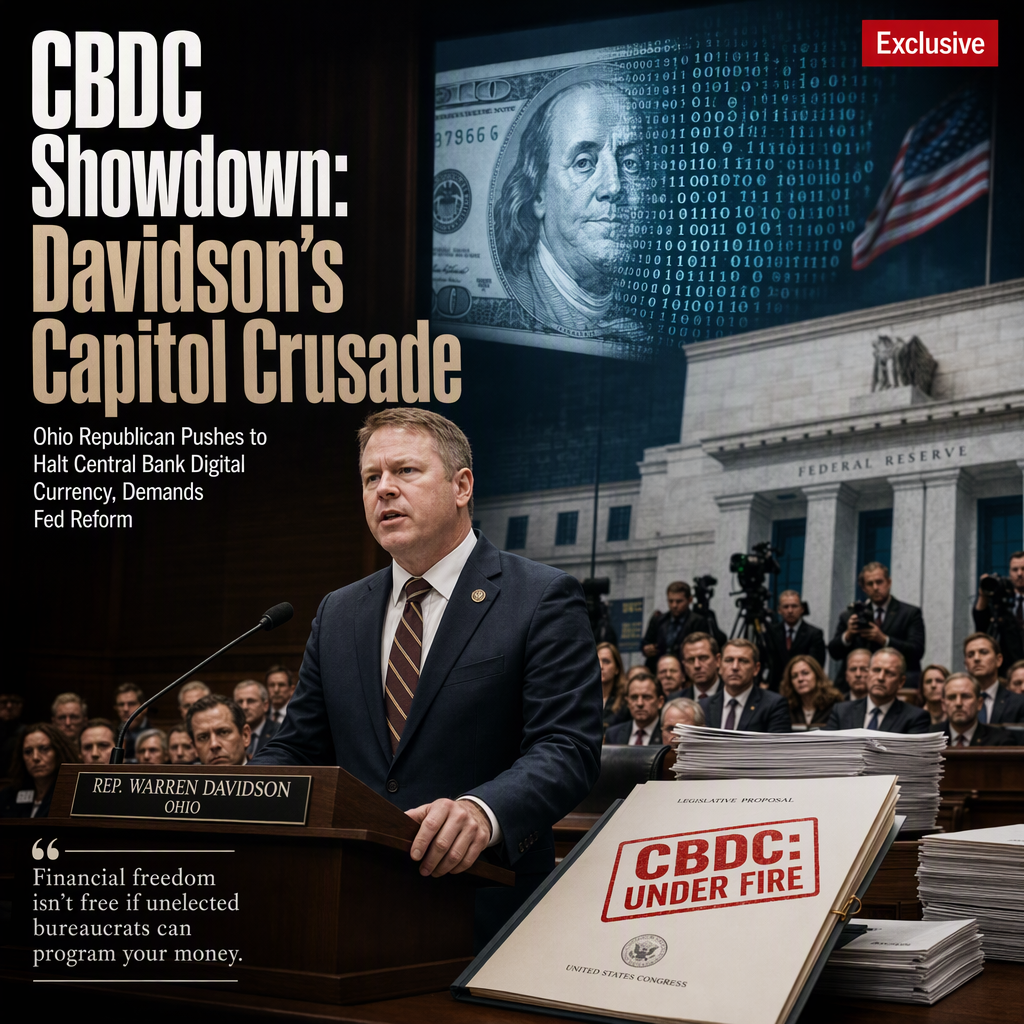
Rep. Warren Davidson, a Republican from Ohio, has announced plans to introduce legislation aimed at regulating or prohibiting the development of a central bank digital currency (CBDC) in the United States, which he described as 'communist money for the digital age' during an interview with Fox News Digital [1]. Davidson expressed concerns that a CBDC could allow the government to exert excessive control over individuals' finances, including the ability to freeze funds or program money for specific uses, which he characterized as 'dystopian' [1].
Davidson has previously stated on social media that he is drafting a bill to regulate CBDC as counterfeit money, equating the design and launch of a CBDC to counterfeiting and calling for prison sentences for those involved [1]. He warned that programmable money would put the government between citizens and their money, calling it an 'existential threat to western civilization' [1].
Currently, a section within the 21st Century ROAD to Housing Act, which became law earlier this year, temporarily prohibits the creation of a CBDC, but this ban is set to expire on December 31, 2030 [1]. Davidson emphasized the need for fiscal discipline and a disciplined monetary policy, suggesting that the money supply should not grow disproportionately to the economy and advocating for at least an audit of the Federal Reserve, if not its complete dissolution and replacement [1].
When asked about former President Donald Trump's proposal to give $5,000 to every American adult if the GOP wins both chambers of Congress, Davidson indicated conditional support, provided the policy is paired with spending cuts to offset the cost. He noted that such a proposal could fuel inflation unless accompanied by significant reductions in government spending, such as overhauling healthcare programs like Obamacare [1].
CONCLUSION
Rep. Davidson's strong opposition to a U.S. central bank digital currency and his call for legislative action highlight ongoing political resistance to CBDC development. The temporary ban on CBDC creation remains in place until 2030, but Davidson's efforts signal continued debate over the future of digital currency and monetary policy in the U.S. Market participants may view these developments as indicative of regulatory uncertainty in the digital currency space.