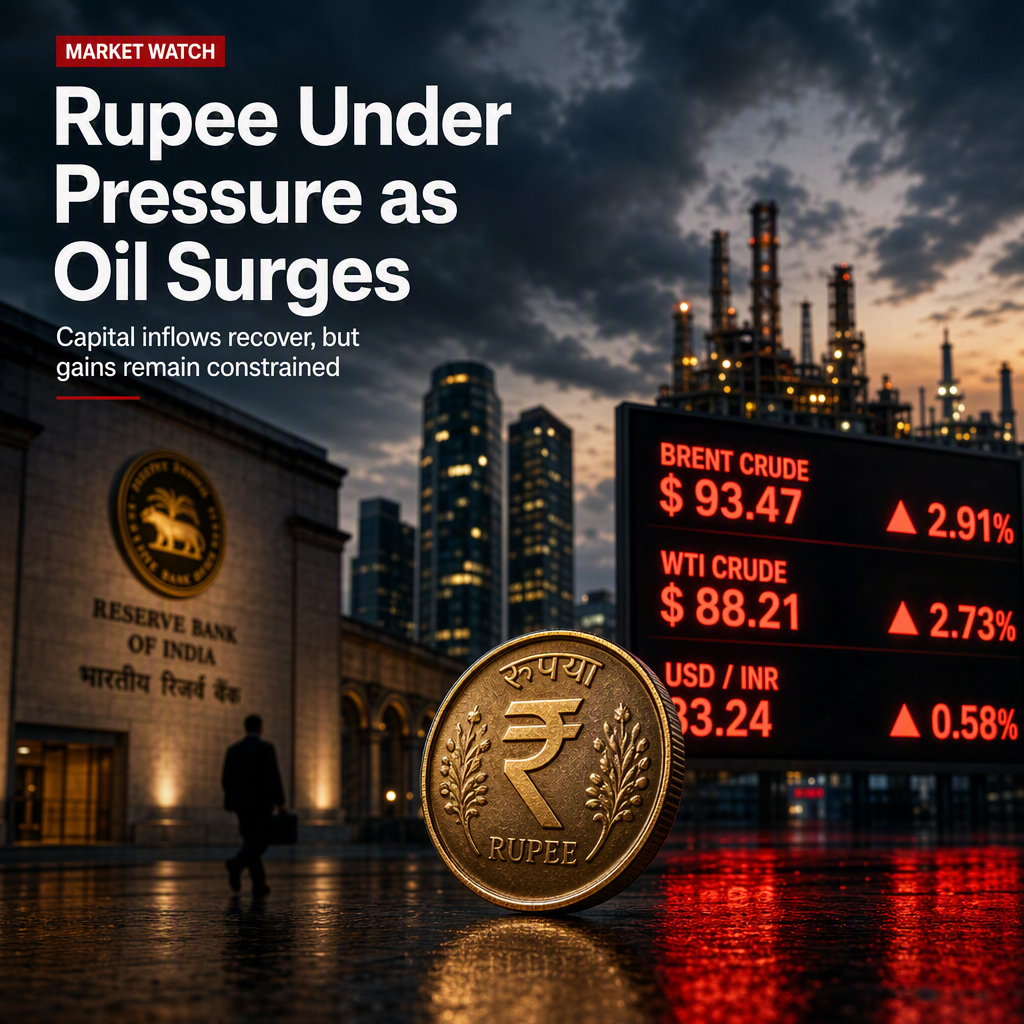
DBS Group Research economist Radhika Rao highlights that India's onshore markets are currently influenced by two opposing forces: higher oil prices, driven by renewed Middle East hostilities and concerns over the Red Sea, and an improving picture for capital inflows [1]. The surge in benchmark crude prices has pushed up the USD/INR exchange rate and long-end bond yields, prompting the central bank to intervene strongly to prevent the rupee from revisiting record lows [1].
The Finance Ministry has warned that high energy costs could put pressure on India's current and fiscal accounts [1]. While portfolio inflows and swap-window funding are recovering, the Indian Rupee remains weaker against the US Dollar. The spot-neutral nature of inflows under the swap windows, increased hedging-related demand, and authorities’ preference to gradually lower their exposure in the forwards book, combined with a firm US dollar due to US policy tightening expectations, have limited the rupee's potential for sharp gains [1].
Despite the turnaround in inflows, the rupee has depreciated by 1.1% this month and a cumulative 6% on a calendar year-to-date basis against the dollar [1]. An overnight pullback in the dollar is expected to provide brief support to Asian currencies, led by the yen, but the rupee is anticipated to return to its familiar trading pattern, with 95.00 marking a floor [1].
CONCLUSION
The Indian Rupee remains under pressure from rising oil prices and a strong US dollar, despite recovering capital inflows. Market interventions and cautious policy responses are helping to limit further depreciation, but significant gains for the rupee appear constrained in the current environment.