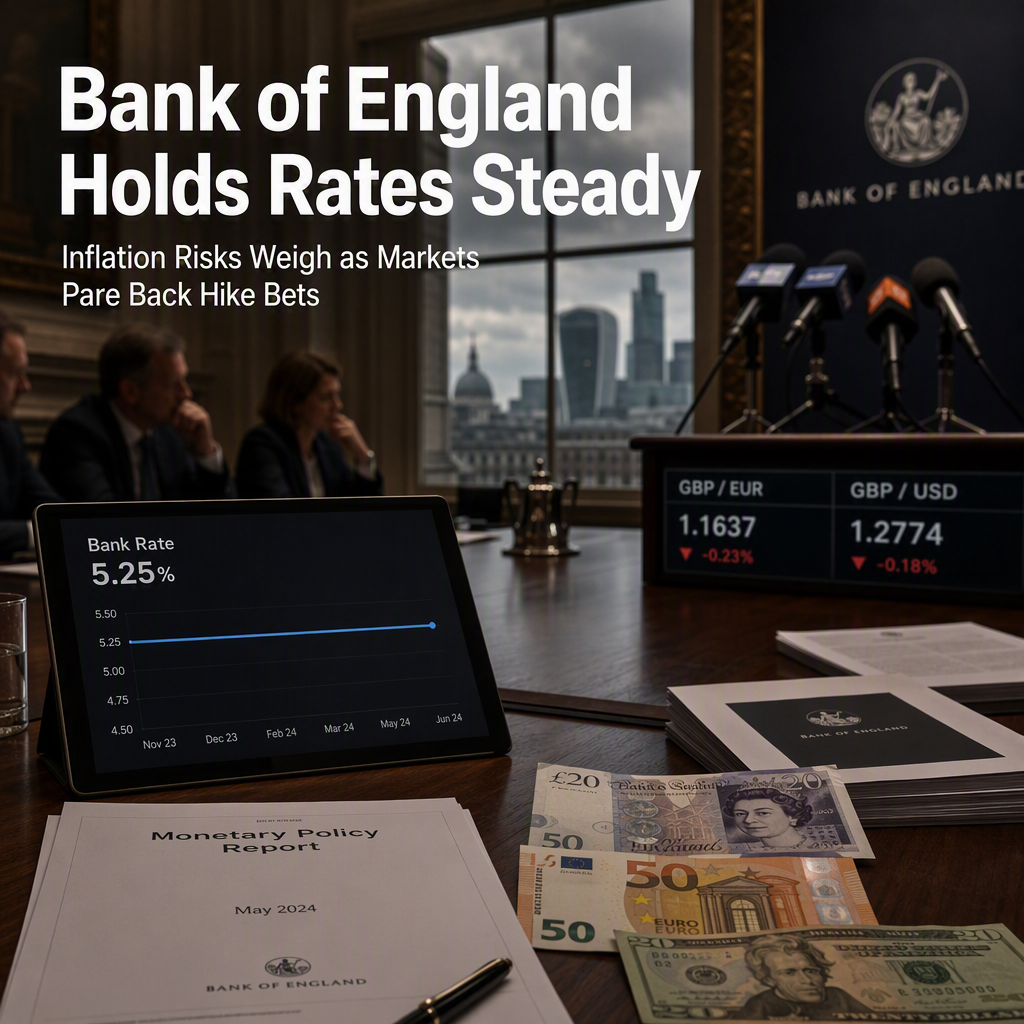
The British Pound (GBP) traded lower against both the Euro (EUR) and the US Dollar (USD) following the Bank of England's (BoE) latest monetary policy decision and the release of Eurozone inflation data on Friday, July 31, 2026 [1][2]. The BoE left interest rates unchanged, as widely expected, but the Monetary Policy Committee (MPC) was split, with three members dissenting in favor of a hike [1][3]. Governor Andrew Bailey emphasized that the Bank is not 'edging towards a hike,' stating, 'no one should leave this room thinking that the BoE is edging towards a hike,' and that a rate increase would only be considered if the Middle East conflict leads to second-round effects on inflation, particularly if oil prices rise above $100 [1][2][3].
Analysts at Deutsche Bank noted that market expectations for a September BoE rate hike dropped sharply, with the implied probability falling from 60% to 30% and 31 basis points of hikes priced by year-end, down 11.4 basis points on the day [2]. Commerzbank analysts highlighted that the BoE's communication was deliberately cautious, with some policymakers acknowledging that rate cuts could come into focus if the Middle East conflict ends [2]. MUFG's sentiment analysis found the MPC remains modestly hawkish overall, with members focused on inflation persistence and geopolitical risks, but the overall tone from Governor Bailey was more balanced, pushing back against imminent tightening [3].
On the data front, the Eurozone's preliminary Harmonised Index of Consumer Prices (HICP) accelerated to 2.9% year-on-year in July from 2.8% in June, matching market expectations. Monthly inflation rose 0.2%, reversing a 0.1% contraction in June. Core HICP increased to 2.5%, above the expected 2.4% [1]. French inflation accelerated to 2.4% in July, surpassing the 2.1% forecast, while the German unemployment rate rose to 6.4% in June from 6.3% in May [1].
The GBP/EUR pair hit session lows at 0.8554, with the Pound drawing some initial support from the BoE's hawkish dissenters but ultimately underperforming as markets reassessed the likelihood of further tightening [1][2]. Against the USD, the Pound recovered some early losses as the US Dollar Index (DXY) retreated amid uncertainty over the Federal Reserve's policy direction [2].
Analysts at TD Securities and MUFG both cautioned that, despite the hawkish split, the majority of the BoE committee appears comfortable keeping rates on hold, and the GBP rally should be faded versus the EUR and USD, as further paring back of rate hike expectations could weigh on the Pound [1][3].
CONCLUSION
The Bank of England's cautious communication and split vote led markets to scale back expectations for near-term rate hikes, pressuring the British Pound. While inflation risks remain a concern, policymakers signaled no imminent tightening, leaving the GBP supported but with limited upside. Market participants are now closely watching geopolitical developments and inflation trends for future policy cues.