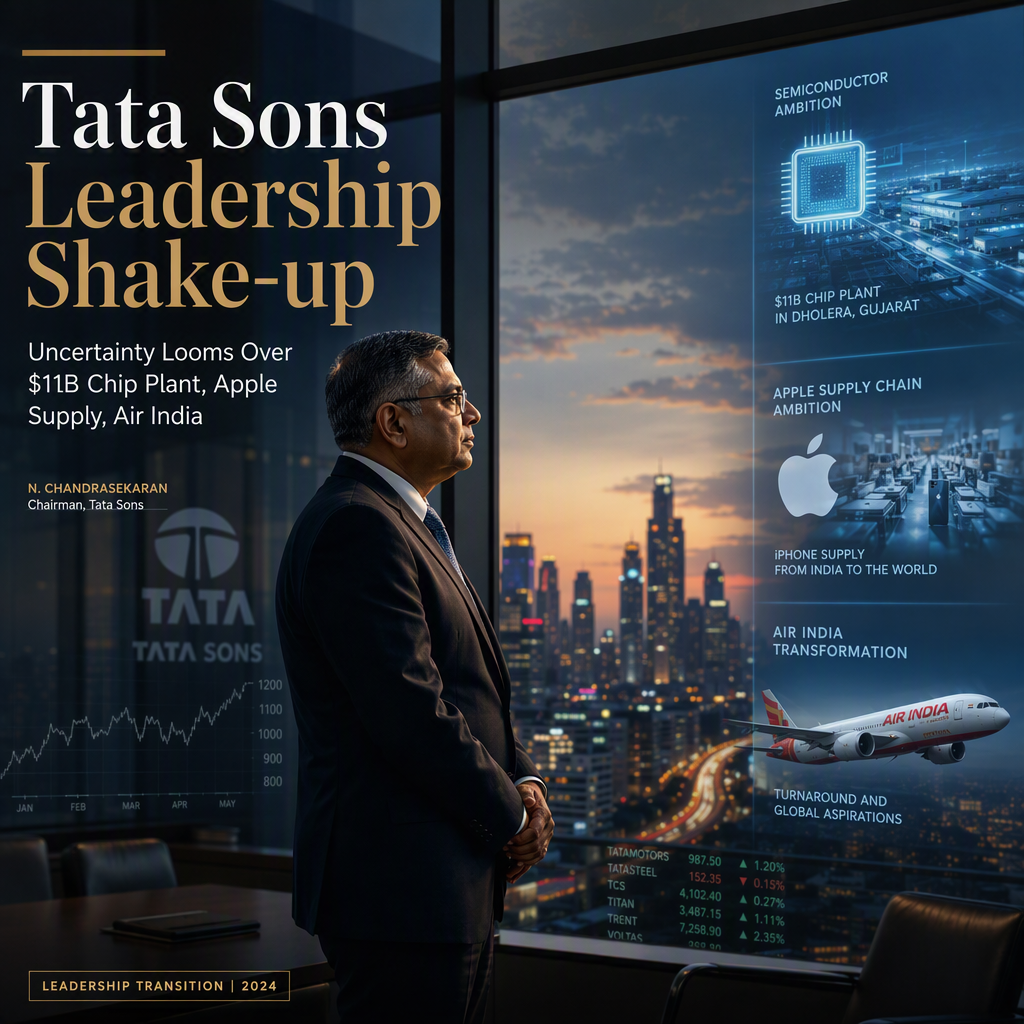
N. Chandrasekaran, the chairman of Tata Sons, has announced he will not seek reappointment, casting significant uncertainty over several of the conglomerate’s high-profile, capital-intensive projects, including India’s first $11 billion semiconductor plant, ambitions to become a major Apple supplier, and the turnaround of Air India [1]. Under Chandrasekaran’s leadership, Tata Sons made some of its largest capital commitments, which he described as foundational for India’s goal to become a developed country by 2047 [1].
The group’s recent initiatives include acquiring Air India in 2022, starting iPhone production after purchasing Wistron and Pegatron, and reportedly surpassing Foxconn’s India unit to become the country’s largest Apple supplier [1]. In 2024, Tata Sons unveiled plans for India’s first semiconductor plant in partnership with Taiwan’s Powerchip Semiconductor Manufacturing Corp., valued at $11 billion [1]. However, all these ventures are still in early investment cycles and are not yet profitable [1].
Chandrasekaran’s decision to pursue bold investments, despite losses and at a time when Tata Consultancy Services faces challenges from artificial intelligence, has led to tensions between Tata Sons and its key shareholder, Tata Trusts, according to experts cited in the article [1]. Ruchir Khare, chief investment officer at Two X Capital, noted that the chairman’s impending departure raises questions about the group’s commitment to large, long-term investments [1].
The process to find Chandrasekaran’s replacement has formally begun, following his expression of displeasure at delays in finalizing his reappointment for another five-year term [1]. The Sir Dorabji Tata Trust, which is part of the trusts holding a 66% stake in Tata Sons, stated it respects Chandrasekaran’s decision and supports a smooth leadership transition [1].
CONCLUSION
N. Chandrasekaran’s decision to step down as Tata Sons chairman introduces significant uncertainty for the group’s major, unprofitable investments in semiconductors, Apple supply, and Air India. The leadership transition and ongoing boardroom tensions could impact the conglomerate’s strategic direction and India’s industrial ambitions.