
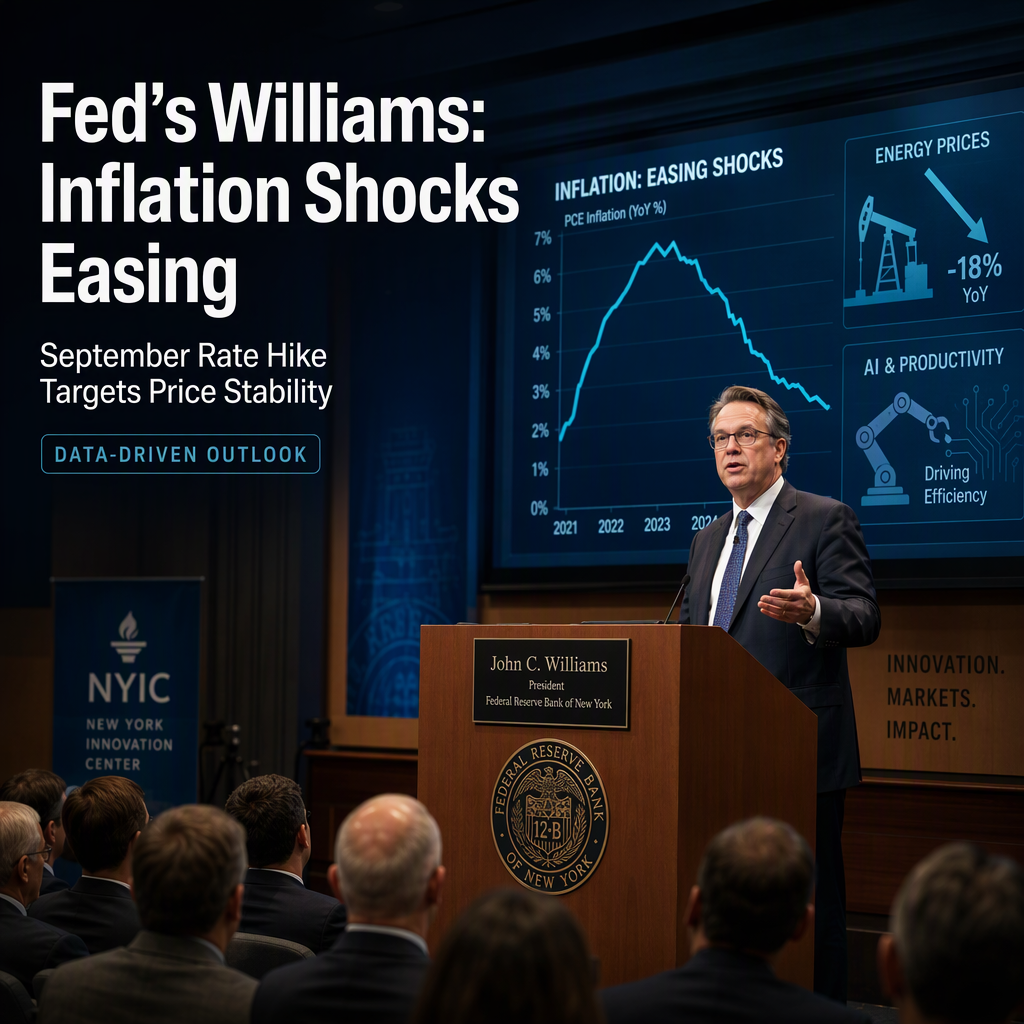
New York Federal Reserve President John Williams stated at the University of Buffalo that the worst inflation shocks have passed, suggesting that inflation should ease as the 'biggest shocks' have largely played out [1]. Williams emphasized that price stability is foundational for the economy and noted that the September rate hike was aimed at creating a swifter return to the Fed's 2% inflation target [1]. He also remarked that determining how restrictive monetary policy is remains challenging and reiterated his commitment to being 'data dependent' in policy decisions [1].
Williams highlighted that energy prices continue to play a significant role in the economy, but the United States is less exposed to energy price volatility compared to the past. He does not expect a further surge in energy prices, depending on the trajectory of ongoing conflicts [1]. Additionally, Williams discussed the impact of artificial intelligence (AI) on asset market valuations and productivity, stating that AI is driving up asset valuations and starting to bolster productivity gains, which could lead to a strong period of productivity and potentially lift the natural rate of interest [1].
He also addressed broader economic dynamics, mentioning the reality of a 'K-shaped economy' and stressing that the Fed should remain focused on data and avoid partisan politics [1]. No specific market reactions or analyst opinions were provided in the article [1].
CONCLUSION
Fed President Williams' remarks indicate optimism about easing inflation pressures and reinforce the Fed's commitment to data-driven policy. The September rate hike is positioned as a proactive step toward achieving price stability. While no immediate market reaction was discussed, Williams' focus on AI-driven productivity and energy price stability suggests a cautiously positive outlook for the US economy.