
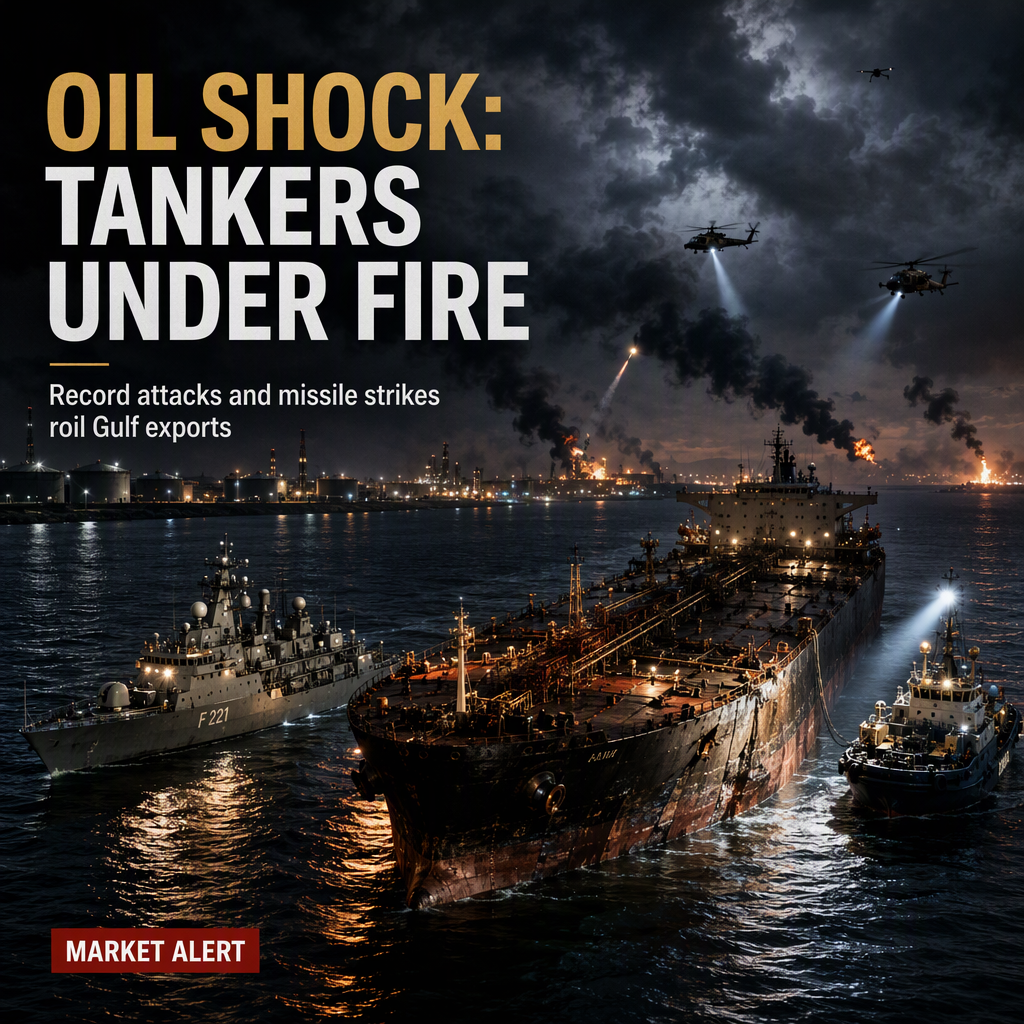
Crude oil prices climbed above $92.00, marking their largest one-day increase since September 10, as Gulf crude exports faced unprecedented disruptions due to record tanker attacks and escalating Houthi missile strikes [1]. According to tanker tracker Kpler, ten tankers were struck in the Strait of Hormuz between September 28 and October 4, surpassing the previous weekly high of six. Only seven tankers managed to cross the strait on Tuesday, which is less than half the seven-day average and the lowest since July 23 [1].
On Wednesday, a tanker was hit by multiple projectiles 51 nautical miles off Qatar's north coast, as reported by UK Maritime Trade Operations (UKMTO). Iran's Revolutionary Guard navy declared its readiness to respond decisively to unauthorized vessels in waters it claims to control [1]. Despite the turmoil, 60% of Gulf exports in September still traversed the strait, with most oil shuttled between tankers off Oman and the United Arab Emirates. The cost of hiring a tanker from the Gulf to China soared to a record $1.3 million per day on Monday, a premium now factored into every barrel shipped along this route [1].
The remaining 40% of Gulf exports were loaded outside the strait, primarily at Fujairah on the Gulf of Oman or Yanbu on Saudi Arabia's Red Sea coast, compared to just 17% before the conflict. Yanbu, supplied by a pipeline across Saudi Arabia, resumed loadings in late September after a pipeline attack on September 10. France announced it would send troops and air defenses to protect the port. Houthi drones and missiles struck Riyadh and Abha airports on Tuesday and Wednesday, resulting in three fatalities, and further ballistic missile attacks targeted Riyadh on Thursday. The Houthis have warned civilians to avoid Saudi energy facilities, labeling them as targets [1].
Since August, Yanbu's cargoes have been rerouted north to Egypt instead of passing south through Bab el-Mandeb, avoiding the strait contested by the Houthis. The Pentagon has instructed US Central Command to prepare for potential major combat operations against Iran, though no date has been set and President Trump has not made a final decision. US and Israeli officials indicated that strikes could occur before the November 3 midterms, likely targeting Iranian energy sites. However, Iran's exports have been nearly zero since the US reinstated its blockade in July, so any strikes would remove barrels already absent from the market [1].
Additionally, storm Isaias formed in the Gulf of Mexico on Wednesday and is forecast to impact the region, potentially adding further volatility to oil markets [1].
CONCLUSION
Crude oil markets are experiencing significant volatility due to record tanker attacks, Houthi missile strikes, and heightened geopolitical tensions in the Gulf. With shipping costs surging and supply routes disrupted, the market impact is high, and further instability is possible as military preparations and weather events unfold.