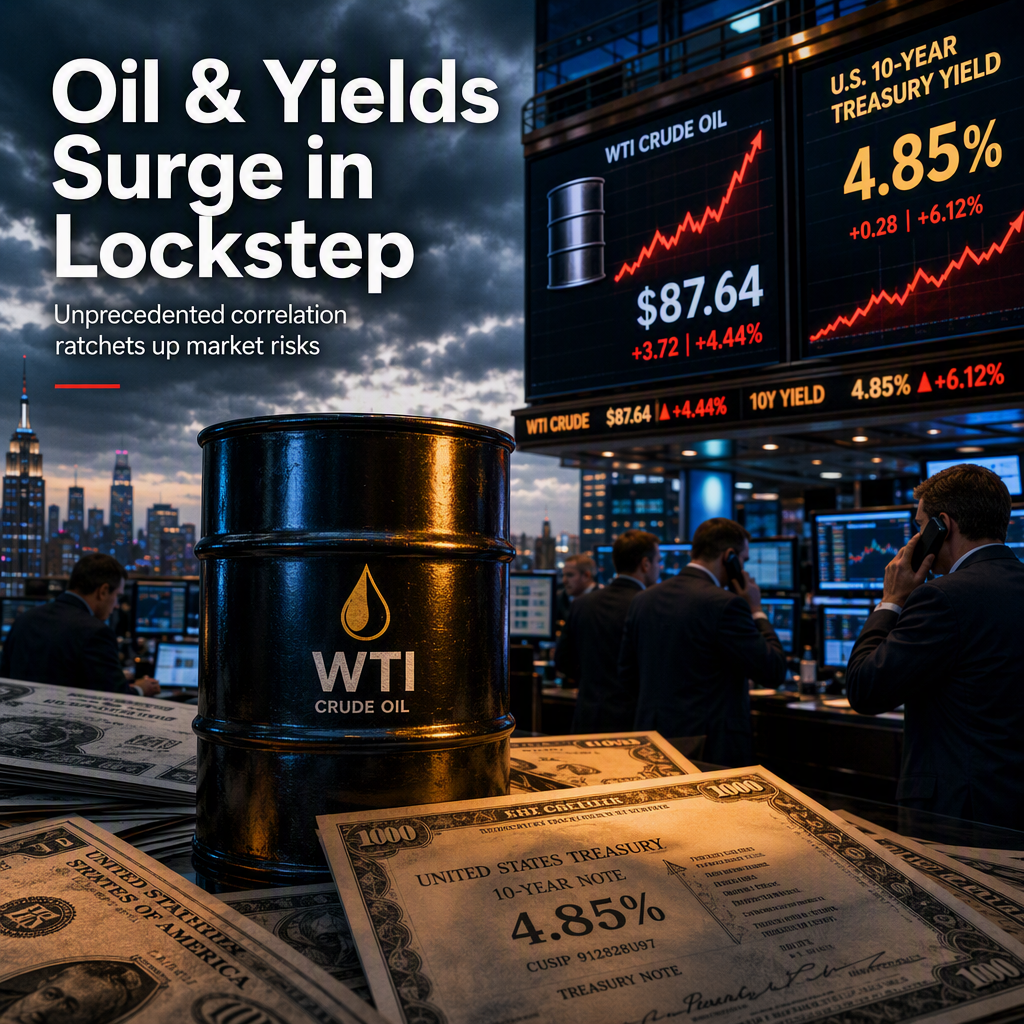
Oil prices and Treasury yields are exhibiting their strongest positive correlation in seven years, with the one-month rolling correlation between front-month West Texas Intermediate (WTI) crude and the 10-year Treasury yield reaching 0.96, according to BMO Capital Markets. This level of correlation was last seen in June 2019 and previously in October 2014 [1]. The synchronized movement is attributed to surging oil prices driven by conflict in the Middle East, which has pushed the benchmark 10-year Treasury yield briefly above 5% on Monday, marking the first time since October 2023 that yields have reached this level [1].
Industry experts warn that this tight relationship amplifies market pressures, as higher oil prices now transmit more directly into financial conditions. Billy Leung, investment strategist at Global X ETFs, explained that elevated crude prices can lift inflation expectations, delay Federal Reserve easing, and raise discount rates across equities and credit simultaneously. This reduces the diversification benefits investors typically expect between commodities and government bonds, making energy headlines more consequential for broader markets [1].
The impact spans multiple asset classes: higher Treasury yields diminish the appeal of equities by increasing financing costs for businesses, while expensive oil squeezes margins for companies reliant on energy and transportation. Growth and technology stocks are particularly exposed due to their reliance on future earnings, which are more sensitive to rising discount rates [1]. Ed Yardeni, president of Yardeni Research, noted that the chain reaction from energy prices through inflation and bonds into monetary policy and equities is "bad news" for markets. He suggested that continued increases in oil prices could lead to higher bond yields and inflation expectations, raising the likelihood of multiple Federal Reserve rate hikes, which would unsettle the stock market [1].
Komal Sri-Kumar, president of Sri-Kumar Global Strategies, is advising investors to avoid assets most vulnerable to higher rates, favoring short-duration fixed income and defensive equities, as well as physical assets like real estate, copper, and gold as hedges. He emphasized that technology growth stocks are more vulnerable as interest rates remain elevated and predicted a bond bear market with yields continuing to rise [1].
CONCLUSION
The unusually strong correlation between oil prices and Treasury yields is intensifying market risks, particularly for equities and growth stocks. Analysts warn that continued oil price increases could trigger further rate hikes and a bond bear market, prompting investors to seek defensive strategies and alternative assets. The market takeaway is clear: rising oil and yields are compounding pressures across asset classes, with significant implications for monetary policy and investor positioning.