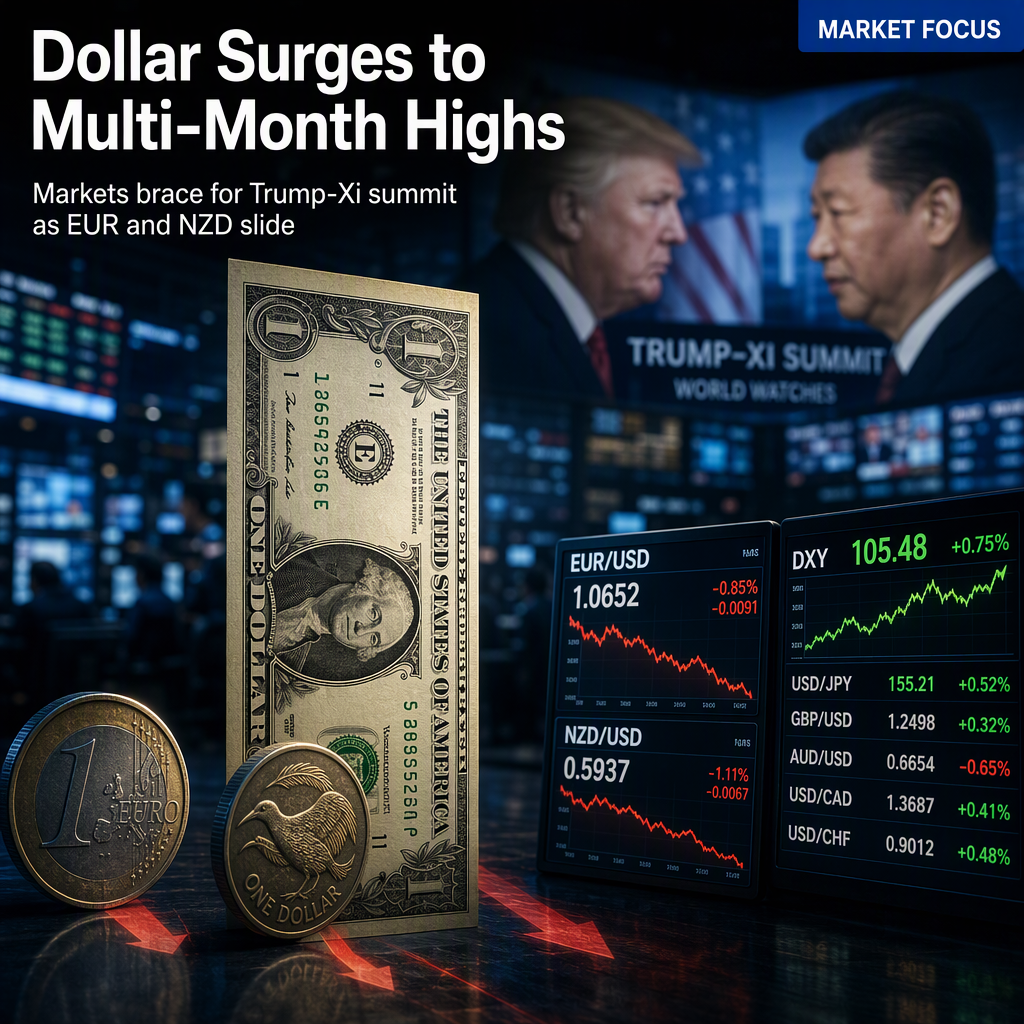
The US Dollar (USD) has shown notable strength against major currencies, with the EUR/USD pair trading around 1.1380-1.1375, marking its lowest level since July 28 and remaining nearly unchanged for the day as traders turn cautious ahead of the highly anticipated meeting between US President Donald Trump and Chinese President Xi Jinping [1]. Similarly, the NZD/USD pair is consolidating near 0.5675, just above its lowest point since early July, as investors await the outcome of the Trump-Xi summit, which is expected to influence sentiment for antipodean currencies [2]. The USD's rally is supported by rising US Federal Reserve rate hike expectations, with investors now seeing a 70% chance of another rate increase in October following a private survey showing US business activity accelerated for a fourth consecutive month. The S&P Global flash Composite PMI Output Index rose from 56.0 to 58.4 in September, the highest since July 2021 [2]. Additionally, an overnight rally in oil prices has reignited inflation fears, further underpinning prospects for Fed tightening [2].
Political instability in Germany is undermining the Euro, while the daily Relative Strength Index (RSI) for EUR/USD has fallen to 25.47, signaling oversold conditions but not yet a durable bottom. The MACD remains negative at -0.0025, indicating persistent bearish momentum. Technical analysis suggests that the one-year low at 1.1325 could offer support, with further downside risk toward the 61.8% Fibonacci expansion at 1.1244. Any recovery toward 1.1425 may be seen as an opportunity to reassess the broader downtrend [1]. For NZD/USD, the pair maintains a bearish bias after breaking below 0.5700, with vulnerability to extend losses toward prior lows near 0.5625. Immediate resistance is seen at 0.5700, and a short-covering rally could lift prices to 0.5765 [2].
The EUR/JPY cross is also trading in negative territory around 179.85, with intervention risks from Japanese authorities providing some support to the Yen. The Bank of Japan (BoJ) raised its policy rates by 25 basis points last week, but Governor Kazuo Ueda's remarks did not meet hawkish market expectations. Analysts believe the JPY could face selling pressure if markets remain unconvinced about further BoJ tightening [3]. Rabobank analysts highlight that US-Japan strategic ties are now reflected in financial markets, with the BoJ and Yen carry trade dynamics playing a role. Technical analysis shows EUR/JPY remains capped under the 100-day SMA, with resistance at 180.00 and support at the September 17 low of 178.48, followed by 177.45 and 175.91 [3].
Geopolitical uncertainties, including escalating tensions between the US and Iran after Trump's warning at the UNGA, continue to support the safe-haven USD and cap risk-sensitive currencies like NZD [2]. The USD was the strongest against the Australian Dollar this week, with percentage changes against major currencies provided in a table [2].
CONCLUSION
The US Dollar's strength is driven by rising Fed rate hike expectations, robust US business activity, and geopolitical uncertainties, leading to multi-month lows for EUR/USD and NZD/USD. Technical indicators across pairs suggest persistent bearish momentum, with limited prospects for immediate recovery. The Trump-Xi summit remains a key event for market direction, and ongoing geopolitical risks are likely to sustain demand for the USD in the near term.