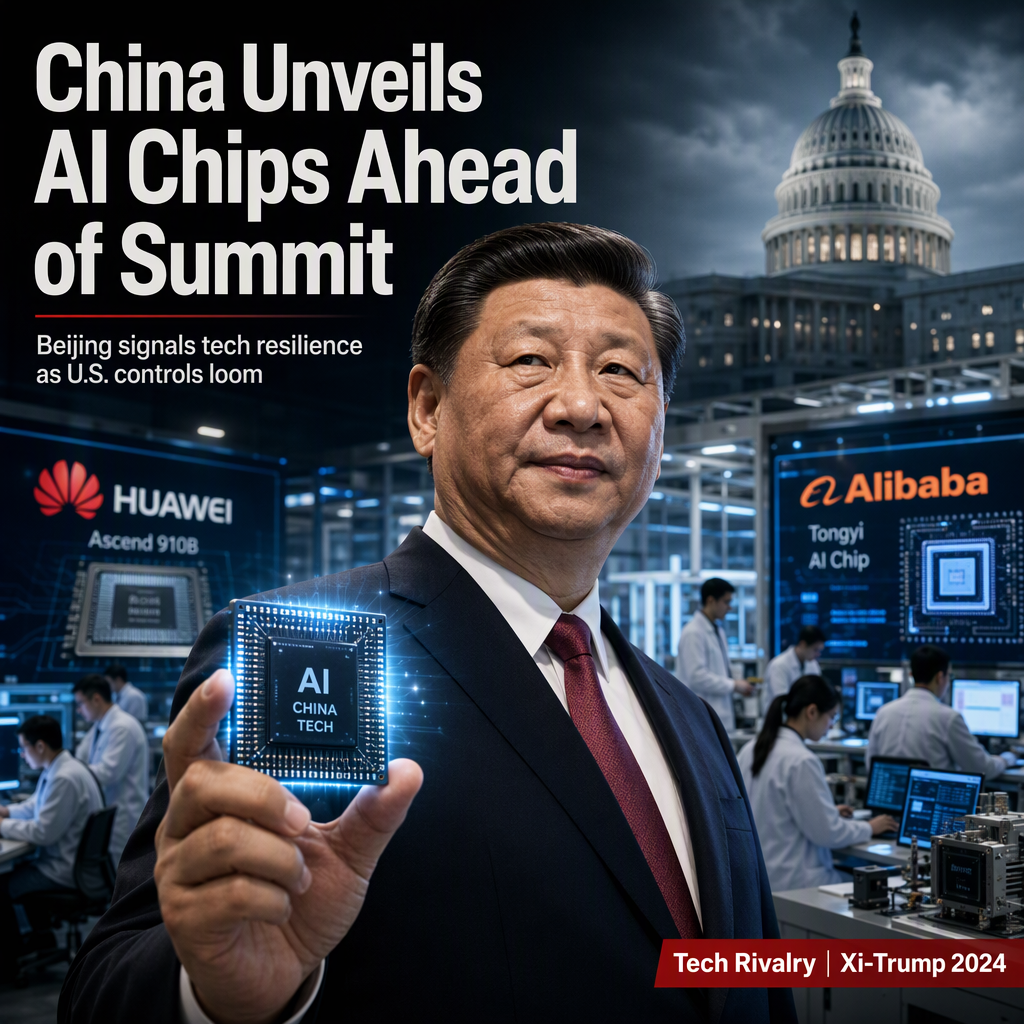
Chinese President Xi Jinping began his first U.S. state visit in over a decade with a surge of confidence, fueled by a series of new chip and AI model launches from national champions such as Huawei Technologies and Alibaba Group. These releases are seen as a strategic move to demonstrate that, despite ongoing U.S. export controls, Chinese firms are making significant progress in AI and semiconductor technology, potentially giving Beijing leverage in discussions with Washington [1].
Huawei accelerated the release of its next AI chip by three quarters, while Alibaba unveiled what it described as the country's most powerful AI processor. Additionally, DeepSeek, a Chinese startup, reportedly assembled the largest known cluster of Huawei chips to date, signaling rapid advancements in domestic AI infrastructure [1]. The timing of these flagship product launches, just days before the summit, has reignited debate over whether China's AI industry has reached a pivotal moment [1].
Experts cited in the article suggest that these moves are intended to show that U.S. technology restrictions can slow but not halt China's AI ambitions. Lizzi Lee of the Asia Society Policy Institute noted that Xi's message is not that China has caught up, but rather that the U.S. cannot simply 'choke off' Chinese technological progress [1]. George Chen of The Asia Group described Xi's confidence in China's innovation as being at a historic high, calling the timing of the launches a 'deliberate' show of strength ahead of the summit [1].
However, Chris Miller of Tufts University pointed out that while China often announces new projects around high-level meetings to signal progress, U.S. AI models remain ahead in technical benchmarks and profitability. American firms such as Anthropic and OpenAI are cited as maintaining a significant lead in the field [1].
CONCLUSION
China's recent AI chip and model launches, timed to coincide with President Xi's U.S. visit, underscore Beijing's determination to demonstrate resilience against U.S. export controls. While these moves highlight China's progress, experts note that American firms still lead in technical and commercial metrics. The developments set a high-stakes backdrop for the Xi-Trump summit, with technology competition at the forefront.