
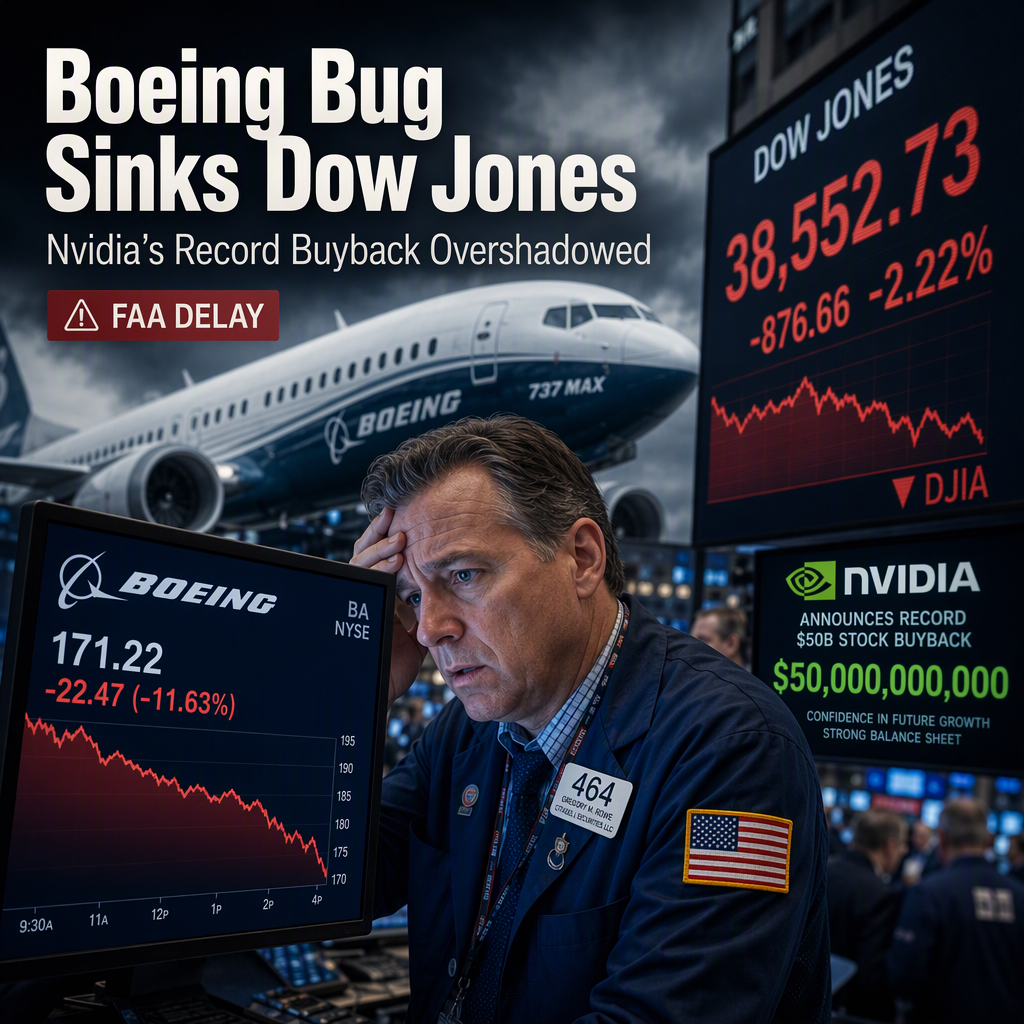
The Dow Jones Industrial Average (DJIA) closed just under 51,500 on Monday, giving back about two-thirds of Friday's rally, primarily due to a significant decline in Boeing (BA) shares following a newly identified software bug in the 737 Max 10 aircraft. The Federal Aviation Administration (FAA) announced it would not certify the 737 Max 10 until a new software issue is assessed, causing Boeing shares to close nearly 7% lower at their weakest level of 2026. Boeing had previously expected approval within weeks. FAA Administrator Bedford explained that while the Max 7 was certified in August with a software version that fixed one bug, it introduced another, leading US airlines to revert to older software for operational planes, with the delay impacting only new deliveries [1].
The DJIA's decline was exacerbated by Boeing's loss of more than $12 per share, which outweighed the positive impact of Nvidia's (NVDA) 1.7% gain following the announcement of a record $150 billion share buyback. At Monday's price, Nvidia's new buyback authorization is roughly equivalent to Boeing's entire market value. The Dow's price-weighted structure meant Boeing's drop had a greater effect on the index than Nvidia's gain, with the planemaker's slide outweighing the chipmaker's rise in index points by more than three to one. Other notable moves included Meta Platforms (META) falling 4.8% (not a Dow member), while Microsoft (MSFT) and Amazon (AMZN), both Dow constituents, slipped about 1%. The problematic software originated from GE Aerospace (GE), which is not a Dow member [1].
Treasury yields also climbed, with the 10-year yield rising above 5.2% and the 30-year reaching about 5.5%, near their highest levels since 2007 and 2004, respectively. The two-year yield increased by approximately 0.17 percentage points in the week to September 25. The Federal Reserve (Fed) raised its rate to 3.75%-4.00% on September 16, marking its first increase since 2023, and futures indicated a nearly 70% chance of another quarter-point hike on October 28. The DJIA has fallen in six of the nine sessions since the rate hike, as higher government bond yields compete with equities for investor capital [1].
Looking ahead, key economic data releases and Fed communications are expected to influence market direction. August job openings are forecast at 7.23 million, with the report due Tuesday, and the August Personal Consumption Expenditures Price Index (PCE), the Fed's preferred inflation measure, is scheduled for Wednesday. The core PCE reading is forecast at 0.3% month-over-month and 3.4% year-over-year, up from 3.3%. A core reading at or above forecast would likely maintain the current odds of an October rate hike [1].
CONCLUSION
Boeing's software setback significantly weighed on the Dow Jones, overshadowing Nvidia's record buyback announcement. Rising Treasury yields and upcoming economic data releases are set to further influence market sentiment and the Federal Reserve's next moves. Investors remain cautious as the index faces pressure from both sector-specific issues and broader macroeconomic factors.