
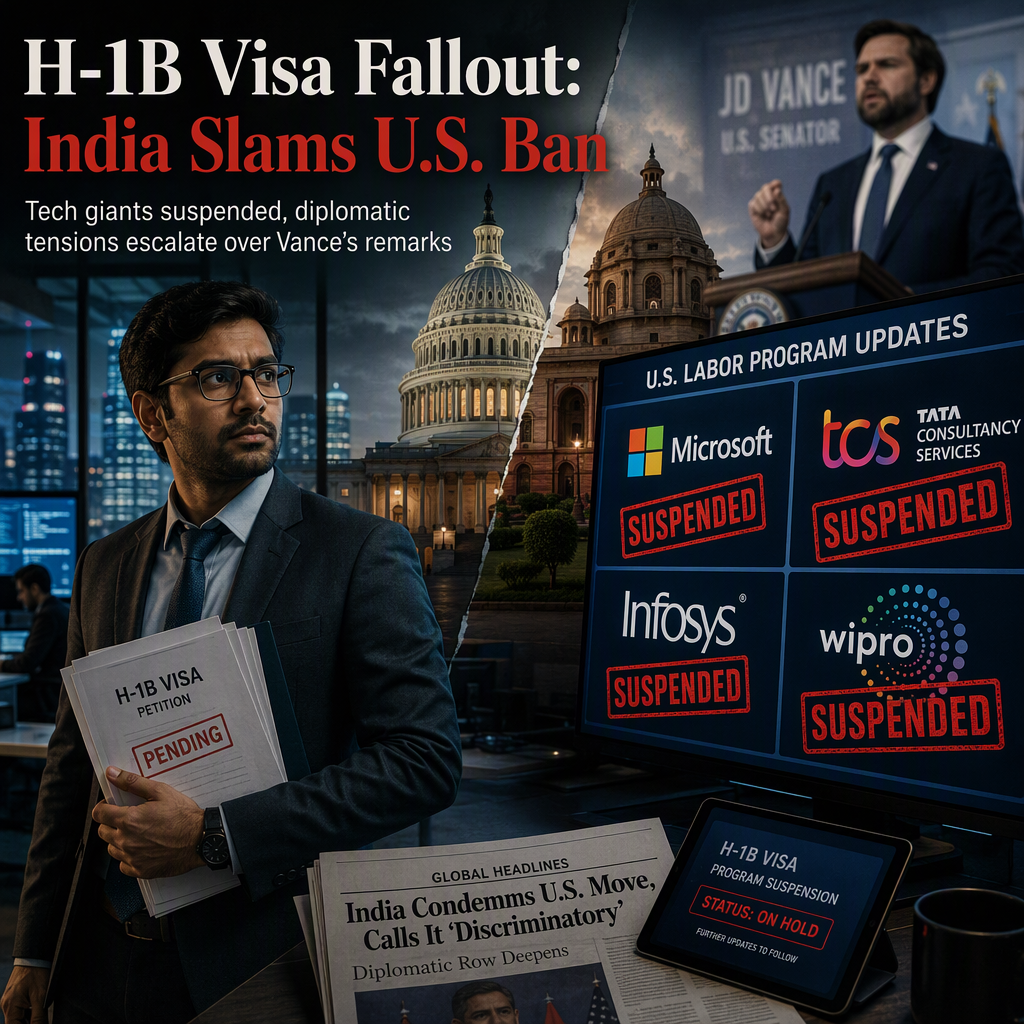
India has strongly criticized U.S. Vice President JD Vance's recent comments regarding the H-1B visa program, labeling his language as 'deeply offensive' and referencing 'terminology that carries painful historical and colonial legacy connotations' [1]. Vance had warned companies that they 'cannot lay off American workers and then replace them with foreign indentured servants,' a statement made as the U.S. Department of Labor announced the suspension of Microsoft, Adobe, and several major Indian IT firms from its Permanent Labor Certification program [1]. This suspension prevents these companies from applying for permanent residency for their employees on H-1B visas [1].
Official data cited in the article indicates that around 70% of H-1B visa beneficiaries in 2025 were born in India [1]. Vance specifically accused Microsoft of replacing 6,000 laid-off workers with H-1B visa holders [1]. The Indian Ministry of External Affairs responded by emphasizing that Indian professionals in the U.S. are 'highly educated and skilled contributors to its economy and innovation ecosystem,' and assured Indian citizens that the new measures would not affect the validity of existing H-1B visas or the status of current visa holders and their dependents [1].
The Indian companies affected by the U.S. ban include Cognizant, Infosys, Capgemini, Tata Consultancy Services (TCS), Wipro, and HCL [1]. NASSCOM, the Indian IT industry body, stated that Indian technology companies have 'significantly reduced their dependence on H-1B visas' in recent years and are increasing domestic hiring in the U.S. [1]. Tata Consultancy Services reported that its H-1B applications were in 'single digits' over the past two years and announced plans to hire an additional 15,000 people in the U.S. over the next five years [1].
The article also notes that in June, a federal judge blocked a $100,000 H-1B visa fee imposed by U.S. President Donald Trump the previous year [1].
CONCLUSION
The suspension of Microsoft and major Indian IT firms from the U.S. Permanent Labor Certification program, coupled with Vice President Vance's controversial remarks, has heightened diplomatic tensions between India and the U.S. While Indian authorities assure that current H-1B visa holders are unaffected, the move signals significant regulatory and reputational risks for the affected companies and could impact talent mobility between the two countries.