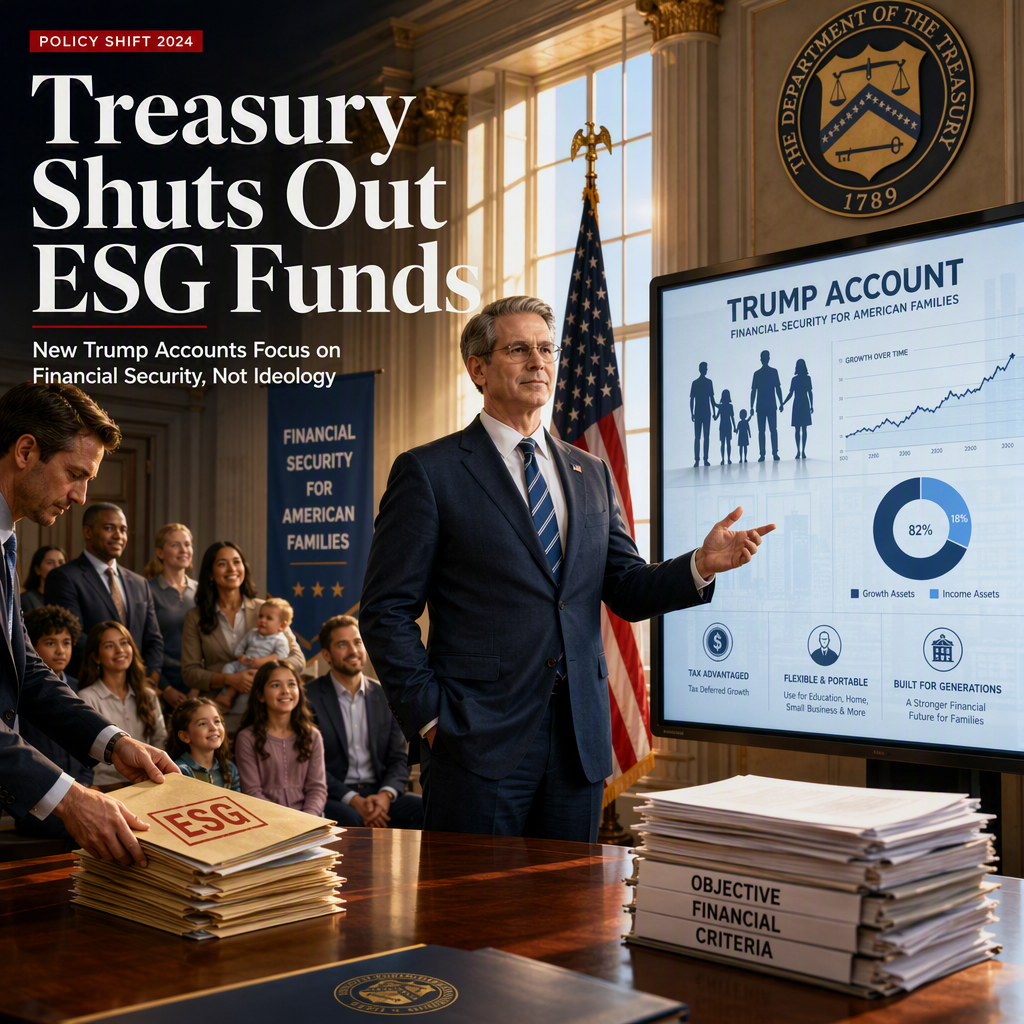
The Treasury Department has implemented new rules that bar investment funds based on environmental, social, and governance (ESG) criteria from being included in Trump Accounts, citing concerns over 'political activism' and a desire to focus on financial security for American children [1]. Treasury Secretary Scott Bessent stated, 'Corporate America has rejected ESG ideology, and we will not allow it to be a part of Trump Accounts,' emphasizing that the accounts are intended to build financial security rather than advance ideological agendas [1].
Under the proposed eligibility framework, only indexes designed primarily to measure the performance of a broad segment of the U.S. or global equity market using objective financial criteria will be allowed. The rule aims to provide families with clear, transparent investment choices focused on cost, diversification, and long-term financial performance, excluding funds that prioritize environmental, social, or governance policies over investor returns [1].
Since the official launch of Trump Accounts on July 4, more than 7 million families have signed up, with over 2 million eligible for a $1,000 federal seed fund for children born between 2025 and 2028 under the One Big Beautiful Bill Act [1]. The Treasury spokeswoman reported over $1.5 billion in investment contributions from individuals and pilot programs, not including philanthropic contributions such as the $6.25 billion from Michael and Susan Dell, which funded $250 initial seed deposits for children under age 10 [1].
The exclusion of ESG funds is part of a broader effort to ensure low fees and maximize investor returns, reflecting ongoing criticism of ESG strategies for prioritizing non-financial criteria [1].
CONCLUSION
The Treasury Department's decision to exclude ESG funds from Trump Accounts marks a significant policy shift, focusing on objective financial criteria and cost efficiency. With strong enrollment numbers and substantial contributions, the move is positioned as a step toward enhancing long-term financial security for American families while steering clear of politically charged investment strategies.