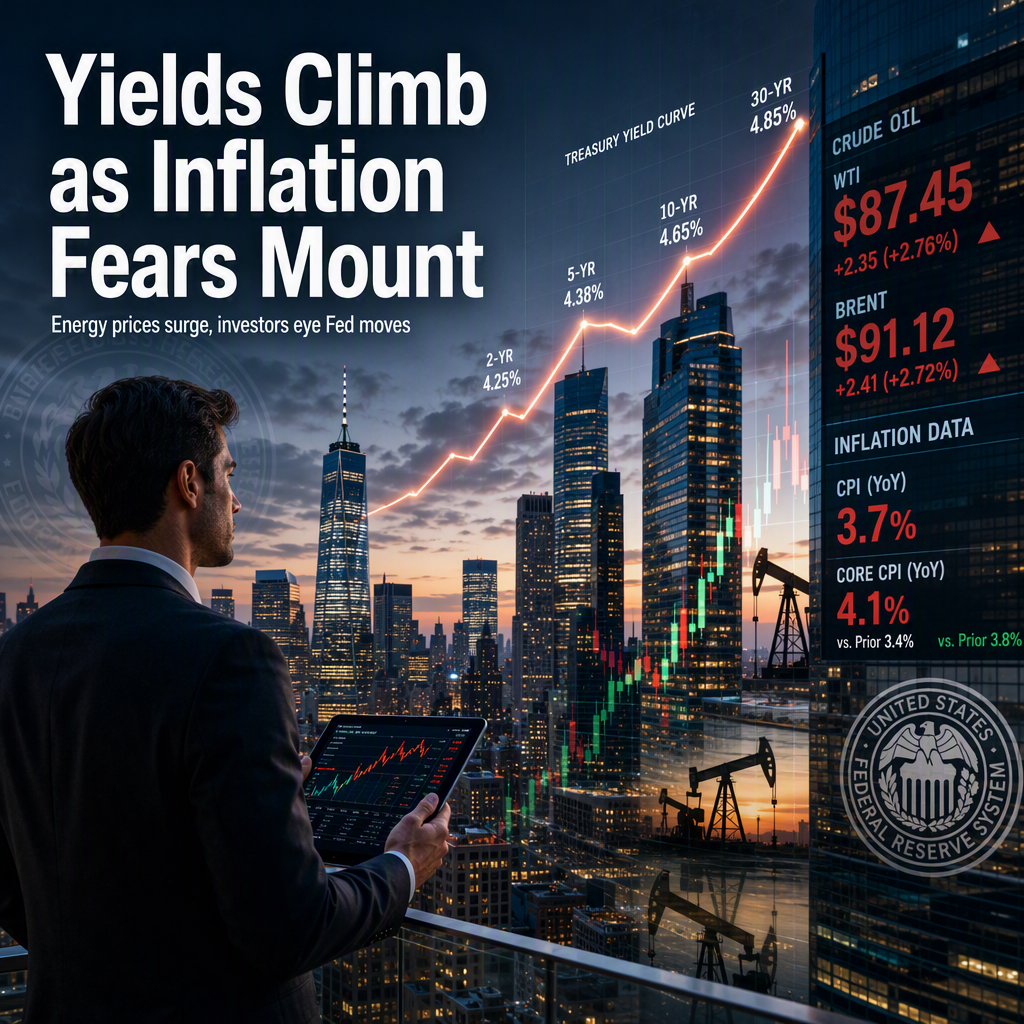
U.S. Treasury yields moved higher as investors prepared for a series of key economic data releases this week, with a particular focus on wholesale inflation data and the impact of rising energy costs on markets [1]. The benchmark 10-year Treasury note yield increased by more than 2 basis points to 4.8063%, while the 30-year bond yield also rose 2 basis points to 5.2708% [1]. In contrast, the yield on the 2-year Treasury note, which is closely tied to short-term Federal Reserve rate decisions, remained flat at 4.3810% [1].
The increase in borrowing costs comes as markets reopened after the extended Labor Day holiday weekend, with investors anticipating the monthly U.S. producer price inflation (PPI) report for August, scheduled for release on Thursday [1]. The PPI is forecast to rise by 0.4% for August, following an unchanged reading in July, highlighting ongoing concerns about underlying inflation pressures [1].
Market sentiment was further influenced by the recent release of August's nonfarm payrolls data, which showed the U.S. economy adding 162,000 jobs—significantly above consensus forecasts of about 53,000 [1]. This robust jobs report has sharpened investor focus on the Federal Reserve's upcoming interest rate decisions, with the next Federal Open Market Committee meeting set for September 15-16 [1].
Energy prices also contributed to inflation concerns, as Brent crude futures approached $100 a barrel and West Texas Intermediate futures rose more than 3% to $94.20 a barrel in early trade [1]. Brent crude advanced 1.76% to $98.71, driven in part by ongoing geopolitical tensions in the Middle East, including strikes by Iran-backed, Yemen-based Houthi militants that led Saudi Arabia to halt operations at certain energy facilities [1].
CONCLUSION
Treasury yields climbed as investors braced for upcoming inflation data and reacted to surging energy prices and strong labor market figures. The combination of robust job growth and rising oil prices has heightened market uncertainty around the Federal Reserve's next moves, signaling potential volatility ahead.