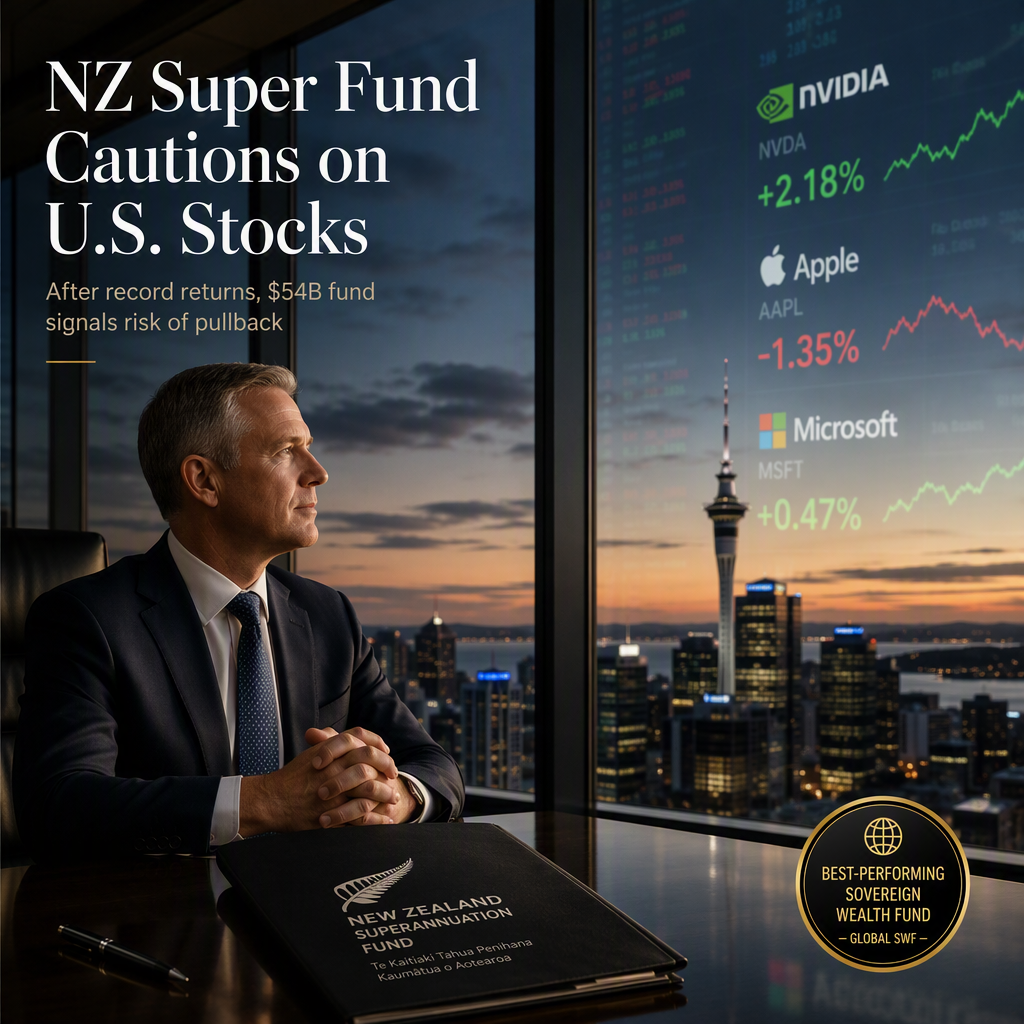
The CEO of the Guardians of New Zealand Superannuation, Jo Townsend, issued a warning on Wednesday about a possible slowdown in the U.S. stock market, following a period of exceptional returns for the New Zealand Superannuation Fund. The fund, valued at NZ$94.4 billion ($54.4 billion) at the end of the 2026 financial year, posted a 14.2% return in the year to June 30, representing annual growth of NZ$9.3 billion. Despite this strong performance, the return was 0.1 percentage points below its benchmark index [1].
Earlier this year, the fund was ranked as the world's best-performing sovereign wealth fund by analytics firm Global SWF [1]. Townsend highlighted that recent U.S. equity returns have been nearly double the annualized returns seen over the past 20 years, suggesting that a reversion to the mean is likely. She stated, 'Returns for U.S. equities over the past couple of years are close to double annualized returns for the past 20 years, so we would expect there to be some reversion to the mean at some point,' indicating a cautious outlook for future U.S. stock market performance [1].
The fund's diversified strategy has contributed to its growth, with its most valuable positions at the end of December including a NZ$3 billion stake in Nvidia, and significant holdings in Apple, Microsoft, Alphabet, and Amazon. The total U.S. equity portfolio was worth NZ$31.7 billion at the end of last year [1]. The fund has delivered an annual average return of 9.68% over the past two decades [1].
Reflecting its cautious outlook, the Guardians lowered the fund's long-term expected annual return from 7.8% to 7.2% earlier this year, and reduced its active risk budget. Townsend emphasized the importance of diversification, stating that while concentrated portfolios can achieve strong short-term results, a diversified approach is better suited for long-term mandates [1].
CONCLUSION
The New Zealand Superannuation Fund's management is signaling caution regarding future U.S. equity returns, despite recent strong performance and significant holdings in major tech companies. The fund's decision to lower its long-term return expectations and risk budget underscores a belief that market returns may moderate going forward. Investors may interpret this as a sign to temper expectations for U.S. stock market gains in the near future.