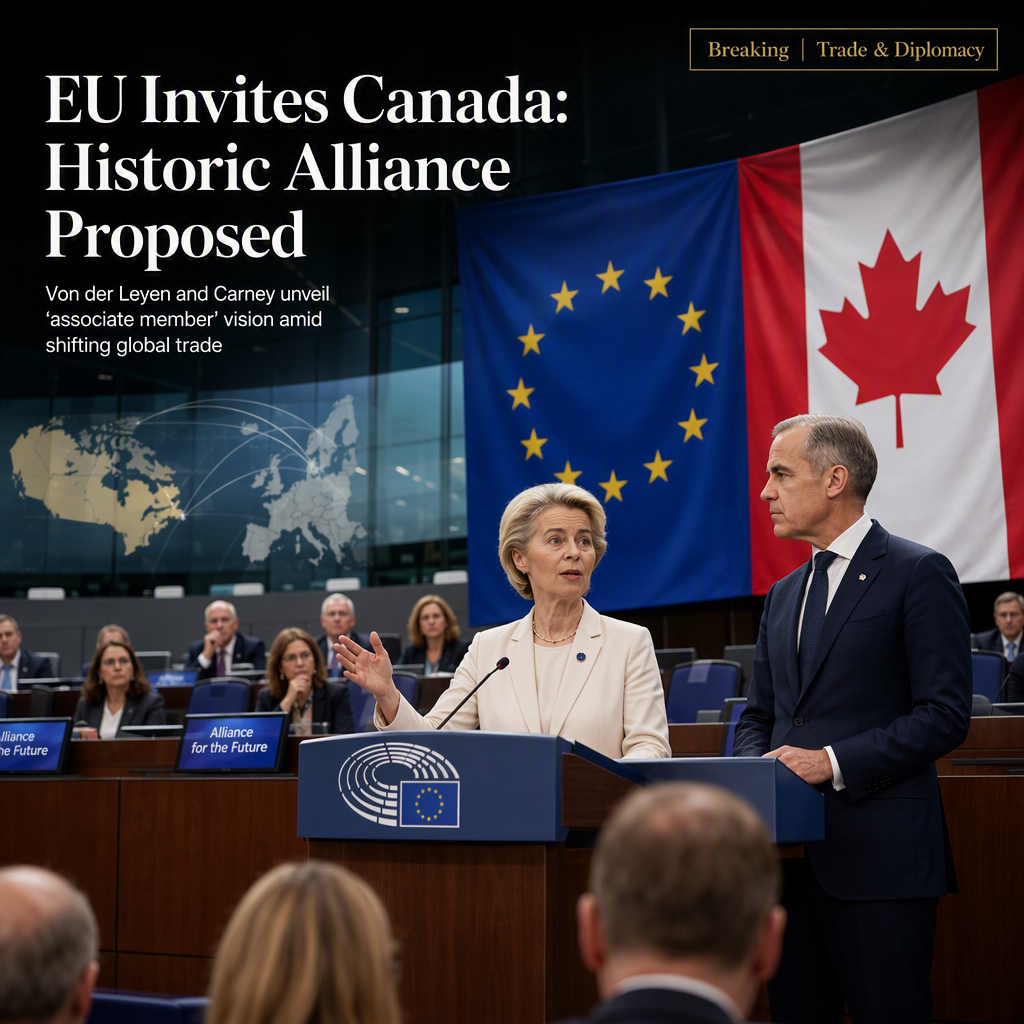
European Commission President Ursula von der Leyen proposed on Wednesday that Canada become the European Union's first 'associate member,' marking a significant step toward closer economic, technological, and security cooperation between Canada and the EU [1]. The announcement was made during von der Leyen's annual State of the European Union address in Strasbourg, with Canadian Prime Minister Mark Carney present in the chamber. Von der Leyen called for a major expansion of collaboration, moving beyond the existing CETA trade agreement toward an 'Alliance for the Future,' which aims to create a shared prosperity and economic security space [1].
The proposed partnership would deepen cooperation in advanced manufacturing, defense production, energy, critical minerals, artificial intelligence, quantum technology, cybersecurity, and the Arctic [1]. Von der Leyen emphasized the shared values between Europe and Canada, including positions on Ukraine, defense, supply chains, climate change, and democracy, stating, 'This is a partnership not against anyone else, but for our common strength' [1].
The timing of the proposal coincides with Canada's efforts to diversify its trade away from heavy reliance on the United States. Carney has pledged to double Canada's non-U.S. trade over the next decade, following a breakdown in Canada-U.S. trade talks last month that led to tit-for-tat tariff measures [1]. Carney, scheduled to address the European Parliament on Thursday, clarified that Canada seeks a 'unique alliance' with the EU, not full membership, and that more detailed discussions are expected at the Canada-EU summit in Montreal in late October [1].
Despite the enthusiasm, the proposal faces significant legal and political hurdles. The EU has historically resisted flexible alliances without a defined legal status, and one EU diplomat expressed surprise at von der Leyen's announcement, warning that the proposal was 'too vague' and that the Commission president was 'overpromising and won't be able to deliver' [1]. Additionally, deeper economic integration could be complicated by longstanding trade obstacles, such as Canada's protection of its telecommunications and dairy sectors, which have frustrated EU officials in the past [1]. Ultimately, the decision rests with EU member states [1].
CONCLUSION
The EU's proposal to grant Canada 'associate member' status represents a potentially transformative shift in international trade relations, especially as Canada seeks alternatives to U.S. trade. While the announcement was met with optimism, significant legal, political, and sectoral challenges remain. The market is likely to watch closely for developments at the upcoming Canada-EU summit in Montreal, as the outcome could reshape economic ties between the two regions.