
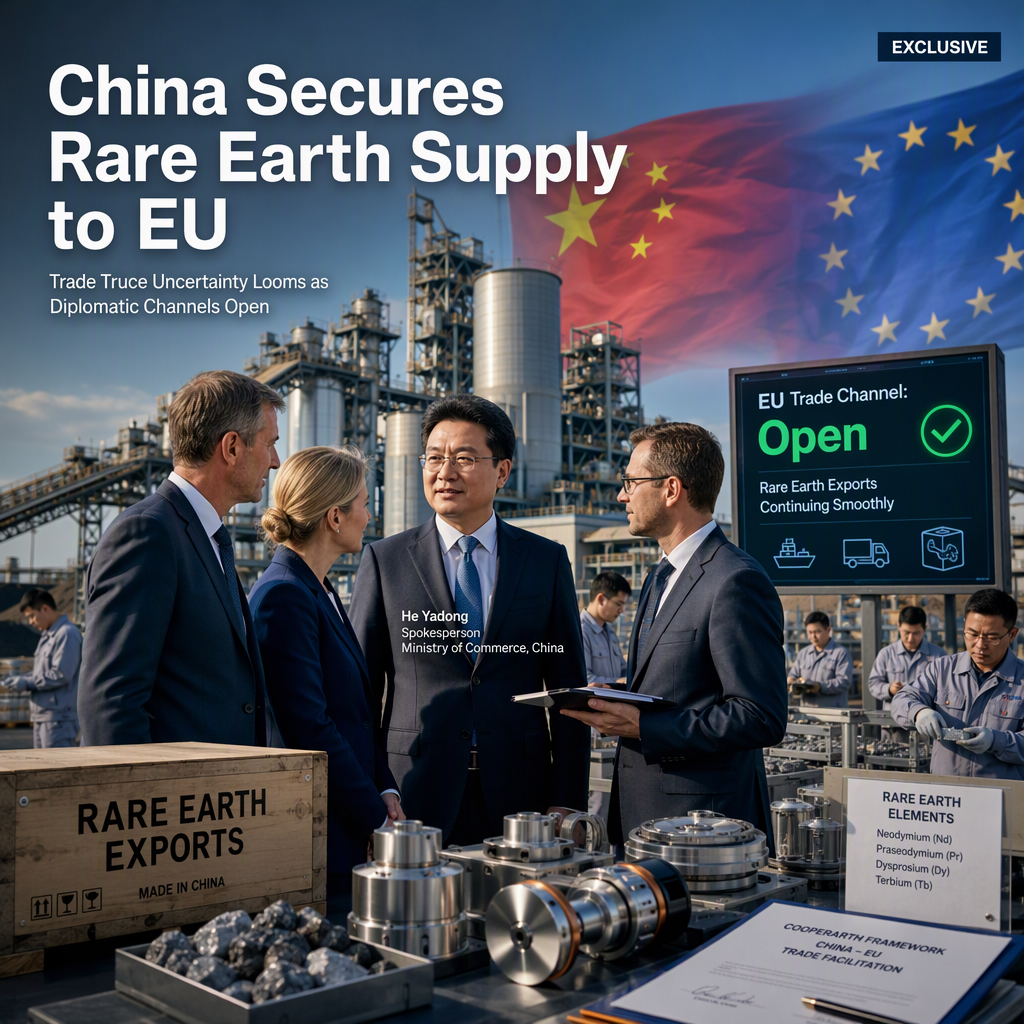
China has announced its intention to maintain rare earth exports to Europe, regardless of the outcome of the U.S.-China trade deal set to expire in January. Chinese Commerce Ministry Spokesperson He Yadong confirmed that China will continue approving rare earth licenses for Europe, responding to concerns about the potential impact of the trade truce deadline between the U.S. and China [1].
In October of the previous year, Beijing imposed stricter controls on rare earth exports, including products containing as little as 0.1% China-sourced rare earths. This action followed the U.S. expanding its blacklist to include majority-owned subsidiaries of Chinese companies, potentially affecting around 20,000 Chinese entities [1]. However, after a meeting between Chinese President Xi Jinping and U.S. President Donald Trump in late October 2025, both countries agreed to suspend these measures for one year. The trade truce was further extended by two months prior to the latest summit, with the new expiration set for January, as announced by U.S. Treasury Secretary Scott Bessent [1].
Trade tensions between the European Union (EU) and China have recently eased. European trade commissioner Maroš Sefčovič met with Chinese Commerce Minister Wang Wentao in Beijing last week, where China expressed willingness to use a 'green channel' mechanism to ensure the continued flow of rare earths to Europe. China also requested the EU's support for its imports of certain products in dual-use sectors [1]. European Commission leaders are scheduled to meet in Brussels on Thursday and Friday to review the details of ongoing trade negotiations with China [1].
No specific market reactions or analyst opinions were mentioned in the article. The focus remains on diplomatic efforts and regulatory assurances to maintain rare earth supply chains between China and the EU [1].
CONCLUSION
China's commitment to sustaining rare earth exports to Europe, despite U.S. trade deal uncertainties, signals a stabilizing influence on EU supply chains. Recent diplomatic engagements have eased tensions, with both sides exploring mechanisms to facilitate trade. The market takeaway is cautiously positive, pending further developments from upcoming EU-China negotiations.