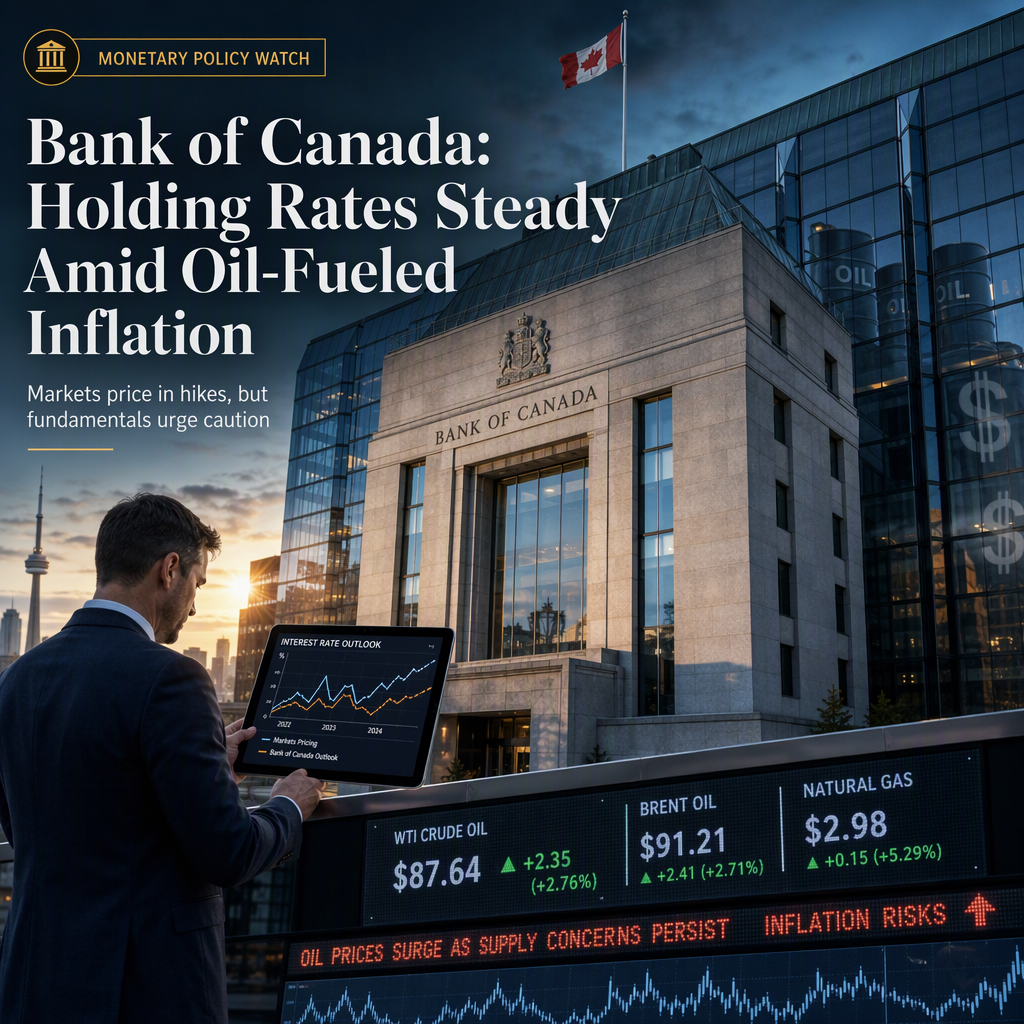
According to Ethan Currie of National Bank of Canada, while the recent increase in oil prices has heightened inflation risks, the Bank of Canada (BoC) is likely to keep interest rates unchanged in October due to ongoing domestic economic slack and trade uncertainty [1]. Currie notes that although market expectations for policy tightening have been brought forward, with Overnight Index Swaps (OIS) pricing in approximately four BoC rate hikes by June 2026, this path may be overstated relative to the underlying economic fundamentals [1].
Policymakers remain focused on preventing second-round effects on inflation, but the timing and pace of rate hikes will depend on how growth and inflation risks evolve [1]. Currie highlights that, despite market volatility and a lingering tightening bias across advanced economies, slack and trade uncertainty in Canada have pushed expected hikes further out, except for a brief reversal following Governor Macklem’s hawkish September press conference [1].
The article also mentions that around 300 basis points of tightening from the Federal Reserve, Bank of Canada, European Central Bank, and Bank of England are expected over the next nine months, though this may be slightly overextended for the Fed and BoC, according to Currie [1]. For central banks yet to deliver a hike, the messaging remains clear: inflation risks are paramount, and markets have appropriately priced in eventual action [1].
CONCLUSION
The Bank of Canada is expected to remain on hold in the near term, despite increased inflation risks from higher oil prices. Market pricing suggests several rate hikes by mid-2026, but analysts caution that these expectations may be ahead of economic fundamentals. The central bank's future actions will depend on how growth and inflation risks develop.