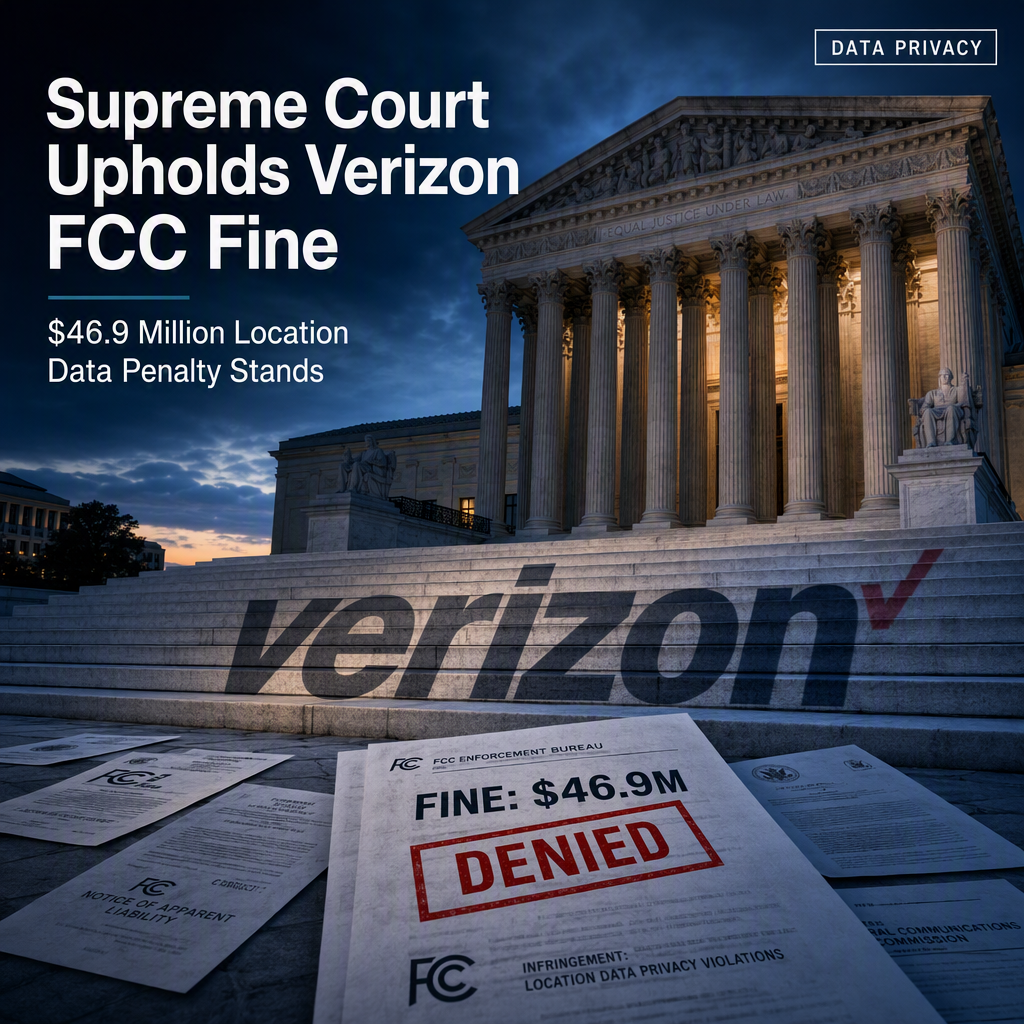
The Supreme Court has rejected Verizon's request for a rehearing regarding a $46.9 million penalty imposed by the Federal Communications Commission (FCC) over the company's former customer location data program [1]. The justices denied Verizon's petition without explanation, thereby upholding the court's earlier judgment against the telecom giant, as reflected in the August 17 order list [1]. This decision effectively ends Verizon's efforts to alter the outcome of a June Supreme Court ruling, which had previously upheld the FCC's forfeiture process against a Seventh Amendment challenge [1].
The FCC levied the nearly $47 million fine in 2024 after determining that Verizon failed to adequately protect customer location information made available through a program involving third-party location service providers [1]. Verizon paid the penalty under protest and challenged the FCC's order in federal court, but the Second Circuit rejected the company's arguments, including its claim that the device-location information was not covered by Section 222 of the Communications Act [1].
Verizon's rehearing petition centered on the argument that the FCC's forfeiture order appeared to require immediate payment within 30 days, while the government later asserted that carriers could decline to pay and await enforcement action instead [1]. The Supreme Court's June opinion did not address whether Verizon had been misled into paying or whether a refund was appropriate, stating that it expressed no view on the merits of that argument or what relief might be available [1]. Verizon subsequently asked the Supreme Court to remand the case to the Second Circuit for further consideration, but this request was denied, leaving the lower court's judgment affirmed [1].
The broader legal dispute over the FCC's authority in such cases remains ongoing. T-Mobile and Sprint have filed their own petitions with the Supreme Court, challenging location data penalties and questioning whether the information at issue falls under the Communications Act's definition of protected customer proprietary network information. Their petition was filed on June 22 and is still pending [1].
CONCLUSION
The Supreme Court's decision to deny Verizon's rehearing request solidifies the $46.9 million FCC penalty and affirms the lower court's ruling. While this closes Verizon's specific case, broader challenges to the FCC's authority by other telecom companies, including T-Mobile and Sprint, remain unresolved. The outcome signals ongoing regulatory scrutiny and legal uncertainty for the industry regarding customer data protections.