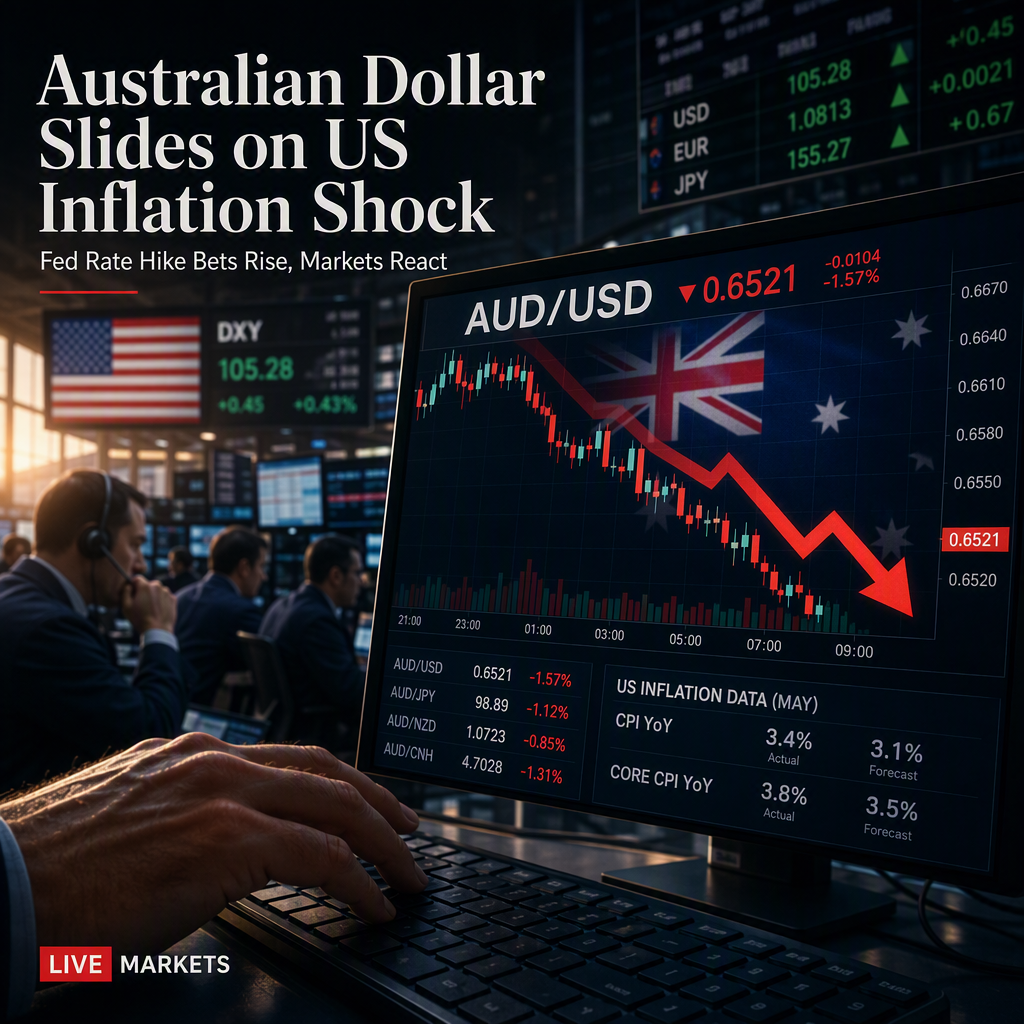
The Australian Dollar (AUD) declined against the US Dollar (USD), with the AUD/USD pair edging lower to around 0.7160 during the early Asian session on Monday, following stronger-than-expected US inflation reports that bolstered the USD [1]. The US Consumer Price Index (CPI) rose 0.4% month-on-month in August, resulting in a 12-month increase of 3.4%, both figures matching the Dow Jones consensus [1]. The core CPI, which excludes food and energy, increased by 0.3% monthly—above the market consensus of 0.2%—and 2.4% annually, slightly down from 2.5% in July [1]. These CPI readings came after robust Producer Price Index (PPI) data released Thursday, intensifying speculation about a potential Federal Reserve (Fed) interest rate hike at its upcoming meeting and supporting the Greenback [1].
Financial markets responded by raising the probability of a quarter-point Fed rate hike at the September meeting to 86.2%, up from 72% before the CPI release, according to CME's FedWatch tool [1]. Despite the AUD's decline, a hawkish stance from the Reserve Bank of Australia (RBA) could help limit losses. RBA Assistant Governor Sarah Hunter stated that the central bank may need to raise interest rates again if inflation proves more persistent than expected, keeping the possibility of another hike at its September meeting alive [1].
Strategists at UOB Group flagged growing downside risks for AUD/USD, noting that after reaching a high of 0.7238 two days ago, the pair plunged and closed 0.83% lower at 0.7157 yesterday [1]. UOB highlighted that the rapid increase in downward momentum suggests the AUD could decline toward 0.7120, marking a shift to a more bearish near-term bias. However, they cautioned that a break above 0.7210 would indicate continued range trading within 0.7160–0.7240 over the next one to three weeks [1].
Technical analysis shows AUD/USD holding above the 100-day moving average and the lower Bollinger Band, suggesting a constructive near-term tone. The Relative Strength Index (14) at 54 leans slightly positive, indicating buyers retain control but without overstretched momentum [1]. Immediate resistance is seen at the middle Bollinger band [1].
CONCLUSION
Stronger-than-expected US inflation data has pressured the Australian Dollar, increasing expectations for a Fed rate hike and boosting the USD. While downside risks for AUD/USD are growing, a hawkish RBA stance and technical support levels may help limit losses. Market participants are closely watching upcoming central bank decisions for further direction.