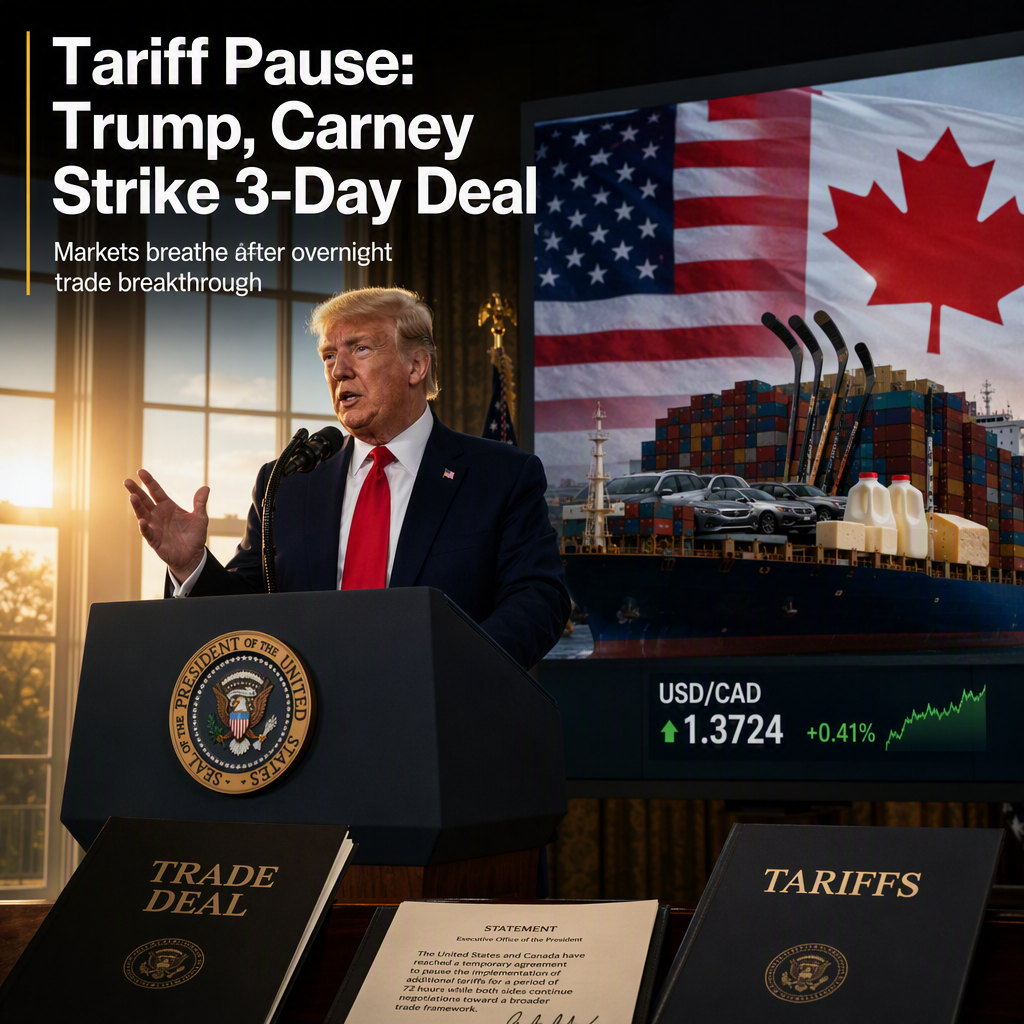
President Donald Trump announced a temporary pause on 50% tariffs against Canadian imports following overnight negotiations with Canadian Prime Minister Mark Carney, stating that the pause will last for three days pending the finalization of a deal between the two countries [1][2][3]. The tariffs, scheduled to take effect under Section 338 of the Tariff Act of 1930, would have impacted approximately $20 billion worth of Canadian goods, including liquor, dairy products, vehicles, hockey equipment, building materials, wearables, synthetic materials, and industrial goods [2][3]. Trump made the announcement on social media, emphasizing that the deal is subject to final documentation and referencing the potential revival of the Keystone XL pipeline, which he said "may be awoken from the grave" [1][2][3].
The pause was announced just hours before the tariffs were set to be imposed, following more than a week of intense meetings and technical talks between U.S. and Canadian officials [3]. Prime Minister Mark Carney described the negotiations as "very delicate and intense" but did not provide further details, and his office did not immediately respond to requests for comment about the deal [3]. Trump and Carney reportedly spoke multiple times in the days leading up to the announcement [2][3].
The threatened duties were described by Carney as a "direct violation" of the U.S.-Canada-Mexico Agreement, which Trump had previously pursued and signed during his first term [3]. The U.S. Chamber of Commerce warned that the introduction of higher tariffs would damage both economies, increase costs for U.S. families, disrupt supply chains, and risk 13 million American jobs dependent on the North American trade pact [3]. The Chamber also stated that lower duties on Canada would benefit U.S. consumers, producers, farmers, and manufacturers [3].
Canadian officials sought not only to have the Section 338 tariffs scrapped but also to lower Section 232 tariffs on industrial products such as steel and aluminum [3]. A sticking point in negotiations was the request for lower automobile duties, with U.S. officials reportedly unwilling to reduce current 25% tariffs below 15% [3]. Trump did not specify whether the duties would be lowered in his announcement [3].
Following the announcement, the Canadian Dollar (CAD) recovered ground against the U.S. Dollar (USD), with the USD/CAD pair down 0.15% on the day at 1.3875 [1].
CONCLUSION
Trump's decision to pause the 50% tariffs on Canadian imports has provided temporary relief to markets and the Canadian Dollar, pending finalization of a deal. The move averts immediate economic disruption and signals ongoing negotiations on broader trade issues, including industrial and automobile tariffs. However, the outcome remains uncertain as details of the deal and potential tariff reductions have not yet been disclosed.