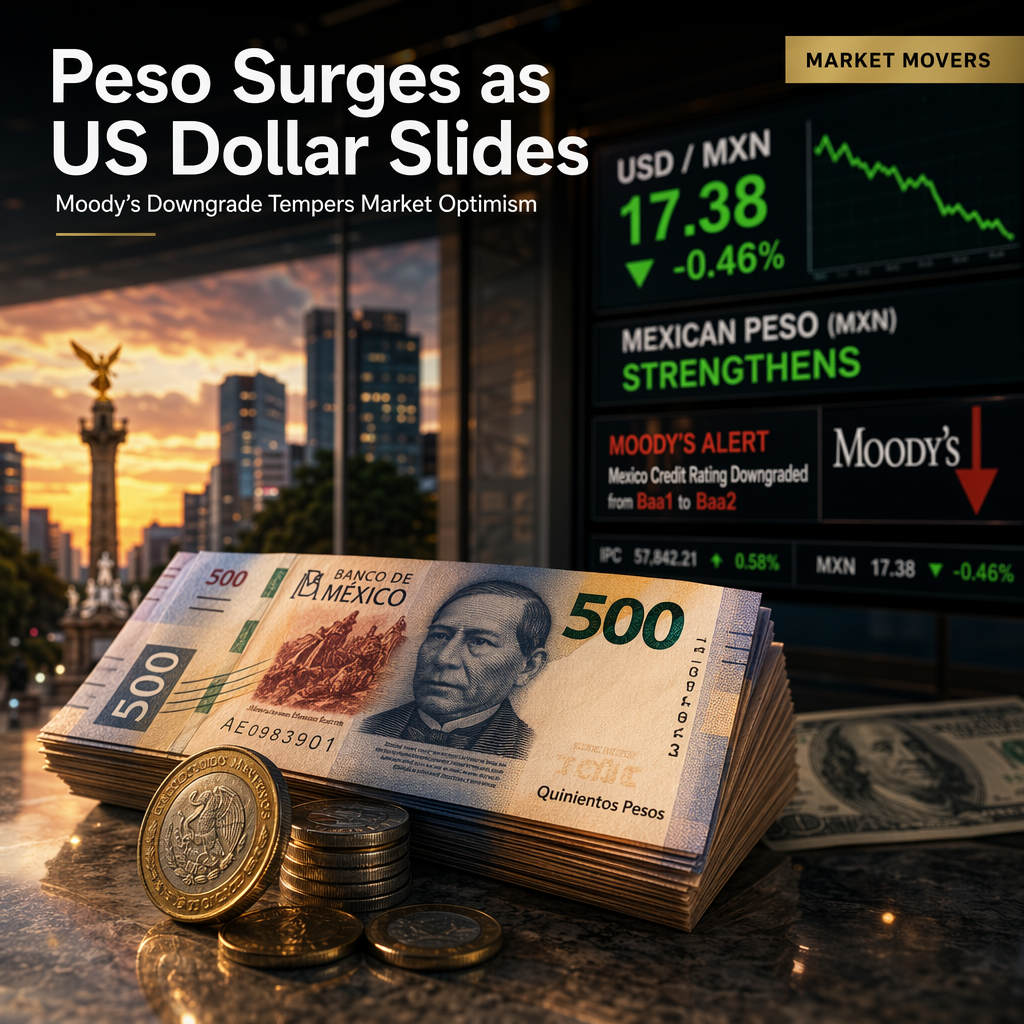
The Mexican Peso appreciated against the US Dollar during the North American session, rising 0.29% after the latest US inflation reports eased expectations for further Federal Reserve rate hikes. At the time of reporting, USD/MXN traded at 17.38, reflecting the Peso’s gains as the US Dollar Index (DXY) fell 0.45% to 100.45, indicating broad pressure on the Greenback [1].
US economic data showed that the Producer Price Index (PPI) increased 5.5% year-over-year in June, down from May’s 6% and below the estimated 6.2%. Core PPI was 4.7% year-over-year, slightly higher than the previous 4.6% but still below forecasts. These figures, combined with the earlier Consumer Price Index (CPI) release, contributed to the US Dollar’s weakness. Following the PPI release, money markets priced in 22 basis points of Federal Reserve tightening by year-end, with investors expecting rates to remain unchanged in July but assigning nearly 64% odds to a move in December [1].
Despite the Peso’s appreciation, ongoing tensions in the Middle East and rising oil prices, which typically support the US Dollar, limited further gains for the Mexican currency. Additionally, Moody’s downgraded Mexico’s credit rating to Baa3, citing concerns over fiscal policy, though the Mexican economic calendar was otherwise quiet [1].
Mexican inflation data for June showed headline inflation at 3.37% year-over-year, down from May’s 3.94% and marking the lowest level since 2020. Core inflation was 4.03% year-over-year, slightly above the Bank of Mexico’s (Banxico) target range of 3% plus or minus 1%. Banxico welcomed the data and, at its last meeting, unanimously held rates unchanged at 6.5%, citing high energy prices driven by Middle East conflict [1].
From a technical perspective, USD/MXN traded at 17.3831, just above the triple simple moving average cluster at 17.3761, which acts as immediate support. The Relative Strength Index (RSI) at 46 suggests subdued momentum and potential consolidation, with the broader structure capped by descending trend-line resistance [1].
CONCLUSION
The Mexican Peso’s recent gains were driven by softer US inflation data, which reduced expectations for further Federal Reserve rate hikes. However, Moody’s downgrade of Mexico’s credit rating and ongoing geopolitical tensions may temper further appreciation. Market sentiment remains cautiously optimistic, with technical indicators suggesting a period of consolidation ahead.