
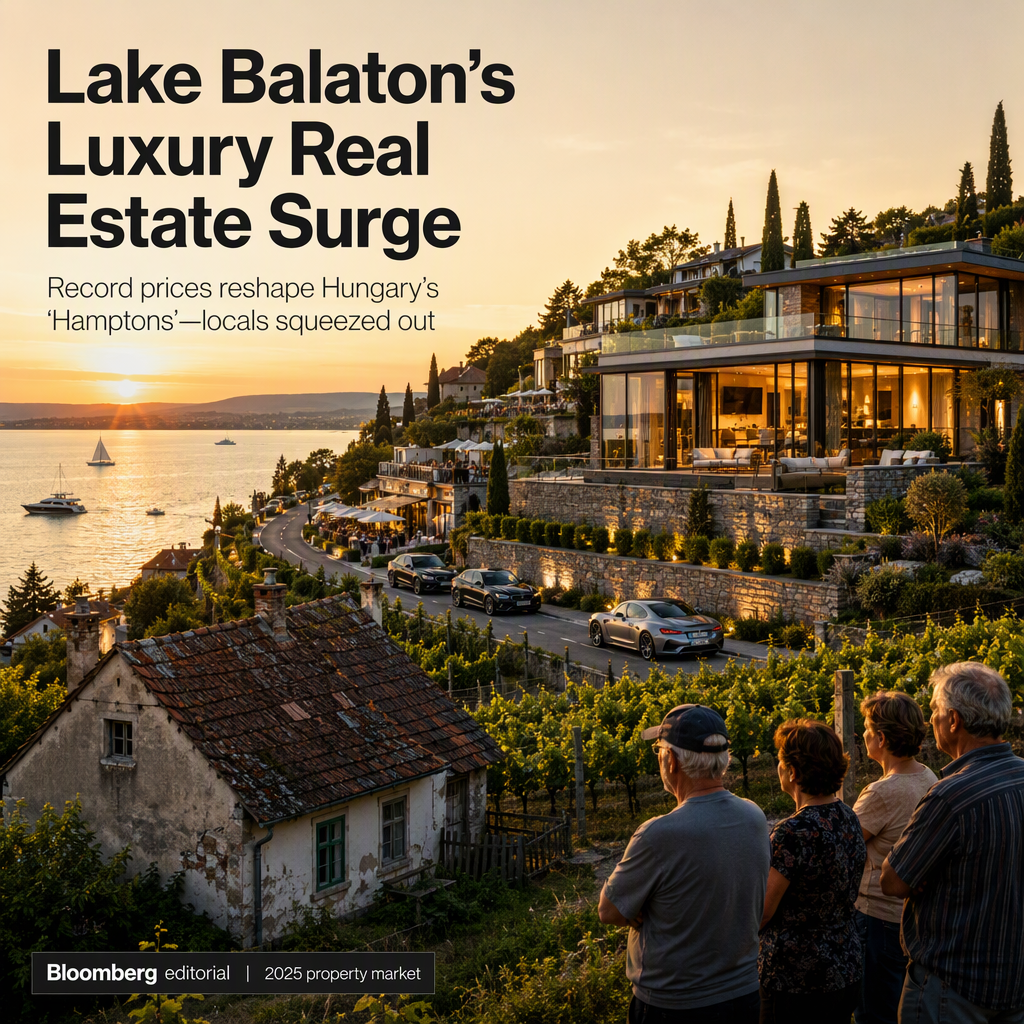
Lake Balaton, Hungary's largest freshwater lake, has become a hotspot for luxury real estate development, attracting both domestic and international investors. Upscale areas such as Balatonfüred and Tihany have seen property prices soar, making it increasingly difficult for locals to afford homes in the region. According to data from real estate brokerage Otthon Centrum, the average transaction value for a vacation home reached 744,000 Hungarian forints (approximately $2,303) per square meter in 2025, nearly quadrupling from less than 200,000 forints per square meter in 2018 [1].
The surge in demand began during the pandemic-era property boom, when many Hungarians sought vacation homes near the lake, driving prices upward. Anikó Woods, a local resident and operator of the website How To Hungary, noted that the northern coast, often referred to as the 'Hamptons of Hungary,' is particularly sought after for its expensive second homes, high-end restaurants, vineyards, and vibrant summer social scene [1].
Luxury listings underscore the market's exclusivity: a three-bedroom, three-bathroom apartment on the Tihany peninsula was listed for as much as 2.45 million euros (about $2.78 million) in September, with Otthon Centrum analyst Gábor Soóki-Tóth identifying Tihany as one of the most expensive places in Hungary to buy a vacation property, surpassing even prices in Budapest [1]. Sotheby's described the region's upscale villas as a 'prime opportunity' for European real estate investors, offering 'opulent' estates often at a fraction of the cost of similar properties elsewhere in Europe [1].
Despite the influx of luxury developers, some projects are reportedly stalling, and the rapid price escalation is raising concerns about affordability for local residents. The market's transformation has significant implications for the region's social fabric and accessibility, as locals are increasingly priced out of their own communities [1].
CONCLUSION
Lake Balaton's luxury property market has experienced dramatic price growth, attracting investors but making homeownership unattainable for many locals. While the region is seen as a prime investment opportunity, the affordability crisis and stalled developments highlight growing tensions in the market.