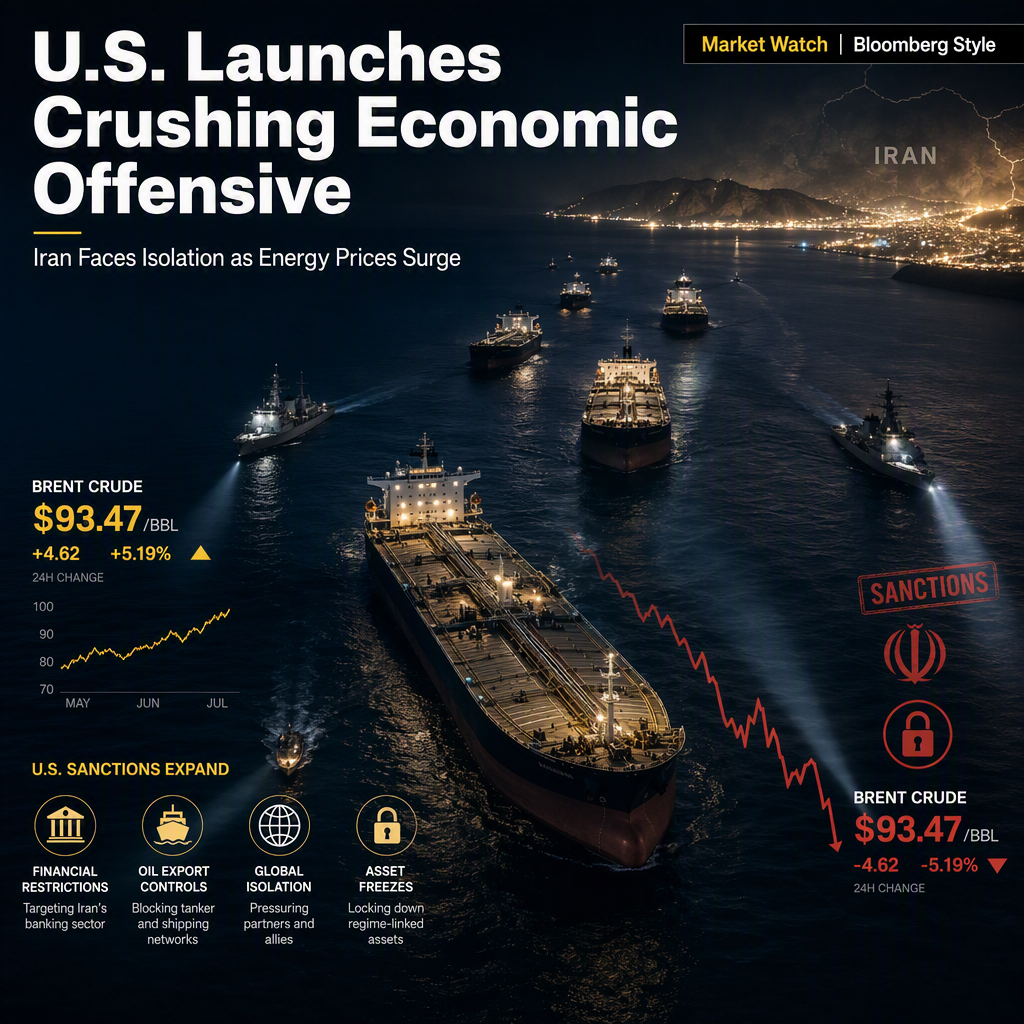
U.S. Vice President JD Vance emphasized the use of economic pressure as the country's 'most effective tool' against Iran, describing the strategy as a 'delicate dance' in recent remarks. This follows President Donald Trump's announcement that the United States will launch what he called the 'most crushing economic operation ever taken against any country,' specifically targeting Iran. Trump warned of severe financial penalties for any nation assisting Tehran in evading sanctions, stating, 'this will be Economic Warfare and Isolation on an unprecedented scale' [1].
Vance noted that both sides are applying pressure, but asserted that 'what has been true over the last couple of weeks is they felt a lot more pressure than we have.' He highlighted the impact of the conflict on energy markets, mentioning that pump prices for Americans remain elevated, but claimed they have decreased 'substantially' due to U.S. efforts to extract 'a lot of oil and gas out' of the Strait of Hormuz with military support [1].
Despite these claims, recent data from trade intelligence firm Kpler showed that ship traffic through the Strait of Hormuz has stayed low, with only 10 crossings on Monday and just two on Sunday, compared to a pre-war average of approximately 130 per day. Vance acknowledged Iran's leverage through its access to the Strait and stated that even partial restoration of oil and gas flows could ease energy prices for Americans [1].
Vance also addressed Iran's actions, stating that the country was being punished for shooting at commercial ships and asserted, 'the U.S. will make sure that Iranian forces are not able to do that.' He expressed confidence in the effectiveness of the U.S. strategy, echoing Trump's claim that Iran was 'on the ropes.' Vance posed the question of whether Iran would prefer to have its economy 'strangled for the rest of time' or pursue a better relationship with the West, reiterating the options presented by President Trump [1].
CONCLUSION
The U.S. is escalating economic pressure on Iran with a sweeping sanctions campaign, aiming to isolate Tehran and curb its leverage over energy markets. While American officials claim success in reducing pump prices and weakening Iran, shipping data indicates continued disruption in oil flows through the Strait of Hormuz. The market remains highly sensitive to developments, with energy prices and geopolitical risks closely tied to the outcome of this economic confrontation.