
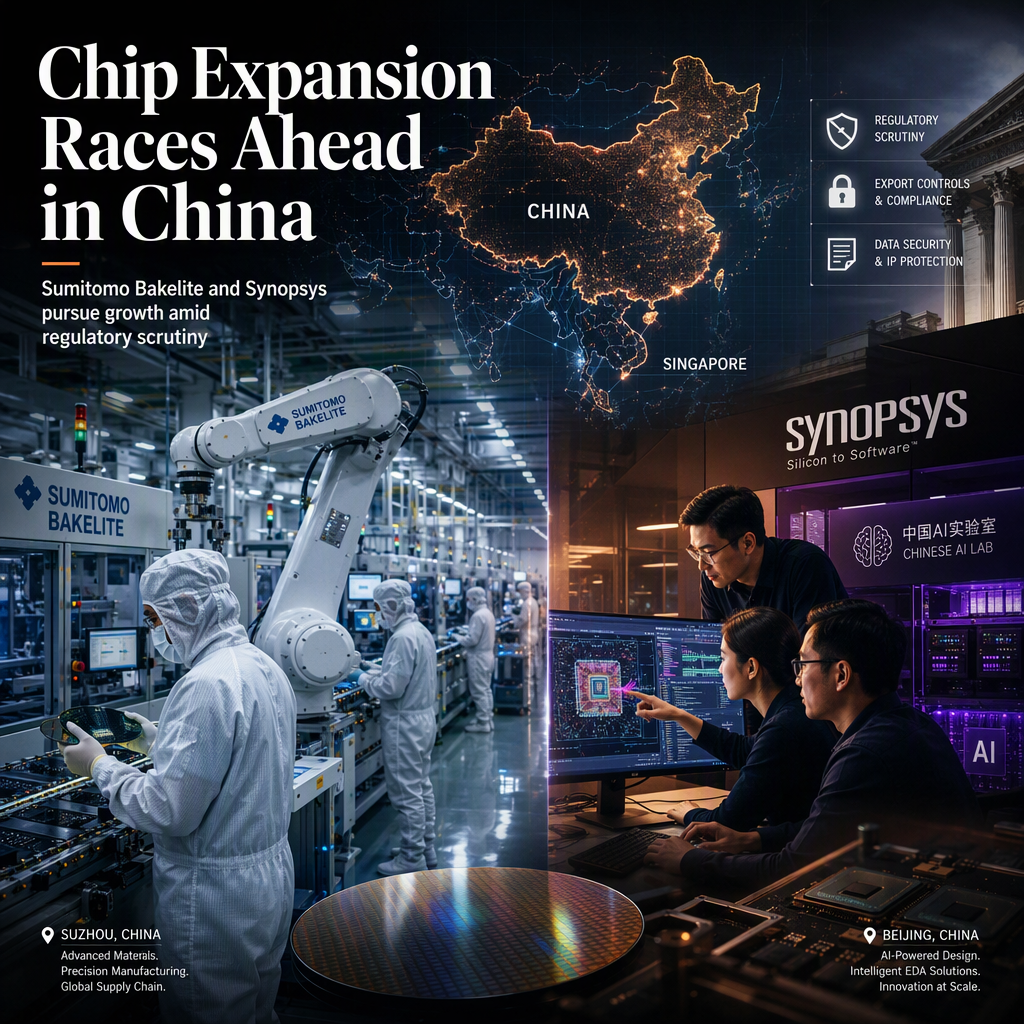
Sumitomo Bakelite, a Japanese plastics company, announced a $63 million investment to increase production of encapsulation materials for advanced chips at its plants in Suzhou, China, and Singapore. This expansion targets the rapidly growing Chinese semiconductor market, with the company aiming to strengthen its position as a leading supplier of encapsulation materials for next-generation chips used in high-performance applications such as data centers [1].
Meanwhile, Synopsys, the world's leading chip design software provider, is seeking to collaborate with Chinese AI labs to accelerate chip development using an AI-enhanced version of its tools. The company stated that it will operate within the framework of tightening U.S. export controls on AI and semiconductor technologies. Synopsys forecasts $11.15 billion in revenue for fiscal year 2027, attributing this growth to deals with OpenAI and Amazon, as well as its push into AI-driven electronic design automation (EDA) solutions [2].
Industry analysts cited in the article note that Synopsys' initiative reflects a broader industry trend of leveraging AI to reduce chip design timelines and improve efficiency. The company emphasized its commitment to complying with all relevant export controls and legal requirements in its collaborations with Chinese partners [2].
Both companies' moves underscore the increasing importance of the Chinese semiconductor market and the global demand for advanced chip technologies. While Sumitomo Bakelite is focusing on expanding manufacturing capacity for chip encapsulants, Synopsys is targeting the design phase, aiming to speed up development cycles through AI partnerships, provided these efforts remain compliant with U.S. regulations [1][2].
CONCLUSION
Sumitomo Bakelite and Synopsys are both making significant strategic moves to capture growth in the Chinese semiconductor sector, with Sumitomo investing in manufacturing expansion and Synopsys pursuing AI-driven design collaborations. These developments highlight strong market optimism and the critical role of regulatory compliance as companies navigate opportunities in China’s booming chip industry.