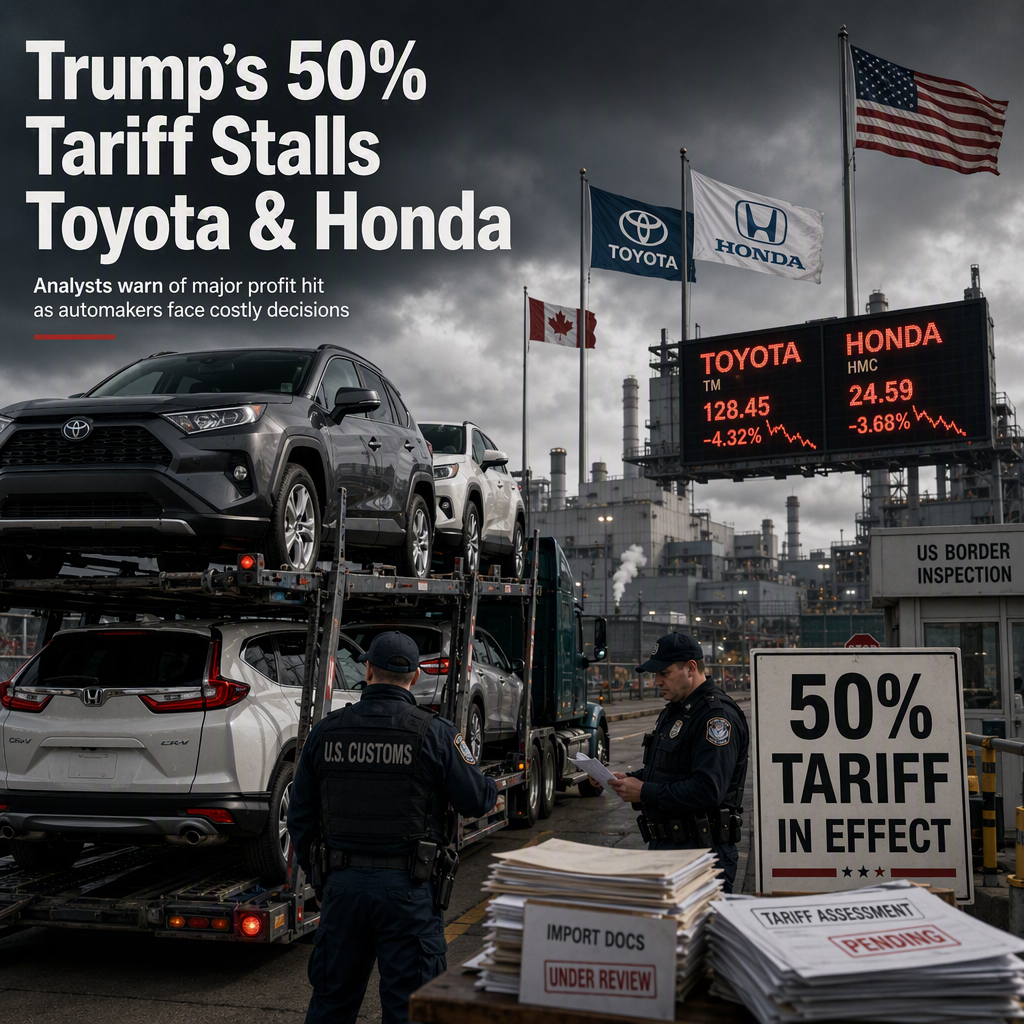
U.S. President Donald Trump announced last week the imposition of a 50% tariff on all cars, trucks, and automotive parts produced in Canada, effective from January next year [1]. This move is expected to significantly impact Japanese automakers Toyota Motor and Honda Motor, both of which use Canada as a major export hub for vehicles destined for the U.S. market [1]. Analysts highlight that the immediate supply chain shift will be difficult due to existing infrastructure and logistics centered in Canada [1].
Industry experts warn that Toyota and Honda may face a sharp decline in U.S.-bound exports from Canada, forcing them to reconsider their production strategies and potentially invest in new facilities or increase capacity at existing U.S. plants [1]. Such adjustments are anticipated to involve substantial costs and could negatively affect profit margins in the short to medium term [1]. One analyst noted, "A 50% tariff is unprecedented and will seriously erode the competitiveness of Canadian-built vehicles in the U.S. market. Toyota and Honda will have to absorb some of the costs or pass them on to consumers, which may impact sales volumes" [1].
As of the article date, neither Toyota nor Honda has announced any immediate changes to their Canadian operations in response to the tariff announcement [1]. However, industry watchers anticipate a range of possible measures, including shifting some production to the U.S. or Mexico, or negotiating with parts suppliers to mitigate cost increases [1].
The tariff comes at a time when global automakers are already grappling with supply chain disruptions, fluctuating demand, and increased competition in the electric vehicle segment [1]. No official financial forecasts or revised earnings guidance have been issued by Toyota or Honda, but market participants are closely monitoring the situation for further updates [1].
CONCLUSION
The imposition of a 50% tariff on Canadian automotive exports to the U.S. is expected to significantly disrupt Toyota and Honda's operations and profitability. While neither company has announced immediate changes, analysts anticipate costly adjustments and potential impacts on sales volumes. Market participants are awaiting further guidance as the situation evolves.