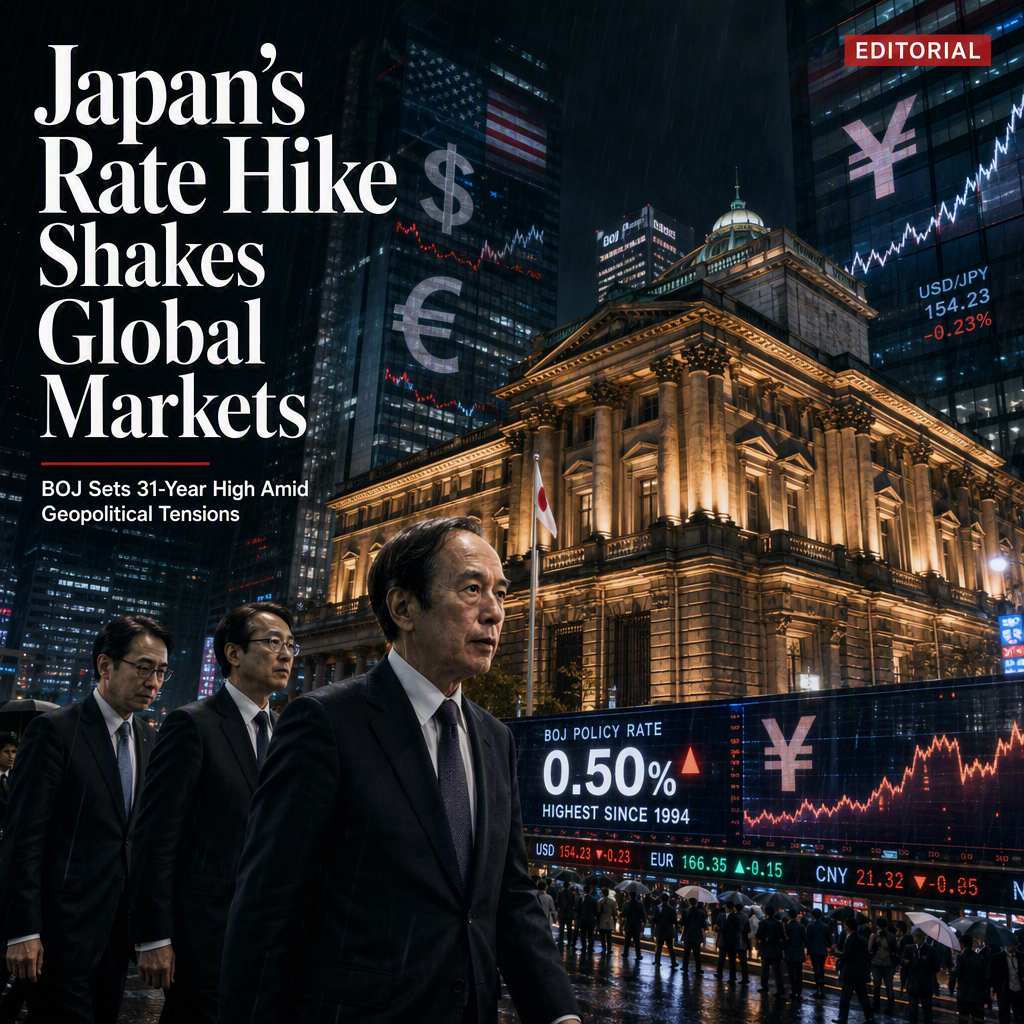
The Bank of Japan (BOJ) accelerated its monetary tightening by raising interest rates by 25 basis points, bringing them to a 31-year high. This move was widely anticipated due to Japan's rising inflation and the historically weak yen. The U.S. administration has also exerted pressure on Japan to continue raising rates, with Treasury Secretary Scott Bessent urging BOJ Governor Kazuo Ueda to take 'decisive market and monetary steps' during the G20 finance ministers and central bank governors meeting earlier this month [1].
The BOJ's decision comes in the wake of a significant week for the Federal Reserve, which also raised rates despite strong resistance from the White House. Further insights into the Fed's decision are expected on Friday, with commentary scheduled from Fed Governor Michelle Bowman and Kansas City Fed President Jeffrey Schmid [1]. In contrast, the Bank of England diverged from the global tightening trend by holding rates steady. However, Governor Andrew Bailey indicated that this pause might be temporary, warning that persistent volatility could necessitate future rate hikes to ensure inflation returns to the 2% target [1].
Looking ahead, investors are expected to shift their focus from monetary policy to geopolitical developments. The United Nations General Assembly will convene in New York on Tuesday, with President Donald Trump reportedly set to meet Gulf leaders to discuss the ongoing conflict with Iran. The main geopolitical event will be Chinese President Xi Jinping's state visit to Washington D.C. next week, where he will meet with Trump on Thursday. Artificial intelligence is a key agenda item, with OpenAI's Sam Altman and Nvidia's Jensen Huang expected to attend the state dinner. Trade tensions remain prominent, as the U.S. House has cleared a bill permitting the Trump administration to impose additional tariffs, though these are expected to be delayed until after the state visit [1].
In the equity market, shares of Mercari surged over 4% on Friday, continuing their recovery from a previous selloff triggered by the company's restrictions on listings of Pokémon's 30th anniversary products. Mercari stated that these restrictions would remain in place as long as deemed necessary [1].
Political developments in Europe and Russia are also on the radar. Two state elections in Germany will test Chancellor Friedrich Merz's leadership following the far-right AfD party's recent regional victory. Merz has decided to skip the UNGA meeting to focus on domestic campaigning. Meanwhile, Russia is preparing for its first parliamentary election since the 2022 invasion of Ukraine, with economic strains potentially affecting voter turnout and sentiment [1].
CONCLUSION
The Bank of Japan's rate hike to a 31-year high marks a significant shift in global monetary policy, reflecting inflationary pressures and currency weakness. Divergence among major central banks and upcoming geopolitical events are likely to drive market volatility in the near term. Investors are closely monitoring both monetary and political developments for further market direction.