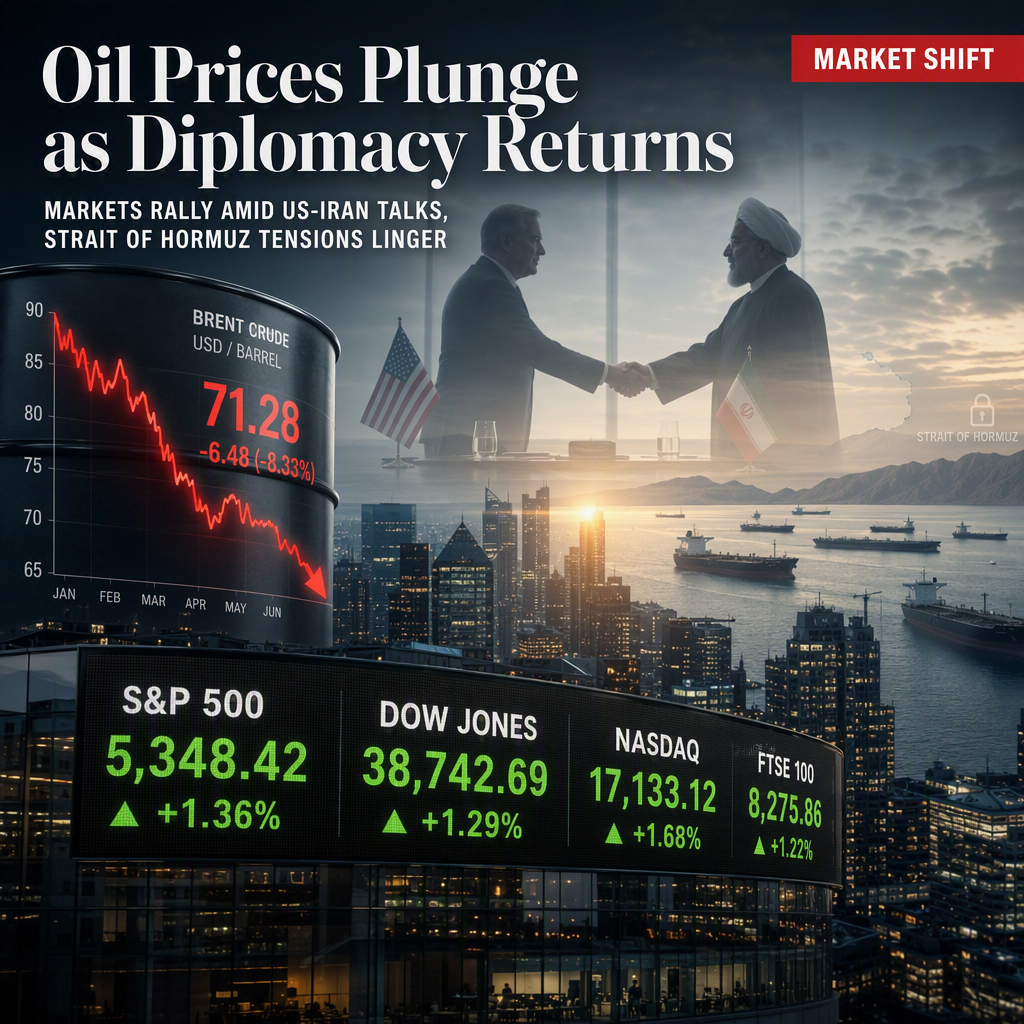
Global financial markets experienced a notable shift in sentiment following the announcement that the United States and Iran would renew diplomatic efforts after US President Donald Trump called off a planned 'massive attack' on Iran over the weekend [1][2][3]. Trump confirmed that negotiations with Iran would resume on Monday, though he did not specify a deadline or disclose the location and participants [1][3]. Iranian President Masoud Pezeshkian urged the US to remain committed to the Memorandum of Understanding signed in June [1]. Saudi Arabian Crown Prince Mohammed bin Salman reportedly urged Trump to refrain from further military action [3].
This de-escalation led to a sharp decline in oil prices, with Brent crude opening over 7% lower under USD84 and West Texas Intermediate (WTI) trading around $78, down more than 8% on the day [1][3]. The drop in oil prices weighed heavily on commodity-linked currencies such as the Canadian Dollar (CAD), with the USD/CAD pair rising to near 1.4030 during the early European session [2]. Analysts at Scotiabank noted that while the CAD had drawn some support from a generally softer USD, it struggled to break through the 1.40 resistance level [2].
Despite OPEC+ approving a modest output increase of 188,000 barrels per day for September, the Strait of Hormuz remained effectively closed, continuing to disrupt Persian Gulf oil exports and stoking inflation concerns, particularly in Asia and Africa [3]. The market mood, however, improved overall, with US stock index futures rising between 0.5% and 0.8% and S&P 500 futures up 0.6% to near 7,535, reflecting a risk-on environment [1][4].
Currency markets also responded to the developments. The US Dollar Index stayed below 100.00 after losing more than 1.5% in the previous week, and the USD was the weakest against the Japanese Yen over the last seven days, down 4.20% [1]. The British Pound underperformed its peers, trading 0.1% lower against the USD, as traders reassessed Bank of England (BoE) rate hike expectations following the latest policy signals [4]. Deutsche Bank analysts highlighted that the implied probability of a BoE September hike dropped from 60% to 30%, and 31 basis points of hikes were priced by year-end, down 11.4 basis points on the day [4].
Looking ahead, markets are awaiting key US economic data releases, including the ISM Manufacturing PMI and Nonfarm Payrolls (NFP) report. The NFP is expected to increase by 91,000 in July, with the unemployment rate projected to rise to 4.3% [2]. The US Federal Reserve left interest rates unchanged at its July meeting, and the probability of a September rate hike has decreased to 64.7% from 77% prior to the meeting [2].
CONCLUSION
The renewed diplomatic push between the US and Iran has triggered a sharp sell-off in oil prices, boosted risk appetite, and led to notable currency and equity market moves. While the immediate risk of military escalation has receded, ongoing disruptions in the Strait of Hormuz and upcoming US economic data remain in focus for investors. Market sentiment has turned more positive, but volatility could persist as geopolitical and economic uncertainties linger.