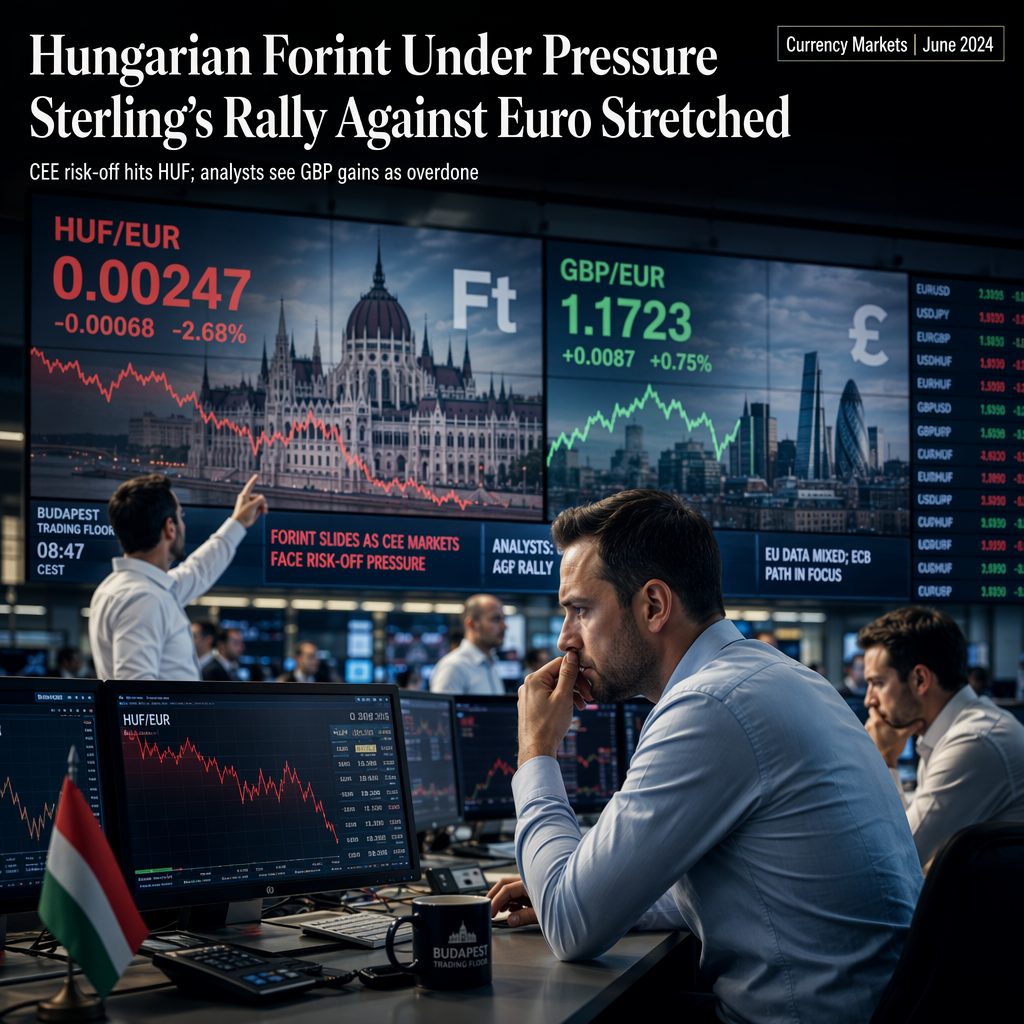
The Hungarian Forint has come under significant selling pressure against the Euro, with ING's Frantisek Taborsky attributing this to crowded long positions and profit-taking following a broadly bullish market view since the April general elections [1]. Elevated oil prices and higher core yields have contributed to a broad risk-off move in Central and Eastern Europe, pushing CEE rates higher [1]. Despite the recent sell-off, Taborsky maintains that Hungarian rates and FX remain attractive, expecting the EUR/HUF to trade mostly in the 350–360 range for the rest of the year [1]. The EUR/HUF stabilized above 361, its highest level since mid-May and close to post-election levels [1]. The expected easing cycle for Hungary has been scaled back from 150 basis points to 120 basis points, while in Poland, rate cut expectations for this year have fallen to around 20% [1].
In contrast, the British Pound has rallied against the Euro, with TD Securities' Macro Research team led by Howard Du suggesting that the move has overshot macroeconomic fundamentals [2]. The EUR/GBP pair broke below the key 0.86 support level due to reduced UK political risk, notably following Starmer's resignation on June 22 and other political developments that lowered the risk premium [2]. As a result, EUR/GBP is now at its cheapest level versus TD's high-frequency fair value estimate since March 2025 [2]. The team forecasts a return to 0.86 for EUR/GBP in 2026 as macro and policy drivers realign [2]. They do not expect the Bank of England to cut rates imminently but anticipate further ECB-BoE policy convergence, with the ECB expected to hike rates in September and UK political risk premium potentially rebuilding in Q4 2026 as the Autumn Budget approaches [2].
Both articles highlight significant currency moves driven by shifts in risk sentiment and political developments. While the Forint's sell-off is seen as overdone with attractive entry levels for investors, the Pound's rally against the Euro is viewed as stretched and likely to revert as fundamentals reassert themselves [1][2].
CONCLUSION
The Hungarian Forint's recent weakness is attributed to profit-taking and risk reduction, but ING still sees value in Hungarian assets and expects stabilization within a defined range. Meanwhile, TD Securities believes the British Pound's strength against the Euro is overdone and forecasts a return to previous levels as macroeconomic and policy factors realign. Both currencies are expected to see adjustments as market fundamentals and policy expectations evolve.