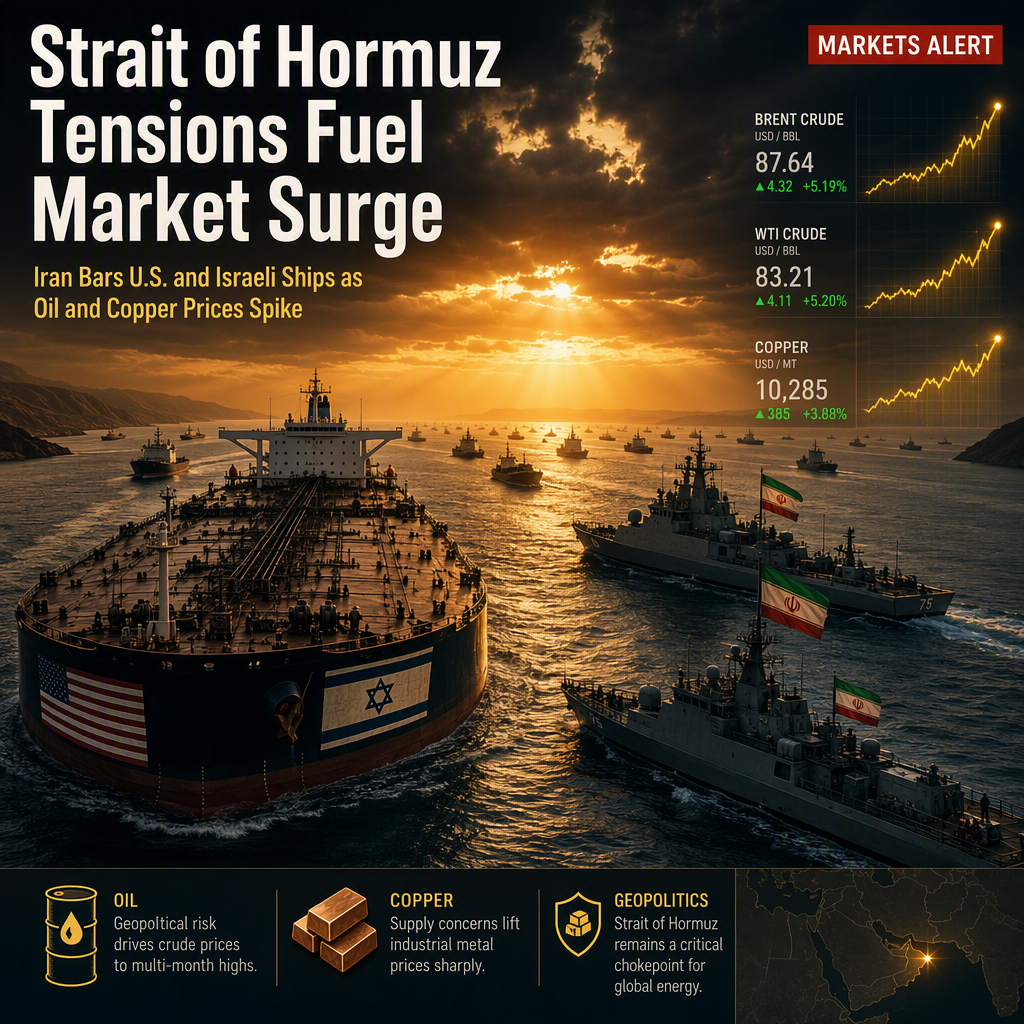
Iran has announced a plan to manage the Strait of Hormuz, barring U.S. and Israeli ships from transiting the waterway. The restrictions will also apply to 'countries and individuals that have caused damage to Iran' until compensation is made, according to Iranian state media Fars [1]. The U.S. government rejected Iran's plan, with a U.S. official stating that any temporary routes will be without impediments, approvals, permissions, tolls, or charges [1].
This development has had a significant impact on commodity markets. Oil prices, which had declined earlier in the week, reversed course and climbed sharply. Brent futures rose 3.8% to close at $82.49 per barrel on Thursday, while U.S. West Texas Intermediate gained about 2.8% to settle at $77.29. Oil continued to trade over 1% higher in Asia on Friday [1]. Copper prices also surged, reaching a record high of around $6.90 per pound on Thursday, driven by supply constraints and increased demand for electrification [1].
The news comes as a potential deal between the U.S. and Iran, previously suggested by U.S. President Donald Trump to be possible by Thursday, appears unlikely to materialize soon. The rhetoric from Iran and the newly announced shipping restrictions suggest that the timeline for an agreement will likely pass without a deal [1].
Beyond the Iran situation, the article notes that SpaceX shares rose as the first tranche of locked-up shares became available for trading, though the stock remains about 50% below its mid-June high. In the tech sector, Softbank shares fell nearly 5% in early Friday trade despite an earnings beat, indicating weak investor sentiment [1].
CONCLUSION
Iran's decision to bar U.S. and Israeli ships from the Strait of Hormuz has heightened tensions and driven oil and copper prices higher. The anticipated U.S.-Iran deal is now seen as unlikely in the near term, adding to market uncertainty. Commodity markets are reacting strongly to these geopolitical developments.