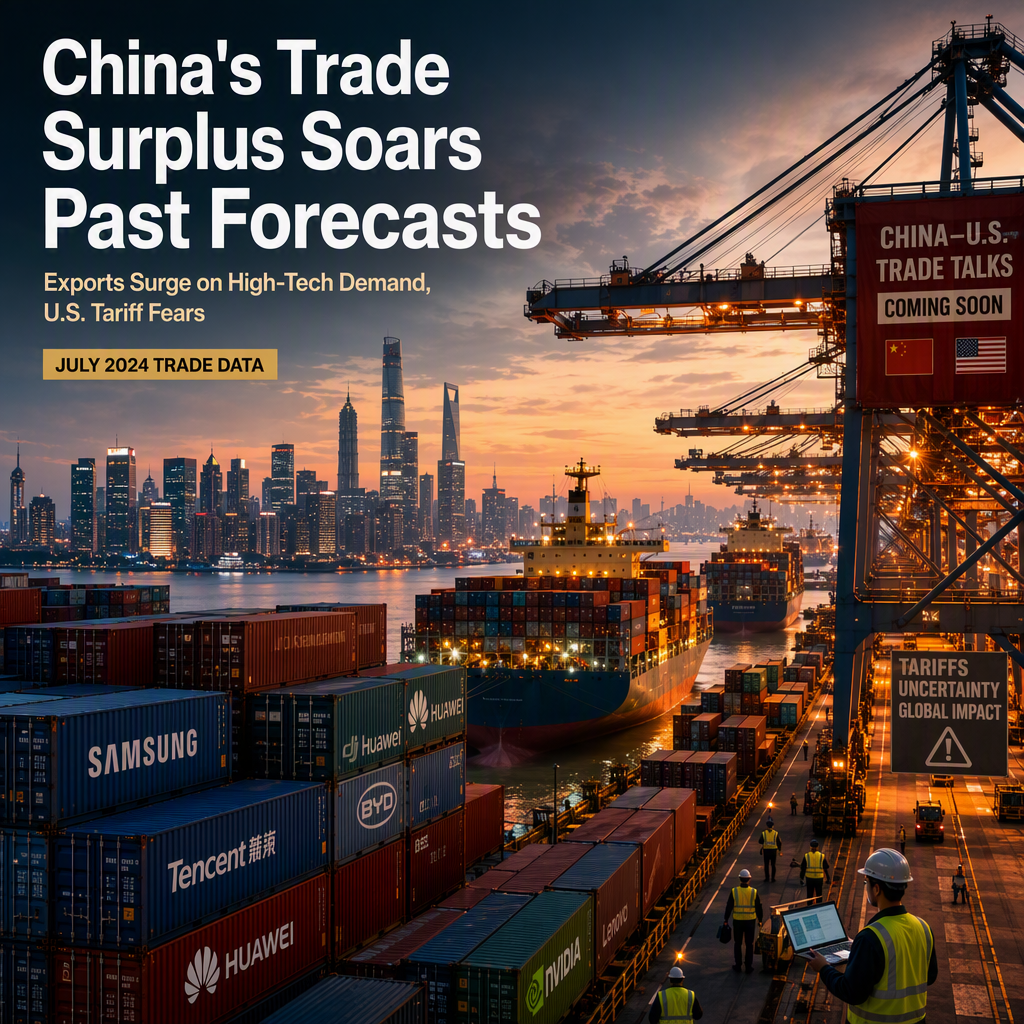
China's trade balance for June recorded a surplus of $112.5 billion, surpassing analyst expectations of $107.0 billion but falling short of the previous month's $125.62 billion [1][2]. Official customs data revealed that exports surged 23% year-over-year in July, exceeding Reuters-polled forecasts of 22.2% growth, though this marked a slowdown from June's 27% increase, which was the fastest since October 2021 [1][2]. Imports also rose 27.5% in July, slightly below the Reuters estimate of 27.9% and decelerating from June's 36% jump, the quickest in five years [1][2].
The robust export performance was attributed to global demand for high-tech components, particularly driven by a worldwide build-out of AI infrastructure, which has helped support China's economy amid subdued domestic consumption and geopolitical shocks [2]. Chinese exporters accelerated shipments to the U.S. ahead of a new 12.5% tariff imposed by Washington in late July, replacing a temporary 10% rate [2].
Despite the strong trade surplus, Beijing's massive trade surplus—over $1 trillion last year—remains a point of contention for trading partners such as the U.S. and the European Union, who are urging China to rebalance its economy toward greater domestic consumption [2]. Zhiwei Zhang, president and chief economist at Pinpoint Asset Management, expects intense negotiations between China and major trading partners in the coming months, especially ahead of the anticipated U.S.-China summit in September and the EU-China meeting on economic relations in October [2].
Chinese authorities reaffirmed their support for the slowing economy during a policy-setting meeting in late July, promising accelerated fiscal rollout and timely monetary adjustment, though they stopped short of announcing concrete measures to boost household spending [2]. China's economy expanded at its weakest pace since Q4 2022, with GDP growth at 4.3% in the second quarter. Retail sales grew just 1% in June, a modest rebound from May's 0.6% contraction, while consumer inflation cooled to 1% in June from 1.2% in May. Factory-gate prices rose 4.1%, the strongest since July 2022 [2].
CONCLUSION
China's trade surplus and export growth in July exceeded expectations, driven by global demand for high-tech goods and preemptive shipping ahead of new U.S. tariffs. While the trade data signals resilience in China's export sector, ongoing negotiations with major trading partners and subdued domestic consumption highlight persistent challenges for the broader economy.