
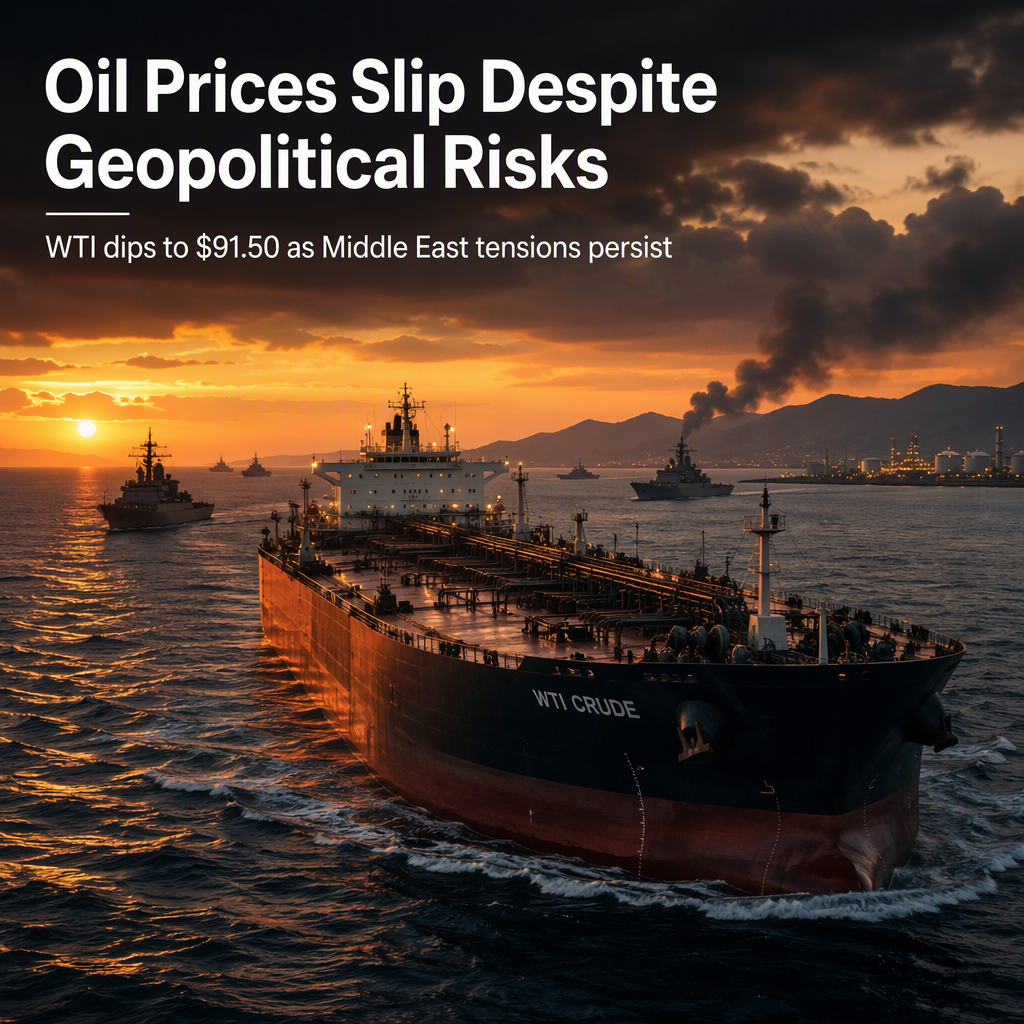
West Texas Intermediate (WTI), the benchmark US crude oil price, declined to approximately $91.50 during the Asian session on Friday, marking a 0.45% drop for the day and ending a two-day winning streak. This pullback comes after a recovery from a nearly four-week low, with downside pressure appearing limited due to ongoing geopolitical risks in the Middle East [1].
Recent developments include a Wall Street Journal report that the Pentagon may soon deploy a third aircraft carrier strike group and 10,000 sailors and Marines to the Persian Gulf. Additionally, Iran’s Persian Gulf Strait Authority (PGSA) reported that several tankers were attacked in the Strait of Hormuz in recent days. US President Donald Trump stated on Wednesday that he would decide very soon whether to take military action against Iran, adding that the war will end very soon one way or the other. These factors are maintaining a geopolitical risk premium in oil markets, which is expected to support crude oil prices [1].
From a technical perspective, WTI remains capped by the long-term trend structure, with the 100-period Simple Moving Average (SMA) on the 4-hour chart at $94.08 and the 38.2% Fibonacci retracement at $93.28 acting as resistance. The Relative Strength Index (RSI) is in neutral-positive territory near 53, and the Moving Average Convergence Divergence (MACD) remains above zero with a positive histogram, suggesting only a modest recovery attempt within a broader corrective phase. Initial support is seen at the 50.0% retracement at $90.59, followed by the 61.8% retracement at $87.89, with deeper support at $84.06 and $79.18. A significant bullish move would require a break above $96.60 and ultimately the structural high near $101.99 to challenge the current short-term bearish bias [1].
CONCLUSION
WTI crude oil prices are under pressure but remain supported by heightened geopolitical risks in the Middle East. Technical indicators suggest a modest recovery is possible, but significant resistance levels must be overcome for a sustained bullish move. The market remains cautious amid ongoing uncertainty and potential escalation in the region.