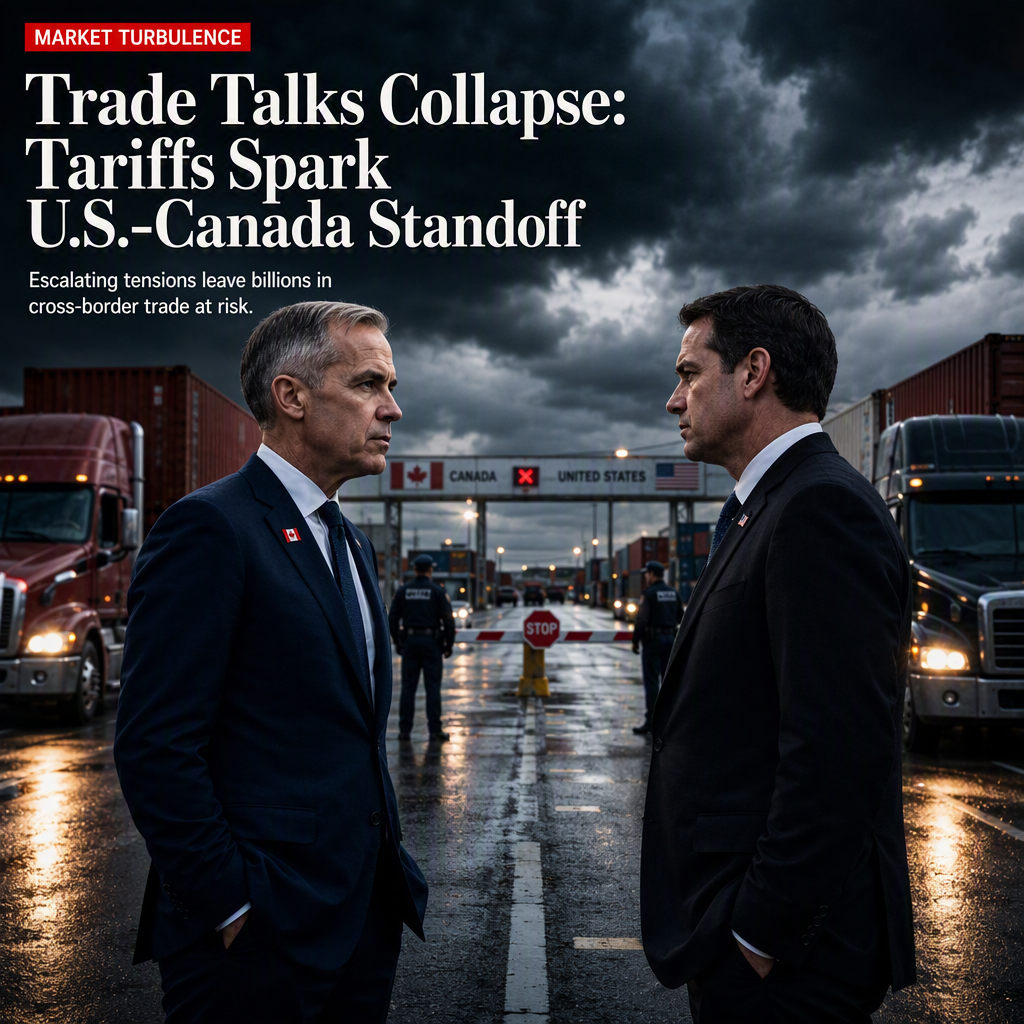
Canadian Prime Minister Mark Carney publicly responded to accusations from Trump administration Commerce Secretary Howard Lutnick regarding the breakdown of U.S.-Canada trade negotiations. Lutnick had claimed that Canada 'blew up' a nearly complete trade deal with the U.S. 'for political reasons only,' asserting that Canadian politicians were acting out of domestic political interests ahead of upcoming byelections in several parliamentary districts [1]. Carney refuted these claims, stating, 'We're ready to sit down and strike that deal when the Americans are ready,' and emphasized that Canada would always act in its best interests [1].
The failed negotiations have led to escalating trade tensions. Negotiators abandoned talks last month after missing President Donald Trump's August 22 deadline, which was tied to the imposition of new 50% tariffs on approximately $20 billion worth of Canadian imports [1]. In response, Canada announced 'dollar for dollar' retaliatory tariffs on U.S. goods, set to take effect the following week [1]. Both sides have accused each other of making unreasonable last-minute demands, with Lutnick alleging that Canada sought tariff relief on medium- and heavy-duty trucks just hours before the deadline, while U.S. Trade Representative Jamieson Greer denied Carney's assertion that French-language requirements were a sticking point [1].
President Trump weighed in on the dispute, suggesting that Carney was using him as a political foil and warning that the strategy would backfire if the Canadian economy suffered as a result of the trade conflict [1]. The rhetoric from both sides signals a significant deterioration in U.S.-Canada relations, with no immediate path to resuming negotiations. Carney, however, reiterated Canada's willingness to return to the table when the U.S. is ready [1].
The imposition of tariffs and the breakdown in talks are expected to have a substantial impact on trade flows between the two countries, affecting billions of dollars in goods. The market implications are significant, as both countries are major trading partners and the escalation could disrupt supply chains and increase costs for businesses and consumers [1].
CONCLUSION
The collapse of U.S.-Canada trade talks and the imposition of reciprocal tariffs mark a sharp escalation in trade tensions between the two countries. With both sides blaming each other and no immediate resolution in sight, markets face heightened uncertainty and the potential for significant economic disruption.