
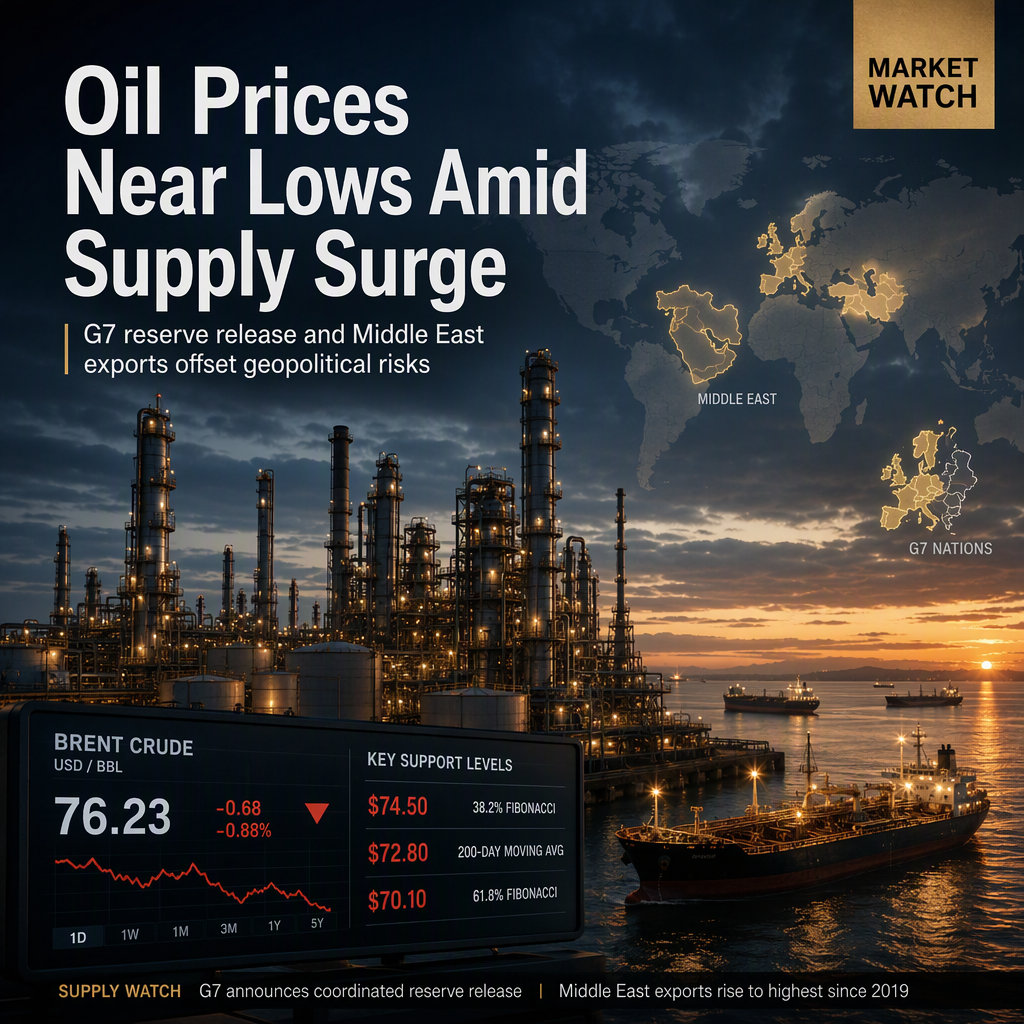
West Texas Intermediate (WTI) crude oil prices remained under pressure, trading near a four-week low around $89.00, as sellers dominated for a second consecutive day amid easing supply concerns and ongoing geopolitical tensions [1]. The G7 agreed on Friday to release 100 million barrels of crude and fuel products from emergency reserves, contributing to downward pressure on prices [1]. Additionally, Middle Eastern crude exports surpassed pre-war levels on four days during the final week of September, further weighing on the market [1]. However, persistent tensions in the Middle East, including the US-Iran standoff and the Russia-Ukraine conflict, have limited further declines [1][2].
From a technical perspective, WTI needs to break below the 38.2% Fibonacci retracement of the July-September upswing to confirm further losses toward sub-$88.00 levels, with significant support expected near the $85.00-$84.50 range, which includes the 50% retracement and the 100-day Simple Moving Average [1]. The MACD indicator remains negative at -0.93, while the RSI is near a neutral 47, suggesting a moderating but still supportive trend rather than a decisive reversal [1].
For Brent crude, ICE Brent repeatedly dipped below $100 per barrel but continued to settle above this level as the market digested conflicting supply and geopolitical signals [2]. According to ING’s Warren Patterson, oil flows through the Strait of Hormuz have returned to more than 80% of capacity, enabling crude exports from Yanbu to recover [2]. Speculators reduced their net long positions in ICE Brent by 13,812 lots to 204,302 lots, the smallest since early August, reflecting caution amid signs of increased oil flows from the Persian Gulf [2].
OPEC+ left production levels unchanged for November, maintaining cumulative supply increases of 1.65 million barrels per day, though these were described as largely 'paper increases' due to ongoing supply disruptions [2]. Saudi Arabia reduced the official selling price for November-loading Arab Light crude into Asia by $3 per barrel, widening its discount to the benchmark to $5 per barrel, and has been shipping larger volumes through the Strait of Hormuz due to an East-West pipeline outage, with recent signs of pipeline recovery [2].
CONCLUSION
Oil prices are currently weighed down by increased supply from G7 reserve releases and higher Middle Eastern exports, but ongoing geopolitical tensions are preventing a sharper decline. Technical and positioning data suggest a cautious market, with key support and resistance levels in focus. The overall market sentiment remains moderately bearish as traders await clearer signals on supply and geopolitical developments.