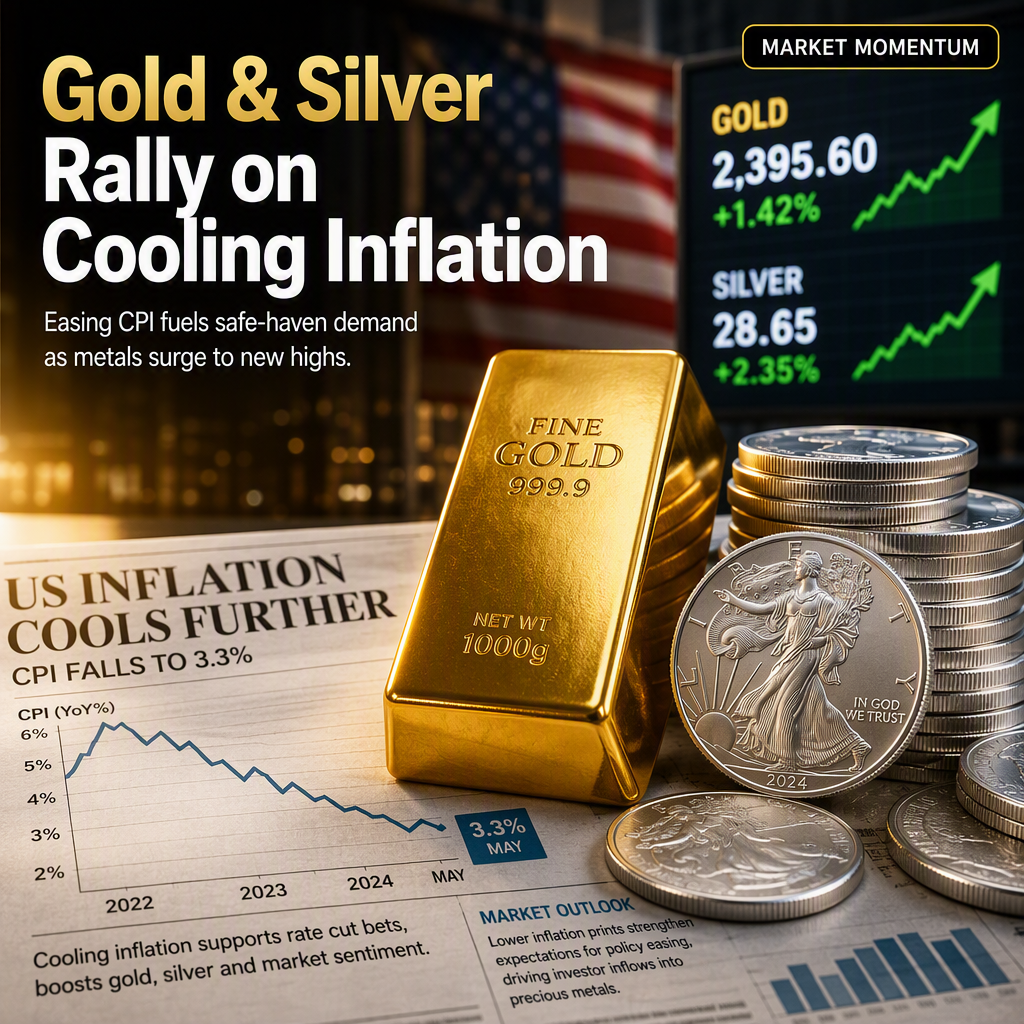
Both gold (XAU/USD) and silver (XAG/USD) prices rallied on Wednesday following the release of US inflation data indicating a continued cooling of consumer prices, moving closer to the Federal Reserve’s 2% target [1][2]. Silver surged over 1.40%, trading at $65.53 after reaching a daily high of $66.80 [1]. Gold registered gains of over 1%, trading above $4,400 after bouncing off daily lows of $4,362 [2].
The July Consumer Price Index (CPI) came in at 3.5% year-over-year, down from 3.6%, while core CPI edged lower from 2.6% to 2.5% year-over-year, according to the US Bureau of Labour Statistics [2]. This data led investors to speculate that the Federal Reserve is less likely to raise rates at its September meeting. Money markets shifted from a 52% chance of a rate hike to a 60% probability that rates will remain steady, with a 73% chance of a hike in December, as per Prime Terminal data [2].
Technical analysis for silver shows a neutral to upward bias, with bulls clearing the 50-day Simple Moving Average (SMA) at around $61.60 and the July 6 high at $63.28, aiming for resistance at $66.59, $68.87 (100-day SMA), and $71.47 (200-day SMA) [1]. For gold, the price cleared the 100-day SMA at $4,388, with resistance at $4,450 and $4,500 (200-day SMA), and a potential target of $5,000 if momentum continues [2]. Both metals are supported by bullish momentum as indicated by their respective Relative Strength Index (RSI) readings [1][2].
Market participants are also monitoring geopolitical developments, particularly tensions between the US and Iran, which could impact energy prices and potentially disrupt the disinflation process in the US [2]. Upcoming US Producer Price Index (PPI) and Initial Jobless Claims data are also in focus, as further labor market weakness could influence the Federal Reserve’s policy path [2].
CONCLUSION
Cooling US inflation has fueled rallies in both gold and silver, as investors anticipate a pause in Federal Reserve rate hikes. Technical indicators and market sentiment suggest further upside potential for both metals, though upcoming economic data and geopolitical risks remain key factors to watch.