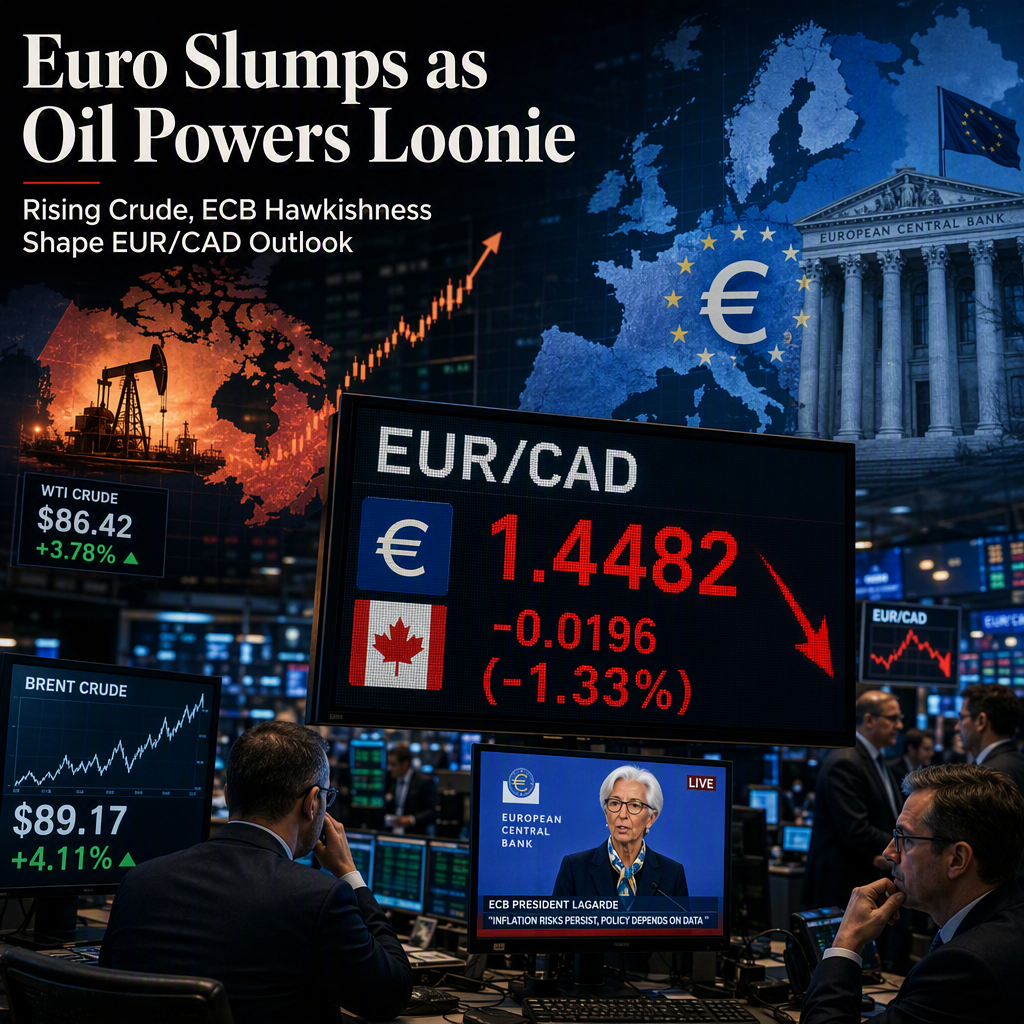
The EUR/CAD currency pair extended its losses for the second consecutive day, trading around 1.6040 during European hours on Tuesday, as the Canadian Dollar (CAD) strengthened on the back of rising crude oil prices [1]. The oil market is experiencing heightened uncertainty due to the ongoing shutdown of Saudi Arabia’s East-West pipeline following drone attacks, with no clear timeline for resumption, further supporting the commodity-linked CAD [1].
Canadian inflation remained steady at 3% year-over-year in August, unchanged from July, according to economists at Royal Bank of Canada (RBC) [1]. Abbey Xu of RBC noted that core inflation measures are close to the Bank of Canada's (BoC) 2% target, suggesting that monetary policy is likely to remain unchanged for an extended period. Any shift in the policy outlook will depend on the persistence of recent oil price strength [1].
On the Euro side, downside pressure on EUR/CAD may be limited by potential Euro strength, as several European Central Bank (ECB) officials have warned of persistent upside inflation risks, fueling expectations for further monetary tightening [1]. The ECB recently raised its key policy rates by 25 basis points as anticipated and signaled that additional rate hikes could be necessary [1]. Major financial institutions, including Goldman Sachs, Citi, and Barclays, now expect another ECB rate increase in December. LSEG data shows financial markets pricing in a 94% probability of a quarter-point hike in December, while Citi projects an additional rate increase extending into March 2027 [1].
The ECB's primary mandate is to maintain price stability, targeting inflation around 2%. Its main tool is adjusting interest rates, which typically strengthens the Euro when rates are high [1].
CONCLUSION
The EUR/CAD pair is under pressure as the Canadian Dollar benefits from rising oil prices and steady inflation, while the Euro finds support from hawkish ECB signals and high market expectations for further rate hikes. The interplay between commodity-driven CAD strength and ECB-driven Euro resilience is likely to shape the currency cross in the near term.